

The white-bellied imperial pigeon is a species of bird in the pigeon family Columbidae. First described by the French ornithologist Charles Lucien Bonaparte in 1854, it is endemic to Indonesia, where it is found on Sulawesi, Buton, Taliabu, Togian, and Peleng. It inhabits primary forest, dense secondary forest, and isolated areas of hill forest. A large pigeon with a long tail, it measures 42.5–51.5 cm (16.7–20.3 in) long and weighs 510 g (18 oz) on average. Males are mainly green, with pale-grey heads and bellies, chestnut vents, and a pale grey tail band, along with a red orbital ring. Females are nearly identical, but have darker grey areas in their plumage.
Region
Wallacea (Sulawesi and nearby islands)
Typical Environment
Endemic to Indonesia, occurring on Sulawesi and adjacent islands including Buton, Taliabu, Togian, and Peleng. It favors primary lowland and hill forests, but also uses dense secondary forest, forest edges, and isolated hill-forest patches. Birds spend most time in the upper canopy, moving between fruiting trees across the landscape. In some areas they visit coastal or village-edge trees when large figs are in season.
Altitude Range
Sea level to 1500 m
Climate Zone
Tropical
Ease of Keeping
Beginner friendly: 1/5
A canopy-dwelling imperial pigeon, it plays an important role in seed dispersal for large-fruited forest trees, especially figs. It is typically shy and stays high in the forest, but will descend to isolated fruiting trees, sometimes near villages. Its deep, booming coos can carry far through dense forest. Habitat loss and hunting pressure pose ongoing concerns on several islands.

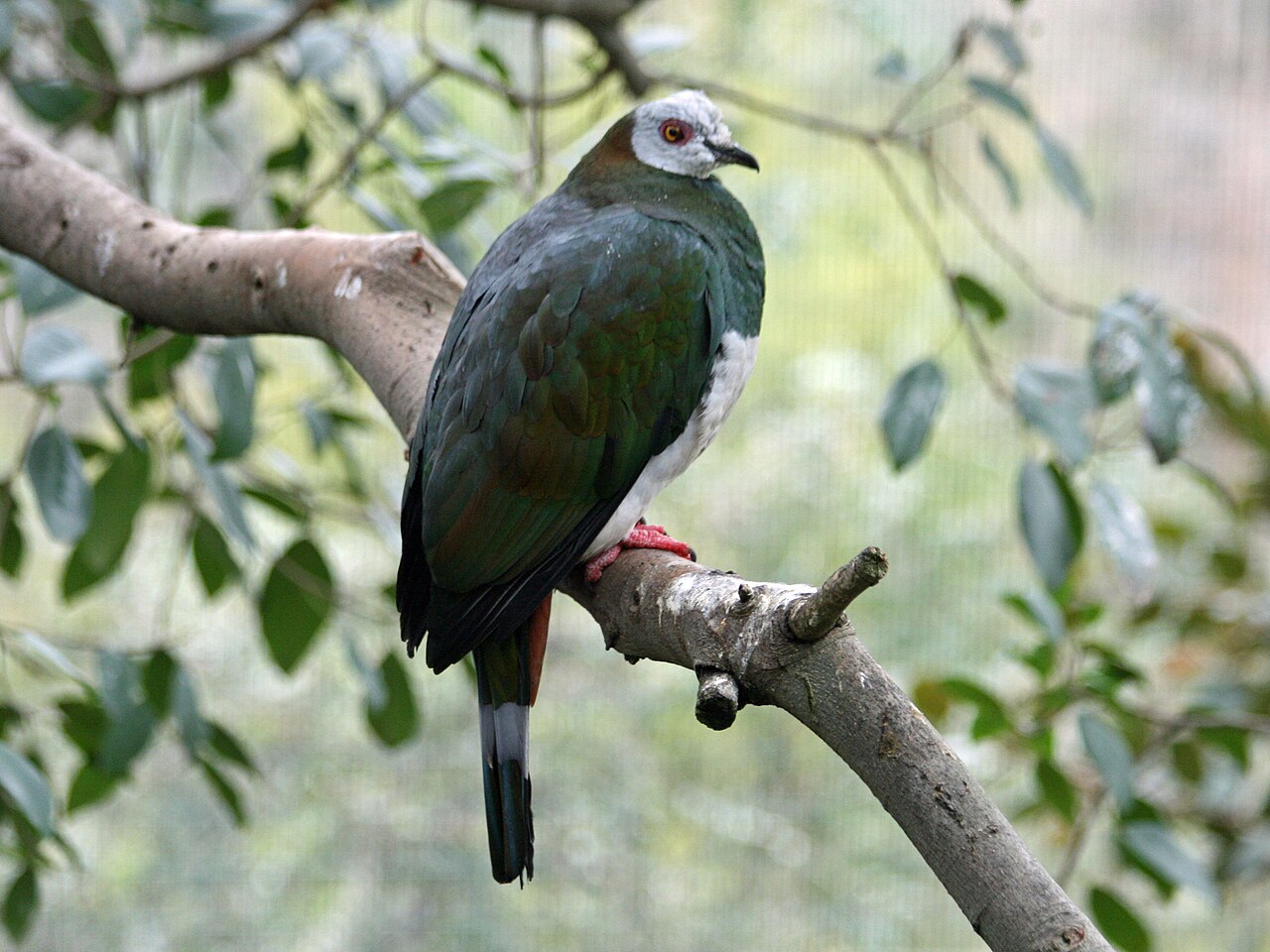
Showing tail band

Temperament
shy and wary
Flight Pattern
strong flier with direct, purposeful flight
Social Behavior
Usually seen singly, in pairs, or in small, loose groups at fruiting trees. Breeds high in the canopy, constructing a flimsy stick platform. Like many imperial pigeons, it likely lays a single egg and both parents share incubation and chick-rearing duties.
Migratory Pattern
Resident
Song Description
Vocalizations are deep, resonant coos delivered in a slow series. Calls carry well through dense foliage and are often heard before the bird is seen.
Plumage
Large imperial pigeon with glossy green upperparts, a pale-grey head and whitish to pale-grey belly, and a chestnut vent. Tail shows a pale grey terminal band contrasting with darker central feathers.
Diet
Primarily consumes fruits, especially figs (Ficus), as well as drupes from laurels, palms, and other canopy trees. It swallows fruits whole and later disperses seeds over long distances. Occasionally supplements diet with soft berries from secondary growth. Foraging is mostly in the upper canopy but will drop to mid-story when fruiting trees are available.
Preferred Environment
Feeds at tall fruiting trees in primary and mature secondary forests. It also uses edge trees, ridge-top fruiting figs, and isolated fruit trees near clearings or villages.


