

The wedge-tailed shearwater is a medium-large shearwater in the seabird family Procellariidae. It is one of the shearwater species that is sometimes referred to as a muttonbird, like the sooty shearwater of New Zealand and the short-tailed shearwater of Australia. It is found throughout the tropical Pacific and Indian Oceans, roughly between latitudes 35°N and 35°S. It breeds on the islands off Japan, on the Islas Revillagigedo, the Hawaiian Islands, the Seychelles, the Northern Mariana Islands, and off Eastern and Western Australia.
Region
Tropical Pacific and Indian Oceans
Typical Environment
Pelagic over warm tropical waters roughly between 35°N and 35°S, widely ranging from the central Pacific to the western Indian Ocean. Breeds on remote oceanic islands including Hawaii, Japan’s offshore islands, Seychelles, the Northern Marianas, and islands off eastern and western Australia. At sea it favors productive fronts, shelf edges, and upwelling zones. Outside the breeding season it disperses broadly across tropical oceans, occasionally moving into subtropical waters.
Altitude Range
Sea level to 500 m
Climate Zone
Tropical
Ease of Keeping
Beginner friendly: 1/5
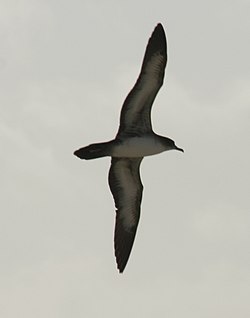
This tube-nosed seabird shows two color morphs: a dark sooty form and a pale form with whitish underparts. It nests in burrows on tropical oceanic islands and returns to colonies mainly at night, filling the air with eerie, wailing calls. The long, wedge-shaped tail and slender hooked bill help identify it at sea. It often forages alongside predatory fish, dolphins, or behind boats to seize small fish and squid.


The pale morph and dark morphs side by side

Egg, Muséum de Toulouse)

Chick in burrow, Kilauea Point National Wildlife Refuge

Temperament
social and colonial
Flight Pattern
dynamic soaring with long glides and few rapid wingbeats
Social Behavior
Breeds in dense colonies, excavating burrows in sand or soil under vegetation. Pairs are largely monogamous and typically raise a single chick per season with shared incubation and feeding. Adults visit colonies mostly after dark to reduce predation and heat stress.
Migratory Pattern
Partial migrant
Song Description
At colonies it gives haunting, wailing moans and yelps, especially at night, often in choruses that carry over long distances. At sea it is generally quiet, uttering only occasional soft calls.
Plumage
Two morphs: dark morph is uniformly sooty-brown; pale morph has brownish-grey upperparts with whitish to pale grey underparts. Feathers are sleek with minimal mottling, and the long tail tapers to a wedge.
Diet
Feeds primarily on small fish (often flying fish), squid, and other cephalopods, with occasional crustaceans. Captures prey by surface-seizing, contact-dipping, and shallow plunge-dives. Frequently associates with tuna or dolphins that drive prey to the surface and may follow fishing vessels for discards.
Preferred Environment
Open ocean over warm, productive waters, especially near fronts, upwellings, and shelf edges. Forages widely around breeding islands but can range far offshore during nonbreeding periods.


