

The Ural owl is a large nocturnal owl. It is a member of the true owl family, Strigidae. The Ural owl is a member of the genus Strix, that is also the origin of the family's name under Linnaean taxonomy. Both its common name and scientific name refer to the Ural Mountains of Russia where the type specimen was collected. However, this species has an extremely broad distribution that extends as far west as much of Scandinavia, montane eastern Europe, and, sporadically, central Europe, thence sweeping across the Palearctic broadly through Russia to as far east as Sakhalin and throughout Japan. The Ural owl may include up to 15 subspecies, but most likely the number may be slightly fewer if accounting for clinal variations.
Region
Northern Eurasia (Palearctic)
Typical Environment
Found from Scandinavia and eastern-central Europe across the taiga belt of Russia to Siberia, Sakhalin, and Hokkaido and Honshu in Japan. Prefers extensive mature mixed or coniferous forests with clearings, bogs, or riparian corridors. Common along forest edges, river valleys, and mosaic landscapes with meadows for hunting and large trees for nesting. Often uses old corvid or raptor stick nests, large tree cavities, or nest boxes. Avoids dense urban areas but may occur near quiet rural settlements.
Altitude Range
Sea level to 2000 m
Climate Zone
Temperate
Ease of Keeping
Beginner friendly: 1/5
The Ural owl is a large, earless owl named after Russia’s Ural Mountains, but it ranges widely across northern Eurasia into Japan. It is a powerful, highly territorial predator that may boldly defend its nest. Pairs are typically long-term monogamous and will reuse suitable nest sites for years. It adapts well to mature forests with natural cavities or old raptor nests, and readily uses nest boxes where provided.


A taxidermed specimen of Ural owl near a pair of its close cousin, the tawny owl

An adult of the well-streaked but otherwise pale subspecies S. u. liturata that is widespread in Europe, seen here in Sweden.

A Ural owl of the large, dark and richly coloured race, S. u. macroura, as seen in Slovakia

In the region of Mount Chausu, a Ural owl of the race S. u. fuscescens

Ural owls often prefer well-wooded areas with large, mature trees

Vole species commonly taken as prey include the bank vole

Although not common as prey, a young mountain hare can be productive prey for a Ural owl

In some parts of Slovakia, Ural owls have come to specialize at preying on Eurasian collared doves

A Ural owl being ringed. For a Strix owl, it has quite formidable talons which aid it in food capture and interspecies conflicts.

A Ural owl in Slovakia sitting on its nest, a natural tree cavity
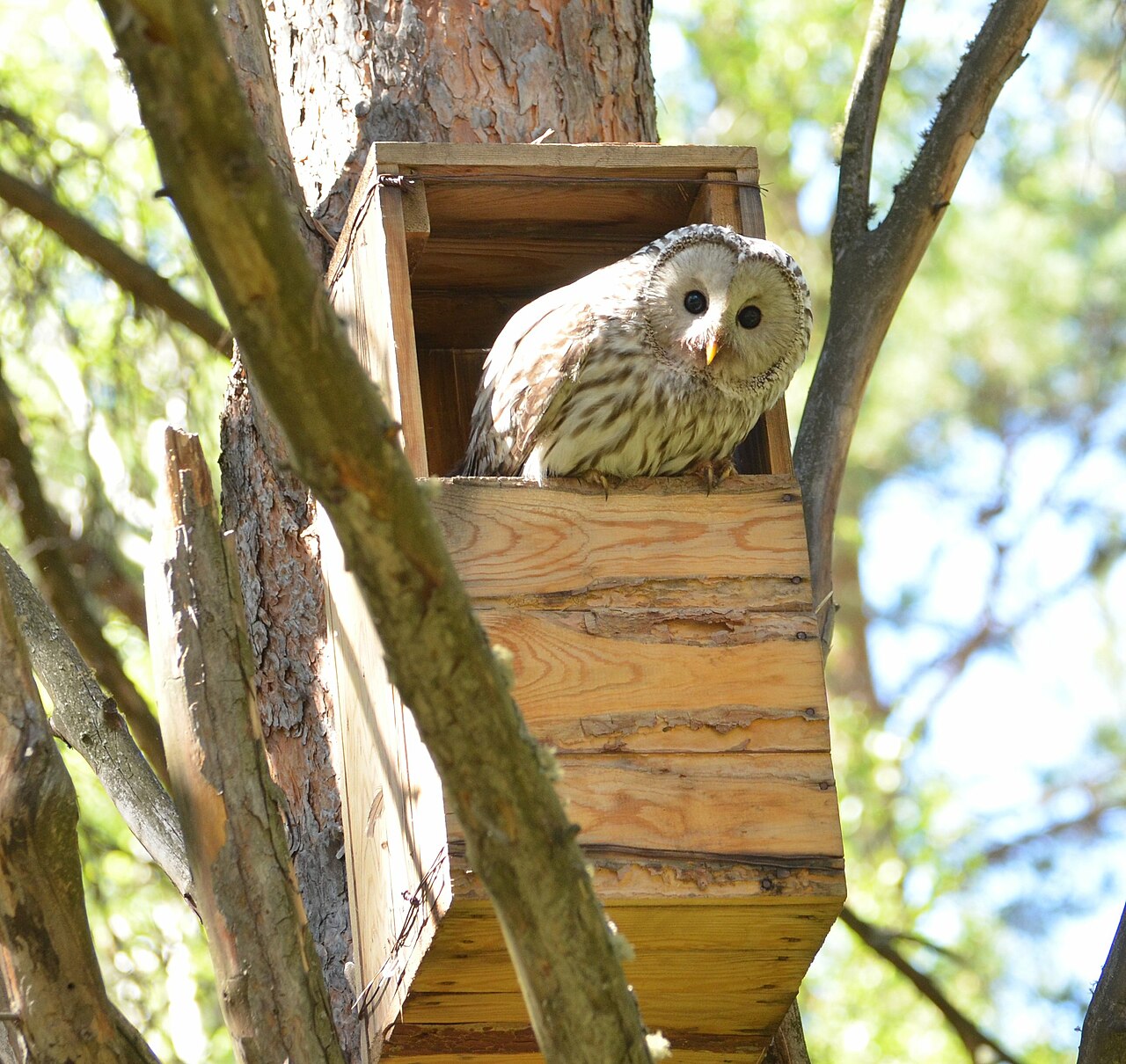
An adult Ural owl emerging from a nest box in Siberia, the use of which has bolstered the populations of the species

The quite rounded, white egg of a Ural owl

A young mesoptile Ural owl shortly after it has left the nest in Albu Parish, Estonia.

A Ural owl perches in the winter on a power pole in Slovakia. As its range expands, the Ural owl may be increasingly vulnerable to anthropogenic mortality causes.
Temperament
solitary and territorial
Flight Pattern
silent, buoyant flight with deep wingbeats and short glides
Social Behavior
Typically forms long-term monogamous pairs that maintain territories year-round. Nests in large tree cavities, old stick nests, or nest boxes, laying 2–4 eggs in late winter to spring. Both adults defend the nest vigorously, and the female broods while the male provides food. Family groups stay together until the young disperse in late summer or autumn.
Migratory Pattern
Partial migrant
Song Description
The male gives a resonant series of deep hoots that carry far through the forest, often in a rhythmic stanza. Females respond with higher-pitched hoots or harsh calls. Contact calls include barks and squeals, especially near the nest.
Plumage
Pale grey-brown overall with fine dark streaking; long, barred tail; rounded head with large, pale facial disc and no ear tufts.
Diet
Primarily hunts small mammals, especially voles and mice, but also takes shrews, small birds, amphibians, and large insects. Hunts from perches, scanning open patches and edges before making rapid, silent strikes. Prey is swallowed whole or torn into pieces, and pellets are cast regularly. In poor vole years, it broadens prey choice and may hunt more by day.
Preferred Environment
Forages along forest edges, clearings, meadows, and wetlands adjacent to mature woods. Riparian corridors and boggy taiga provide abundant small-mammal prey. Uses elevated perches and quiet flight paths through semi-open woodland.


