

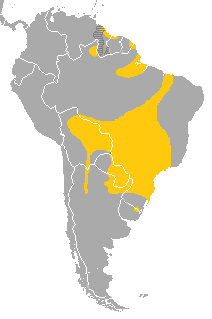
The toco toucan is a species of bird in the toucan family Ramphastidae. It is the largest species of toucan and has a distinctive appearance, with a black body, a white throat, chest and uppertail-coverts, and red undertail-coverts. Its most conspicuous feature is its massive beak, which is yellow-orange with a black base and large spot on the tip. It is endemic to South America, where it has a wide distribution from the Guianas south to northern Argentina and Uruguay, and its range has recently been expanding southwards. Unlike other toucans, which inhabit continuous forests, toco toucans inhabit a variety of semi-open habitats at altitudes of up to 1,750 m. They are especially common in the Brazilian cerrado, gallery forests, and the wetlands of the Pantanal.
Region
South America
Typical Environment
Occurs from the Guianas and northern Brazil south through Bolivia, Paraguay, and much of Brazil to northern Argentina and Uruguay. Prefers semi-open habitats such as the Brazilian Cerrado, gallery forests along rivers, forest edges, and the wetlands of the Pantanal. Also uses palm groves, savannas with scattered trees, and orchards or plantations with fruiting trees. Less tied to continuous rainforest than other toucans and may occupy human-altered mosaics. Often perches conspicuously atop emergent trees and snags.
Altitude Range
Sea level to 1750 m
Climate Zone
Tropical
Ease of Keeping
Beginner friendly: 2/5
The toco toucan is the largest toucan, instantly recognized by its oversized yellow-orange bill with a black tip spot. Despite the huge bill, it is lightweight and helps with thermoregulation by shedding heat. Toco toucans are important seed dispersers in savanna-forest mosaics and wetlands. They adapt well to semi-open landscapes and often occur near human-modified areas with fruiting trees.


Adult (left) and juvenile toucan

A partially leucistic toco toucan

Toco toucan flying in the Brazilian Pantanal

Close-up of toco toucan beak

Toco toucan feeding on papaya


Ad featuring the Guinness toucan in Dublin, Ireland
Temperament
social and active
Flight Pattern
short rapid wingbeats interspersed with glides
Social Behavior
Typically seen in pairs or small groups that move between fruiting trees. Pairs are monogamous and nest in tree cavities, occasionally using old woodpecker holes. Both parents share incubation and chick rearing, and birds engage in mutual preening and bill-tossing displays.
Migratory Pattern
Resident
Song Description
Vocalizations are loud, croaking, frog-like grunts and yelps that carry over long distances. Also produces bill-clacking sounds during social interactions. Calls are often given from exposed perches at dawn and dusk.
Plumage
Glossy black body with a crisp white throat, chest, and uppertail-coverts, and bright red undertail-coverts.
Diet
Primarily eats a wide variety of fleshy fruits and plays a key role in seed dispersal. Also takes insects, small lizards, and occasionally raids nests for eggs or nestlings. Uses its long bill to pluck and deftly toss food items to the back of the throat. Forages methodically among fruiting crowns and edge trees.
Preferred Environment
Feeds mostly in the canopy and subcanopy of semi-open woodlands, gallery forests, and forest edges. Regularly visits fruiting palms, fig trees, and orchards in rural and peri-urban settings. Will descend to lower levels to glean fallen fruits or insects when available.


