

The Tenerife blue chaffinch is a species of passerine bird in the finch family Fringillidae. It is endemic to Tenerife in Spain's Canary Islands. This bird is the natural symbol of this island, together with the Canary Islands dragon tree.
Region
Canary Islands (Macaronesia)
Typical Environment
Found almost exclusively in mature Canary Island pine forests on Tenerife, especially within and around Teide National Park and the Corona Forestal. It favors open pine stands with natural clearings and a sparse shrub layer, where it gleans seeds from cones and the forest floor. Outside breeding season it may use forest edges and nearby ravines but remains tied to pine habitat. It avoids low coastal scrub and urban areas, keeping to mid- and high-elevation woodlands.
Altitude Range
1000–2300 m
Climate Zone
Highland
Ease of Keeping
Beginner friendly: 1/5
The Tenerife blue chaffinch is a finch endemic to Tenerife in Spain’s Canary Islands and is one of the island’s natural symbols. Males are striking slate-blue while females are brownish-grey and more cryptic. It relies heavily on mature Canary Island pine forests, feeding on pine seeds and switching to more insects during breeding. Unlike its Gran Canaria relative, this species is not currently considered threatened.


Egg of Fringilla teydea teydea MHNT
Temperament
solitary and territorial
Flight Pattern
short rapid wingbeats with undulating finch-like flight
Social Behavior
Pairs defend territories during the breeding season, nesting in pines where they build neat cup nests. Outside breeding, they may form small loose flocks, often family groups, moving through pine stands. Clutch size is usually small, and both parents tend the young.
Migratory Pattern
Resident
Song Description
The male’s song is a rich series of bright, metallic trills and whistles delivered from prominent perches. Calls include sharp chups and soft twitters used to keep contact within pairs and small groups.
Plumage
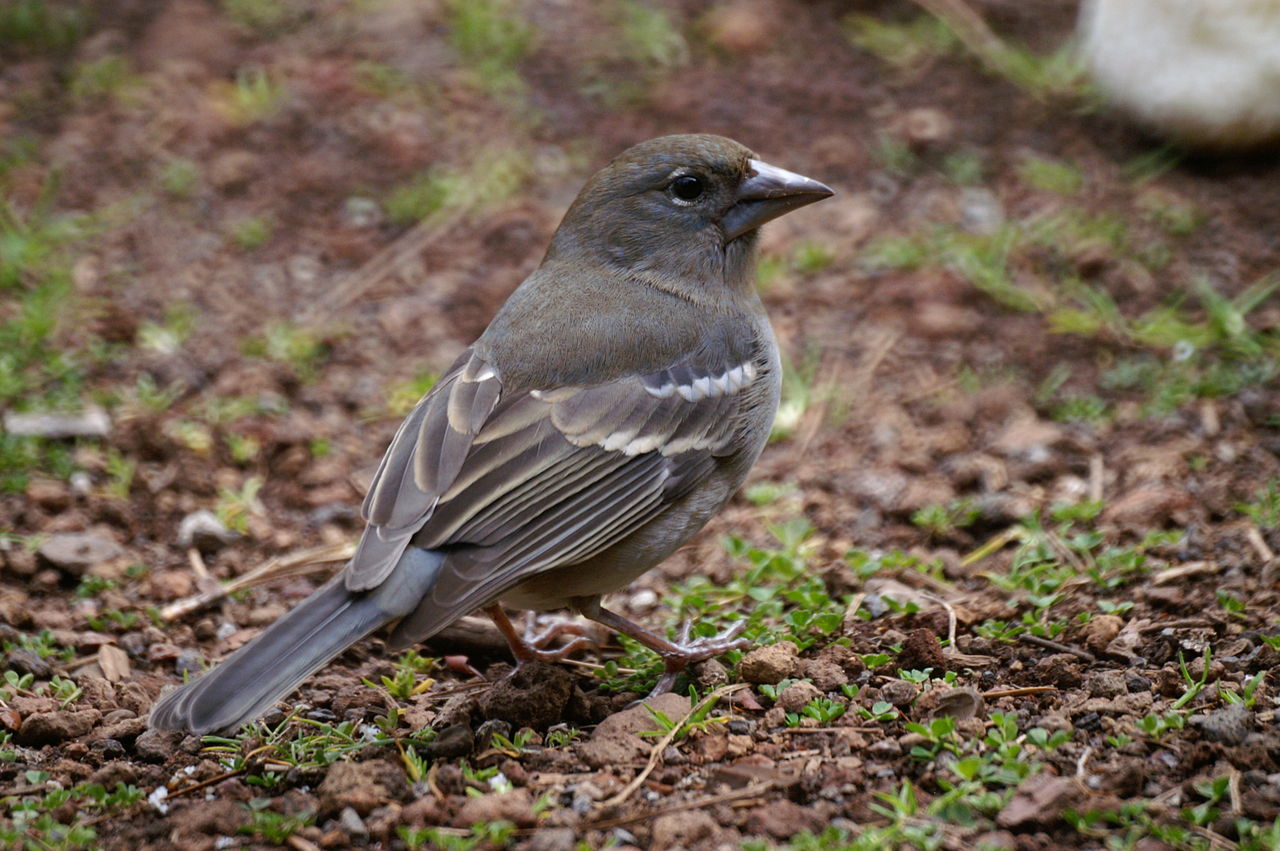
Male is uniform slate-blue to bluish-grey with darker wings and two crisp pale wing bars; female is brownish-grey with subtle streaking and paler underparts. Both sexes show white edges to the tail and wing bars typical of chaffinches.
Diet
Primarily consumes seeds, especially those of the Canary Island pine, extracting kernels from cones and foraging on fallen seeds. It supplements this with small invertebrates such as beetles, caterpillars, and other larvae, particularly during the breeding season to feed nestlings. Berries and other plant material are occasionally taken.
Preferred Environment
Forages in the canopy and mid-story of pine trees as well as on the forest floor in clearings and along paths. Frequently visits areas with exposed cones and natural seed fall, and uses water sources in ravines during dry periods.


