

The sword-billed hummingbird, also known as the swordbill, is a neotropical species of hummingbird from the Andean regions of South America. It is the only member in the genus Ensifera. Among the largest species of hummingbird, it is characterized by its unusually long bill, being the only bird to have a beak longer than the rest of its body, excluding the tail. It uses its bill to drink nectar from flowers with long corollas and has coevolved with the species Passiflora mixta. While most hummingbirds preen using their bills, the sword-billed hummingbird uses its feet to scratch and preen due to its bill being so long.
Region
Andes Mountains
Typical Environment
Found along humid montane slopes of the northern and central Andes from Venezuela and Colombia through Ecuador and Peru to Bolivia. It favors cloud forest edges, shrubby ravines, and secondary growth with abundant long-tubed flowers. Birds also visit high-elevation gardens and hedgerows near forest. They forage from midstory to canopy, often along forest borders and in clearings. Local elevational movements track seasonal flowering peaks.
Altitude Range
1700–3500 m
Climate Zone
Highland
Ease of Keeping
Beginner friendly: 1/5
This Andean hummingbird is the only bird whose bill is longer than the rest of its body (excluding the tail). It has coevolved with long-tubed flowers such as Passiflora mixta, acting as a key pollinator at high elevations. Because its bill is so long, it uses its feet to preen. It often performs slow, hovering inspections of flowers high in the canopy that most other hummingbirds cannot exploit.


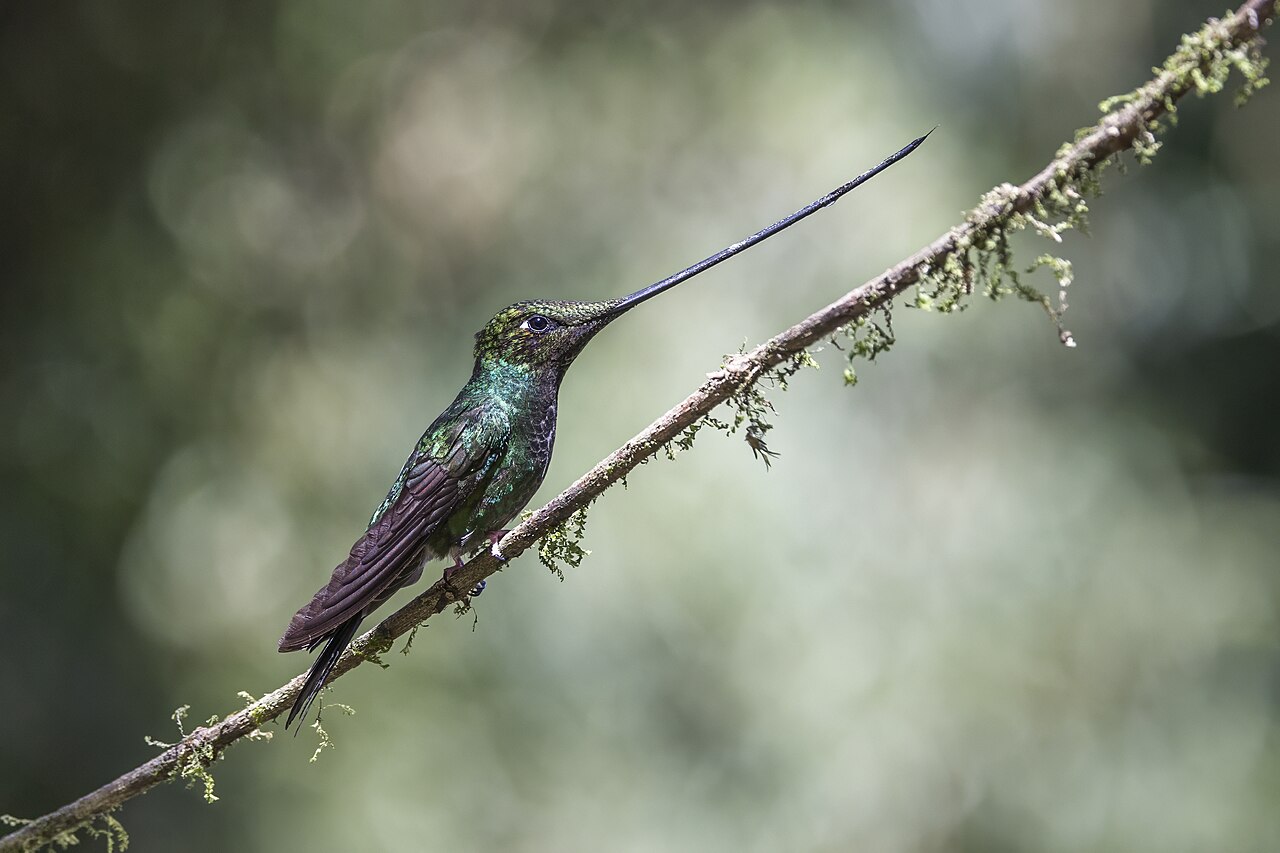
Male sword-billed hummingbird in Caldas, Colombia

Female sword-billed hummingbird feeding in flight

The long corolla of Passiflora mixta is coevolved with the bird's bill as a pollination strategy.
Temperament
solitary and territorial
Flight Pattern
short rapid wingbeats with sustained hovering; agile, strong flier
Social Behavior
Generally solitary at flowers and aggressively defends rich nectar sources. Courtship includes aerial chases and display perches. The small cup nest is built of plant fibers and moss, often suspended on banks or in protected forks in humid montane habitats.
Migratory Pattern
Partial migrant
Song Description
Vocalizations are thin, high-pitched seeps and rapid chitters given during foraging and territorial encounters. Males add buzzy twitters during display. Wing hum is audible at close range while hovering.
Plumage
Iridescent green upperparts with bronzy sheen; throat and breast green to grayish with fine scaling; belly grayish-buff; tail bronzy to dusky and slightly notched. Overall sleek appearance accentuated by an extremely long, straight bill.
Diet
Primarily nectar from long-corolla flowers such as Passiflora mixta, Brugmansia/Datura, Fuchsia, and Bomarea, which few other birds can access. It uses its elongate bill and extensible tongue to reach deep nectar. Small insects and spiders are also taken for protein, gleaned from foliage or hawked in short sallies. As a specialist pollinator, it transfers pollen between widely spaced flowers.
Preferred Environment
Feeds along forest edges, clearings, and shrubby ravines where long-tubed flowers are abundant. Also visits high-elevation gardens and hedgerows near cloud forest. Forages from midstory into the canopy and occasionally at tall flowering shrubs.


