

Swainson's hawk is a large bird species in the Accipitriformes order. This species was named after William Swainson, a British naturalist. It is colloquially known as the grasshopper hawk or locust hawk, as it is very fond of Acrididae and will voraciously eat these insects whenever they are available.
Region
Western North America and South American Pampas
Typical Environment
Breeds in open country across the Great Plains, Great Basin, and western interior of North America, from southern Canada through the western United States into northern Mexico. Prefers prairies, shrubsteppe, and agricultural landscapes with scattered trees or shelterbelts for nesting. In the non-breeding season it concentrates in the Pampas, Chaco, and other open lowlands of Argentina, Paraguay, Uruguay, and adjacent Brazil. It favors broad, open habitats that allow soaring flight and ground foraging for insects.
Altitude Range
0–3000 m
Climate Zone
Temperate
Ease of Keeping
Beginner friendly: 1/5
Swainson's hawk undertakes one of the longest migrations of any North American raptor, traveling between western North America and the grasslands of South America. During migration it forms huge kettles of hundreds to thousands of birds soaring on thermals. Nicknamed the grasshopper or locust hawk, it switches heavily to large insects outside the breeding season. Populations rebounded after restrictions on harmful pesticides in parts of Argentina where they winter.


in Ecuador

Swainson's hawk migration route.30 birds were fitted with satellite tracking devices to produce this map. Incomplete: the birds also pass through Ecuador.

Swainson's Hawk and prey, Weld County, Colorado

A Swainson's hawk chick
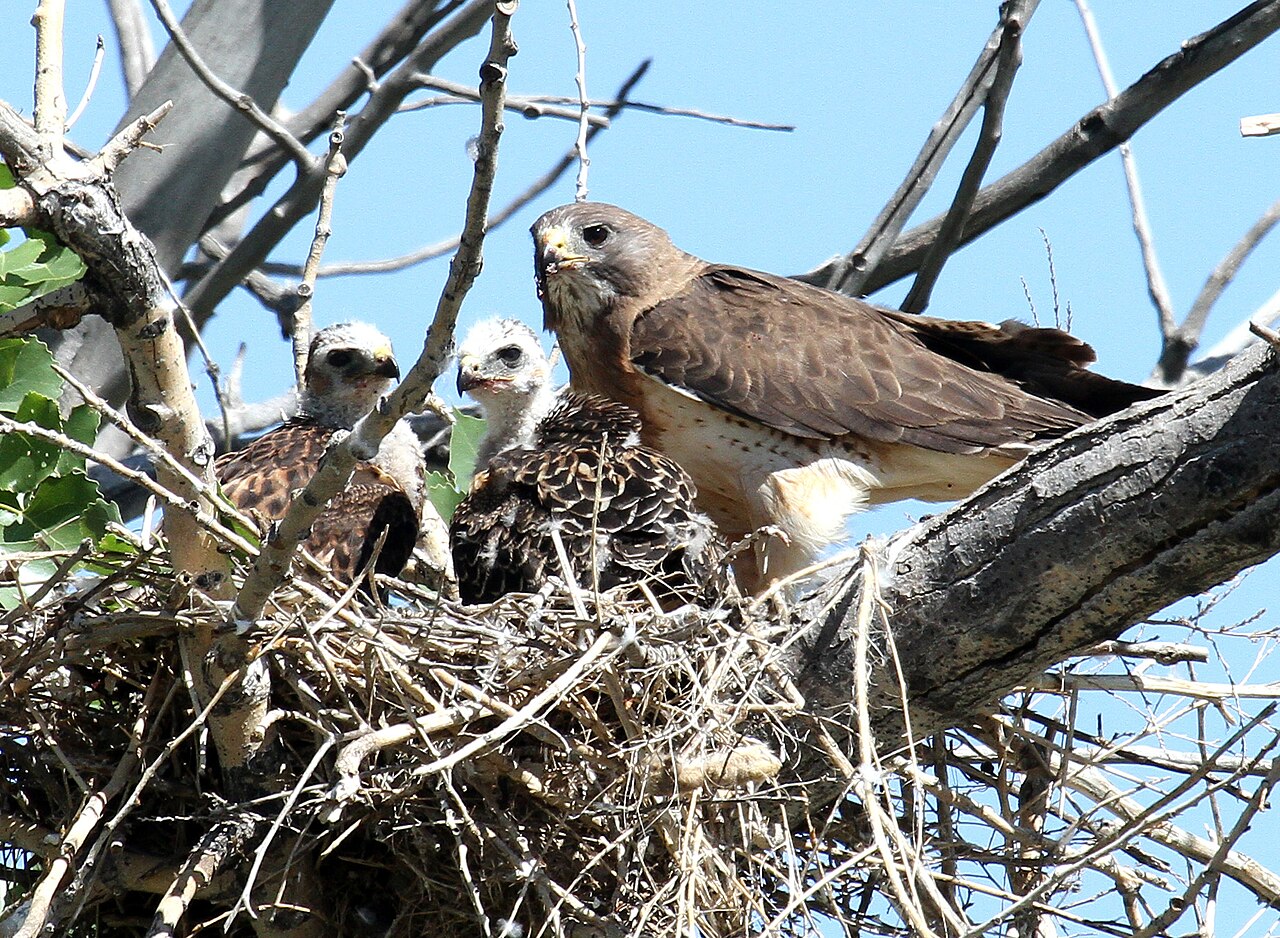
Swainson's Hawk and nestlings, Weld County, Colorado

Juvenile Swainson's hawk
Temperament
Territorial on breeding grounds but highly social in migration and on wintering grounds.
Flight Pattern
Soaring glider that rides thermals with minimal flapping; buoyant, long-winged flight.
Social Behavior
Typically nests as a monogamous pair, often reusing territories in trees, shelterbelts, or on utility structures near open foraging areas. Clutch size is usually 2–3 eggs; the female incubates more, while the male supplies prey. Outside the breeding season they gather in large flocks to roost and forage, especially where insect swarms are abundant.
Migratory Pattern
Seasonal migrant
Song Description
Calls are high, thin whistles and drawn-out keee notes typical of Buteo hawks. Vocal activity increases near the nest and during territorial displays, but they are generally quieter than some other raptors.
Plumage
Variable, with light and dark morphs; light morph shows pale underparts with a rufous to brown chest bib and contrasting dark flight feathers, while dark morphs are mostly chocolate-brown. Underwings often appear two-toned with pale coverts and a darker trailing edge. Long, narrow wings and relatively small head give a slim, long-winged Buteo silhouette.
Diet
On breeding grounds they take small mammals such as ground squirrels, voles, and pocket gophers, as well as small birds and reptiles. During post-breeding and winter they shift strongly to large insects, especially grasshoppers, crickets, and dragonflies. They will exploit insect outbreaks and may feed on swarming locusts on the ground. Carrion is taken occasionally when other food is scarce.
Preferred Environment
Hunts over open prairies, hayfields, pastures, and harvested croplands where insects and small vertebrates are abundant. Often forages from low perches, by hovering, or by coursing low over fields, and will also hawk insects on the wing.


