
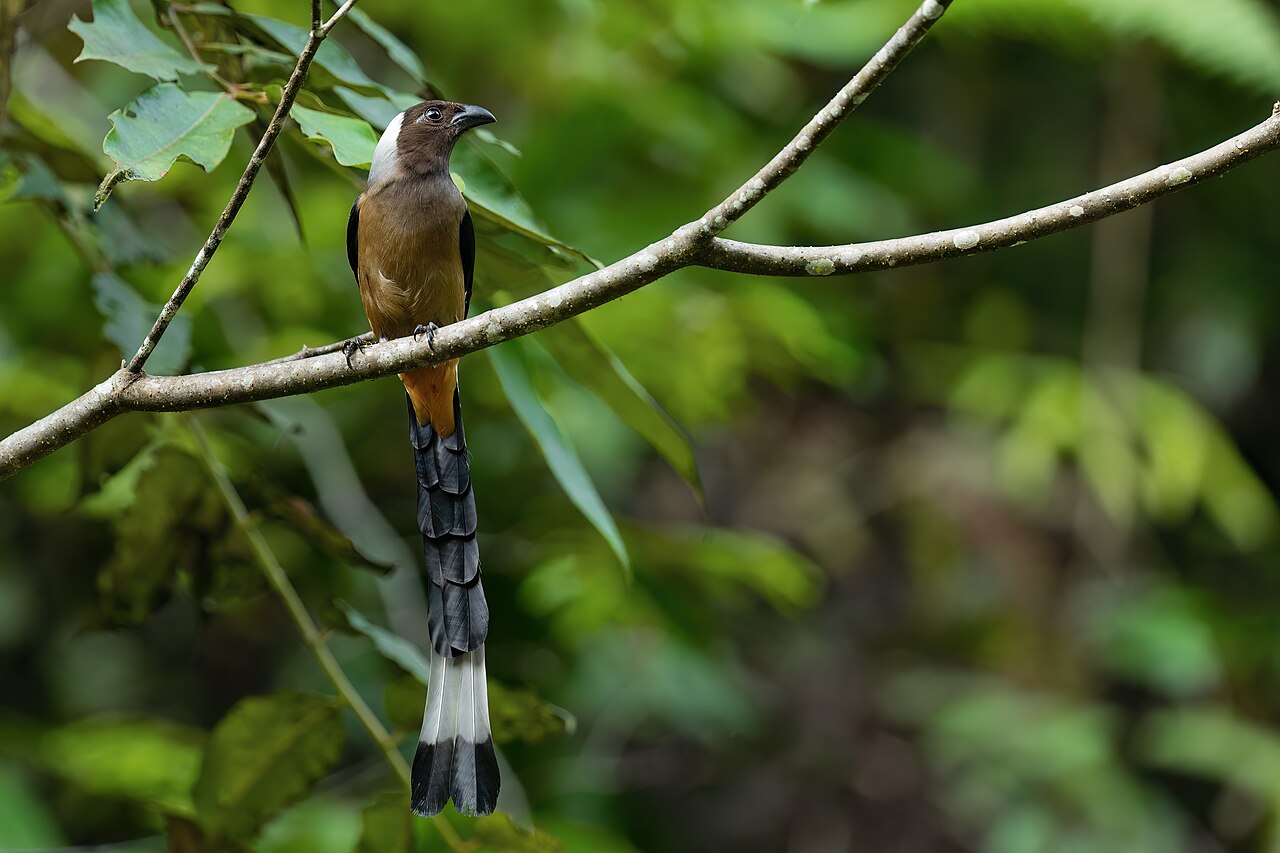
The Sumatran treepie or Sunda treepie is a species of bird in the family Corvidae. It is endemic to the island of Sumatra in Indonesia. Its natural habitats are subtropical or tropical moist lowland forest and subtropical or tropical moist montane forest. The Bornean treepie is sometimes considered to be a subspecies of this bird.
Region
Greater Sunda Islands
Typical Environment
Endemic to Sumatra, occurring from lowland evergreen forests to montane forest on the Barisan range. It frequents primary and well-developed secondary forest, forest edges, and clearings with tall trees. The species is most often seen in the mid to upper canopy but also descends to fruiting shrubs at edges. It tolerates some disturbance but remains strongly tied to forested landscapes.
Altitude Range
Sea level to 2200 m
Climate Zone
Tropical
Ease of Keeping
Beginner friendly: 2/5
The Sumatran treepie, also called the Sunda treepie, is a forest-dwelling corvid known for its long tail and contrasting mask. It forages acrobatically through the mid to upper canopy and is an opportunistic omnivore. The Bornean treepie is sometimes treated as a separate species but has also been considered conspecific in the past. Ongoing habitat loss on Sumatra likely affects local populations.

Temperament
social and active
Flight Pattern
short rapid wingbeats with glides
Social Behavior
Usually seen in pairs or small family parties, moving methodically through the canopy. It builds a cup-shaped nest high in trees and both sexes participate in nesting duties. Territorial calling and tail-flagging are common during the breeding season.
Migratory Pattern
Resident
Song Description
Vocalizations include harsh chattering, grating scolds, and mellow whistles delivered in short sequences. It can be quite vocal at dawn and when moving between feeding sites.
Plumage
Smooth brownish upperparts with grey tones, paler buff underparts, and a long, graduated tail with a pale tip. The head shows a dark mask and cap contrasting with a paler nape/collar, and there is a small whitish patch on the wings visible in flight. Feathers are sleek and slightly glossy on the head and tail.
Diet
Takes large insects and other arthropods, small lizards, and occasionally eggs or nestlings. Also consumes a variety of fruits and berries, switching seasonally to available crops of figs and other soft fruits. Will opportunistically pick food from foliage clusters and probe bark crevices.
Preferred Environment
Feeds mainly in the mid to upper canopy of primary and mature secondary forest. Also forages along forest edges, clearings, and sometimes in tall trees near villages.


