
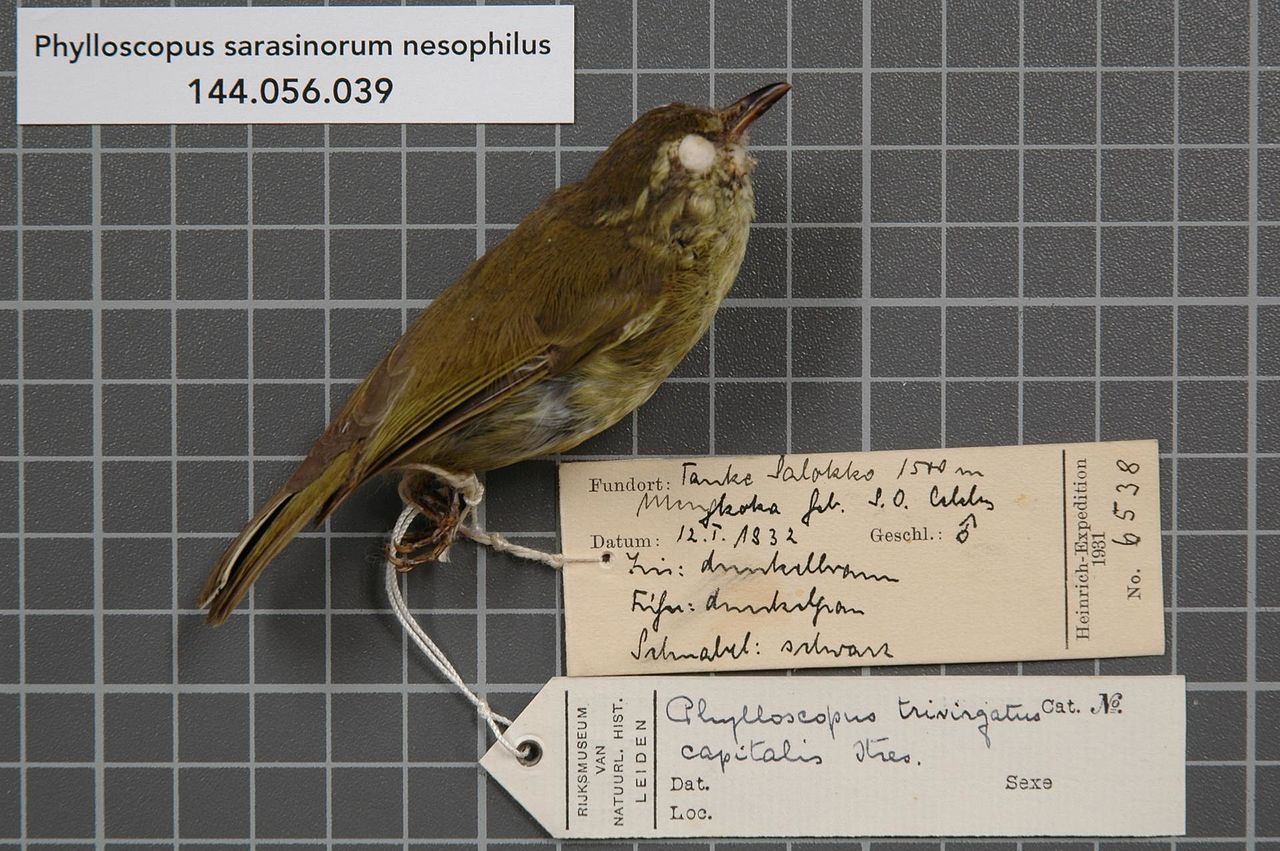
The Sulawesi leaf warbler is a species of Old World warbler in the family Phylloscopidae. It is found only in Sulawesi Island, Indonesia. The Sulawesi leaf warbler was formerly considered conspecific with the Lompobattang leaf warbler and both were grouped under the name P. sarasinorum, but more recent analyses indicate that it is a distinct species.
Region
Wallacea (Sulawesi)
Typical Environment
Occurs in montane and submontane forests across much of Sulawesi outside the extreme southern Lompobattang range. Prefers mature evergreen and mossy forests, but may also use forest edges and tall secondary growth. Typically forages from the understory to mid-canopy, moving quickly through foliage. It frequently associates with mixed flocks of small insectivores.
Altitude Range
800–2500 m
Climate Zone
Highland
Ease of Keeping
Beginner friendly: 1/5
This species is confined to Sulawesi, Indonesia, and was recently split from the Lompobattang leaf warbler based on vocal and genetic differences. It is a restless canopy gleaner that often joins mixed-species flocks. Subtle features like voice and head pattern are key to separating it from similar leaf warblers.
Temperament
social and active
Flight Pattern
short rapid wingbeats
Social Behavior
Often travels in pairs or small groups and readily joins mixed-species flocks with white-eyes and small babblers. Nests are thought to be cup-shaped and placed low in shrubs or among dense vegetation. Territorial singing males defend small breeding areas during the breeding season.
Migratory Pattern
Resident
Song Description
Song is a fast series of high, thin trills and sweet seee-tsit notes, delivered in rapid phrases. Calls are sharp, high-pitched chips used to maintain contact while foraging.
Plumage
Olive-green upperparts with yellowish underparts and clean whitish-yellow throat and breast. A bold pale supercilium contrasts with a darker eyestripe; wingbars are faint or absent. Feathers are sleek and close-fitting, suited to agile foliage gleaning.
Diet
Feeds primarily on small insects and their larvae, including caterpillars, beetles, and flies. It also takes spiders and other small arthropods. Prey is gleaned from leaves and twigs, occasionally taken in short sallies.
Preferred Environment
Forages in the understory to mid-canopy of montane forest and along forest edges and trails. Frequently moves through dense foliage in mixed-species flocks, exploiting small prey flushed by other birds.


