

The steppe eagle is a large bird of prey. Like all eagles, it belongs to the family Accipitridae. The steppe eagle's well-feathered legs illustrate it to be a member of the subfamily Aquilinae, also known as the "Booted eagles". This species was once considered to be closely related to the sedentary tawny eagle and the two forms have previously been treated as conspecific. They were split based on pronounced differences in morphology and anatomy; two molecular studies, each based on a very small number of genes, indicate that the species are distinct but disagree over how closely related they are.
Region
Eurasian steppes (breeding), Africa–Middle East–South Asia (wintering)
Typical Environment
Breeds widely across open steppe, semi‑desert, and arid grasslands from Eastern Europe through Kazakhstan, Mongolia, and adjacent regions. Nests on the ground, low mounds, or occasionally on pylons and isolated trees. In winter it frequents open savannas, agricultural plains, deserts, and rubbish dumps, often near carcasses. It is frequently seen soaring over wide, treeless landscapes and gathering at abundant food sources.
Altitude Range
Sea level to 3500 m
Climate Zone
Arid
Ease of Keeping
Beginner friendly: 1/5
The steppe eagle is a large booted eagle with feathered legs, belonging to the Aquilinae. It breeds across the open steppes of Central Asia and undertakes long migrations to winter in Africa, the Middle East, and the Indian subcontinent. Formerly lumped with the tawny eagle, it is now treated as a distinct species based on morphology and genetics. Major threats include electrocution on powerlines, habitat conversion, and declines in ground-squirrel prey.


The gape of the steppe eagle is an easy way to distinguish it from the tawny eagle. The gape extends beyond the center of the eye as against the tawny. The oval nostril sets it apart from the spotted eagles.

Detailed view of a young steppe eagle in flight in Pakistan.

Adult steppe eagle in flight, Aravalli Biodiversity Park, Gurgaon

A young captive steppe eagle in Wildpark Tripsdrill, Germany, displaying several typical features including the distinctive pale bands about the wings and huge gape.

A steppe eagle flying over the snowy mountains near the Hunza Valley in Pakistan.

A young steppe eagle seen in Tanzania.

The vast and quite flat steppe is the unique home of breeding steppe eagles.

A steppe eagle juvenile seen in Kerala.
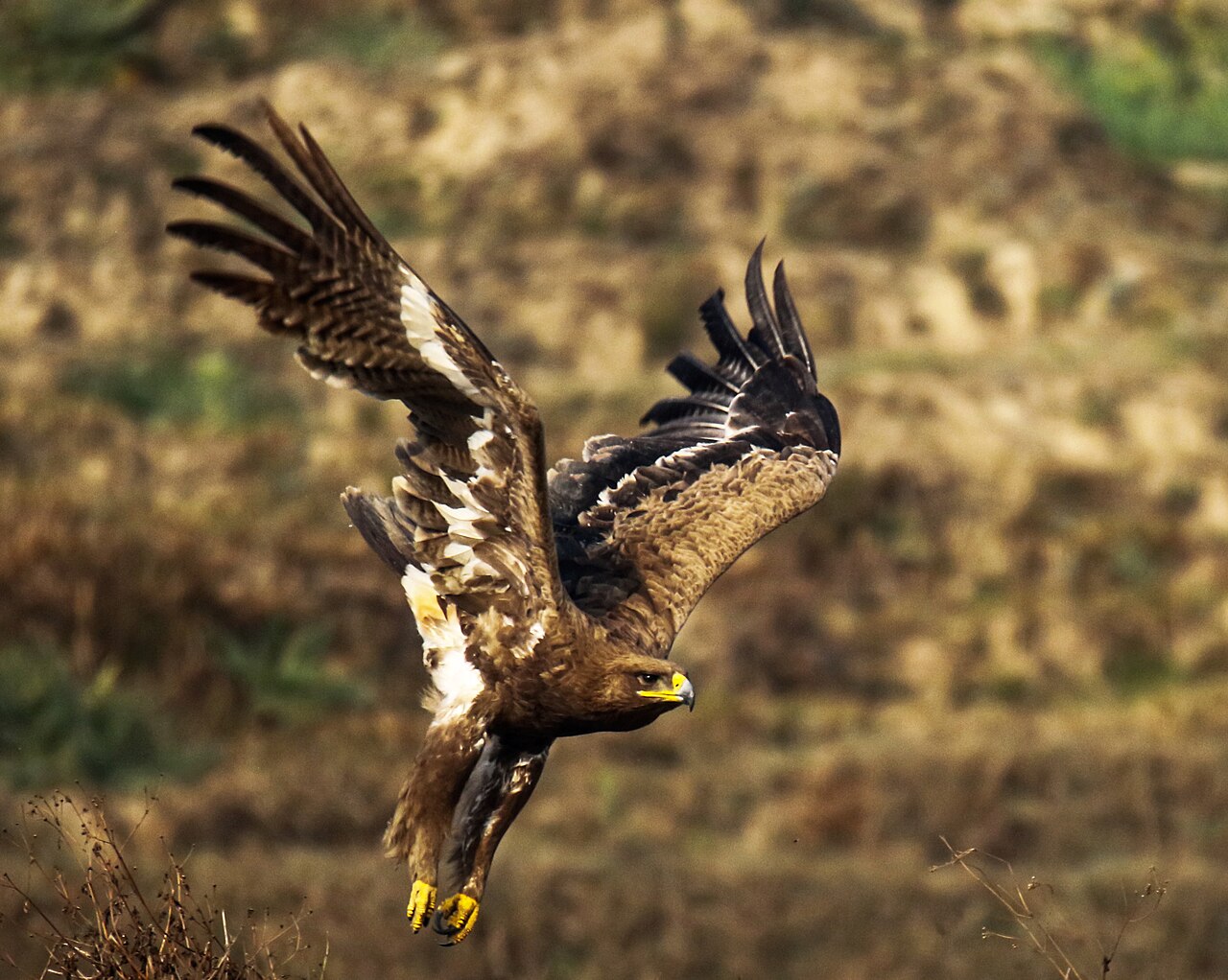
A steppe eagle photographed in Nepal, arguably their primary point of passage in the eastern part of the range.

An unusual, pale probable subadult steppe eagle in Nepal.

Ground squirrels like long-tailed ground squirrels are often the most important prey for breeding steppe eagles.

Small mammals like Daurian pika are often taken in significant numbers by steppe eagles.
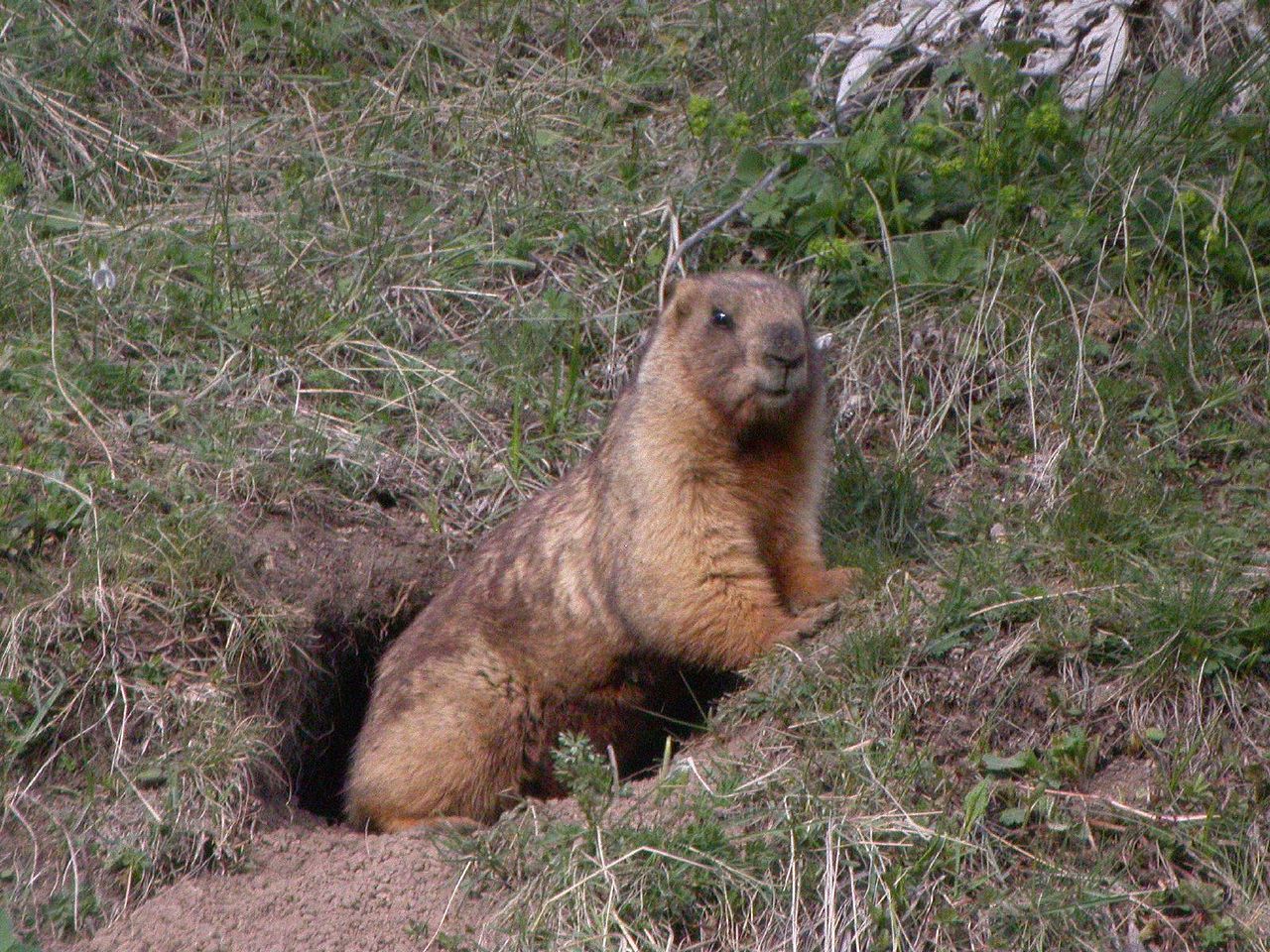
Larger prey such as gray marmots are infrequently targeted by steppe eagles.

A harvester termite, the most significant wintering food for southern African steppe eagles.

A steppe eagle appearing to scavenge amongst a garbage dump; among all Aquila eagles, it appears to have the least discerning diet and least predatory demeanor.

Three steppe eagles seen perched near an Indian carcass dump with another large scavenging bird, the griffon vulture.

Red fox make their home in the steppe habitat quite often (as seen) and both the steppe eagle and fox are known to threaten each other, especially the young of the other predator.
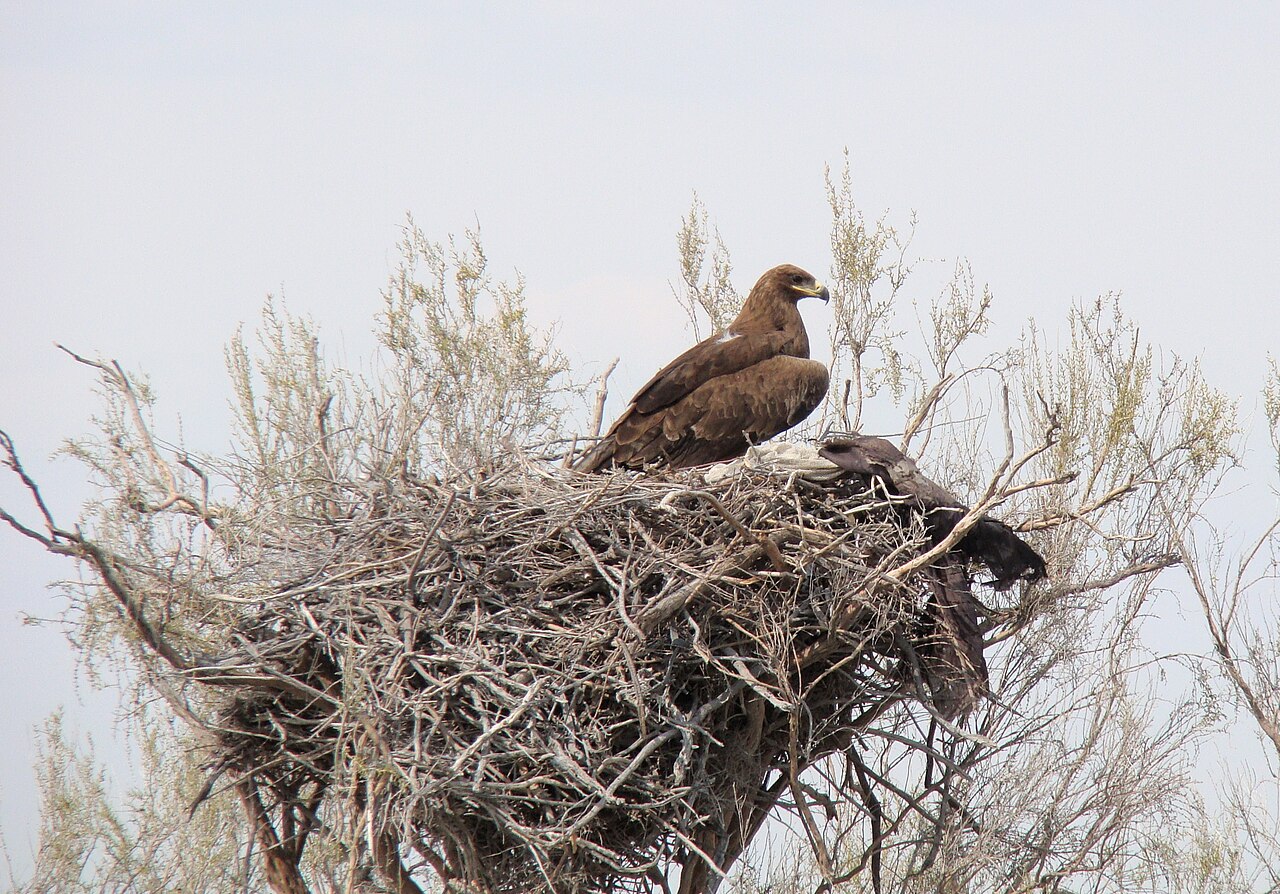
An adult steppe eagle on its nest in Baikonur.

Elevated portions of land, whether rocky or not, are the typical nesting site for steppe eagles.

Egg, Collection Museum Wiesbaden

A lone young nestling steppe eagle in a Russian nest.

A steppe eagle and the sunrise in Tal Chhapar Sanctuary

Powerline electrocutions are depleting the population of steppe eagles in many parts of the range.

A steppe eagle mother with its eaglet; this eagle is still quite young and not in adult plumage. Subadult breeding is generally considered indicative of population stress in raptors.

Steppe eagle near Chandigarh.
Temperament
solitary and territorial
Flight Pattern
soaring glider with deep, powerful wingbeats
Social Behavior
Pairs defend nesting territories during the breeding season and build bulky ground or low-platform nests. Outside the breeding season they can be loosely gregarious, especially at rich food sources like carcasses or refuse sites. Courtship includes soaring displays and mutual calling.
Migratory Pattern
Seasonal migrant
Song Description
Generally silent away from nests; near the nest it gives harsh barks and yelping cries. Calls are carrying and abrupt, often delivered during display flights or when alarmed.
Plumage
Mostly dark brown to umber with a somewhat paler nape; flight feathers are darker with a contrasting paler band across the underwing coverts. Well-feathered tarsi give a ‘booted’ look. Juveniles often show more contrast with paler wing panels and a narrow pale tail band.
Diet
Primarily hunts small to medium mammals such as ground squirrels, pikas, and hares, and also takes reptiles and birds. It readily scavenges at carcasses and offal and will exploit locust swarms and other large insects when abundant. Wintering birds often frequent landfills and roadkill sites, mixing hunting with opportunistic scavenging.
Preferred Environment
Hunts over open steppe, semi-desert, and broad agricultural plains with sparse tree cover. Commonly uses elevated perches like poles and pylons to scan for prey and also quarters low over the ground while soaring.


