

The southern giant petrel, also known as the Antarctic giant petrel, giant fulmar, stinker, and stinkpot, is a large seabird of the southern oceans. Its distribution overlaps broadly with the similar northern giant petrel, though it overall is centered slightly further south. Adults of the two species can be distinguished by the colour of their bill-tip: greenish in the southern and reddish in the northern.
Region
Southern Ocean and subantarctic islands
Typical Environment
Breeds on subantarctic and Antarctic islands including South Georgia, the South Orkney and South Shetland Islands, the Antarctic Peninsula, Prince Edward, Crozet, Kerguelen, Heard, Macquarie, and Diego Ramírez. Outside the breeding season it disperses widely across the Southern Ocean and into cool temperate waters of the southern continents. It frequents open ocean, shelf edges, and coastal waters, often following ships to scavenge offal. Around colonies it patrols beaches and penguin and seal rookeries for carrion and live prey. Birds occasionally range north into temperate waters during winter.
Altitude Range
Sea level to 600 m
Climate Zone
Polar
Ease of Keeping
Beginner friendly: 1/5
Also called the Antarctic giant petrel or giant fulmar, it is a powerful seabird and the largest member of the Procellariidae. It is notorious for its aggressive scavenging at penguin and seal colonies and often gathers at carcasses, which earned it the nicknames 'stinker' and 'stinkpot.' Adults can be told from the similar northern giant petrel by their greenish bill tip (reddish in the northern). The species shows both dark and striking white morphs.


Flying over East Falkland

Egg

Juvenile
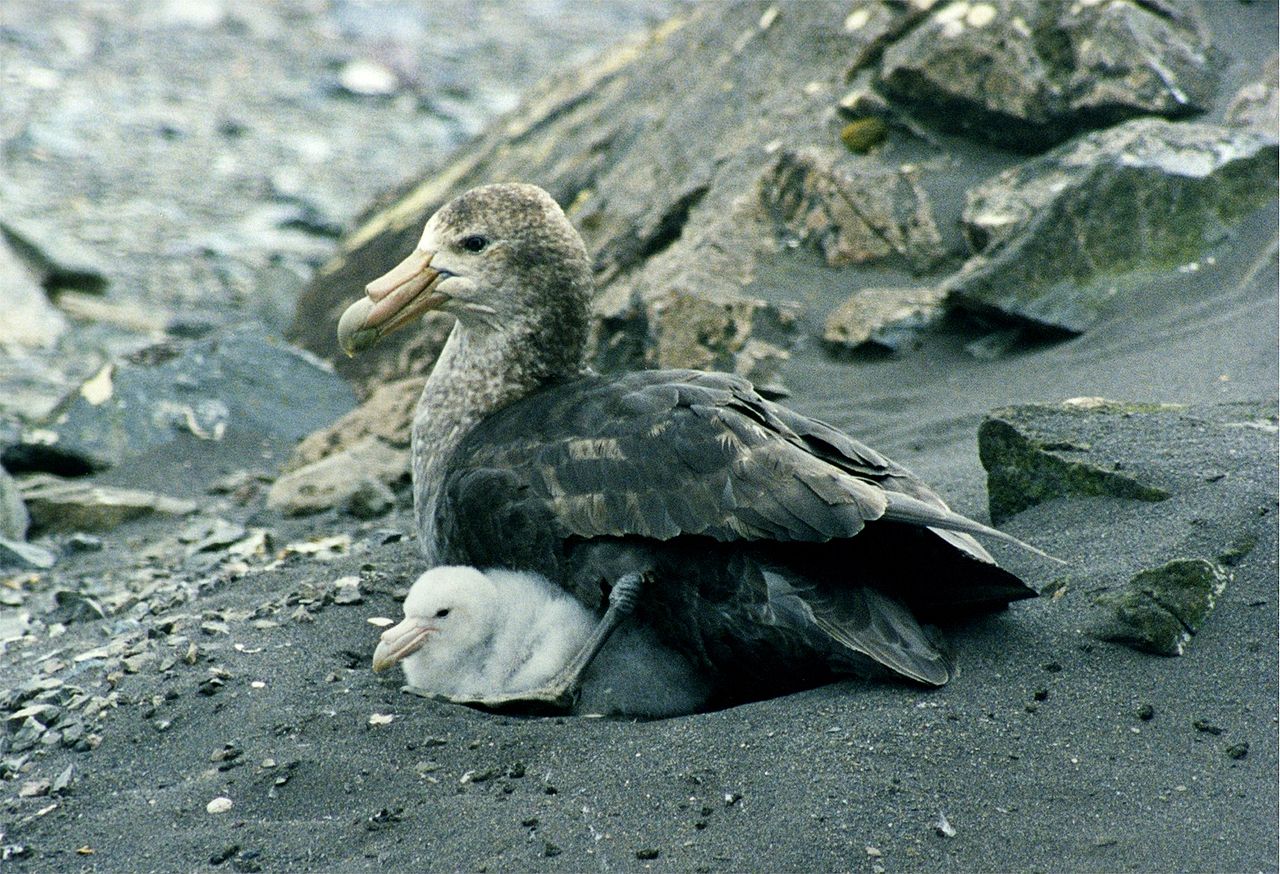
Adult with chick
Temperament
assertive and opportunistic
Flight Pattern
dynamic soaring and gliding with long, stiff-winged arcs
Social Behavior
Breeds in loose colonies on open ground or gentle slopes near the coast. Pairs are generally long-term and monogamous, constructing a low mound nest and laying a single egg. Both parents share incubation and chick rearing, and adults often defend food aggressively at carcasses. Outside breeding, birds are largely solitary or in small groups at rich food sources.
Migratory Pattern
Partial migrant
Song Description
Vocalizations include guttural cackles, grunts, and hisses, especially during disputes at carcasses or at the nest. Bill-clapping and harsh croaks are common in threat displays.
Plumage
Variable; dark morph is mottled chocolate-brown with pale speckling, while the white morph is mostly white with dark flecks, especially on the wings. Feathers are dense and oily, well-suited to marine life. Juveniles are darker and more uniformly brown.
Diet
Primarily scavenges carrion from seals, penguins, and whales, but also takes live prey including fish, squid, krill, and seabird chicks. Frequently follows fishing vessels to feed on offal and discards. It is capable of kleptoparasitism, harassing other seabirds to steal food. Foraging is both surface seizing and scavenging along shorelines and at sea-ice edges.
Preferred Environment
Open pelagic waters, coastal shelves, and waters around breeding islands. Common at penguin and seal colonies, beaches, and around fishing vessels. Often patrols the ice edge and tide lines where prey concentrates.


