
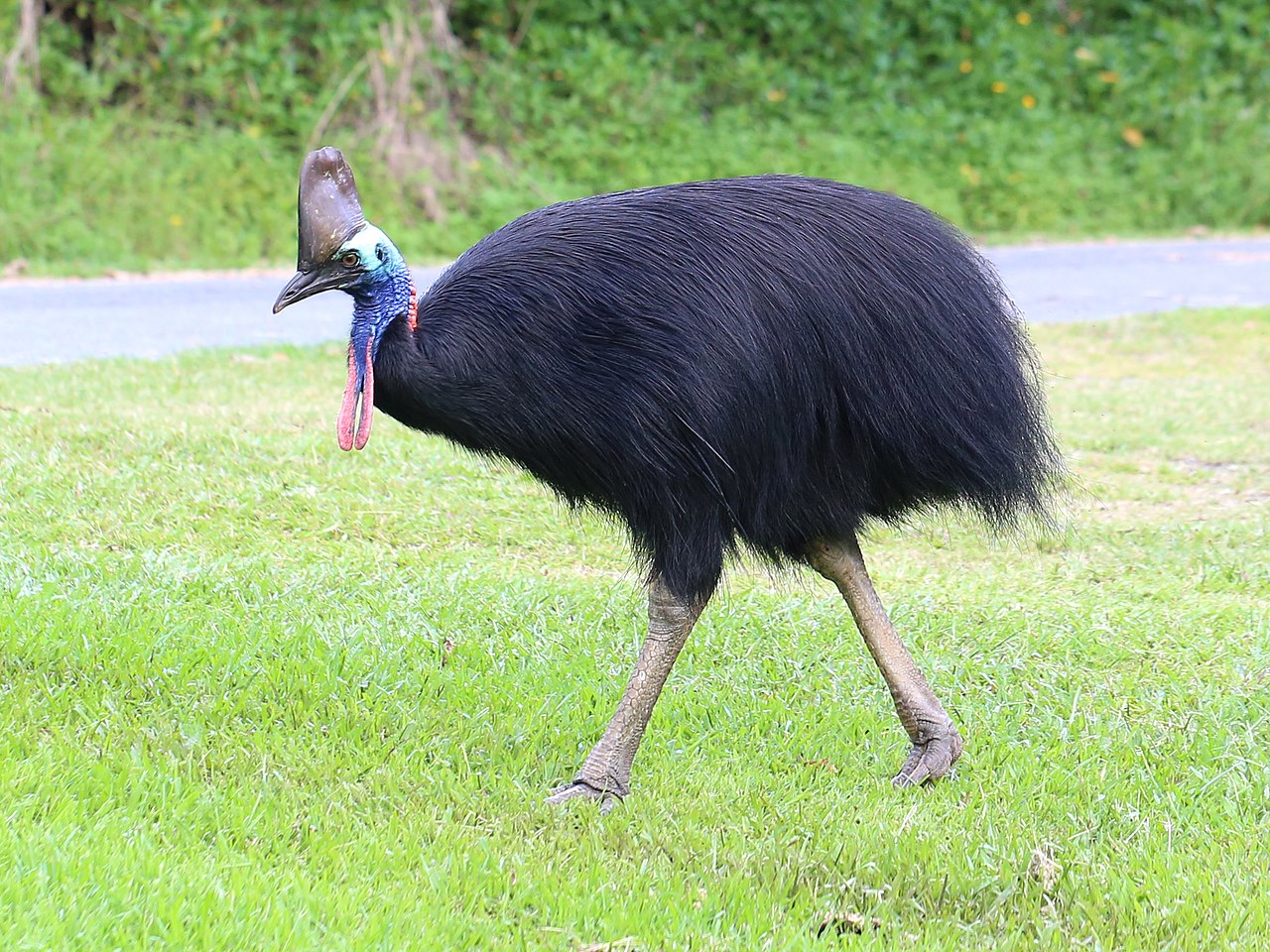
The southern cassowary, also known as double-wattled cassowary, Australian cassowary, or two-wattled cassowary, is a large, flightless, mostly black bird, found in Indonesia, Papua New Guinea, and northeastern Australia. It is one of the three living species of cassowary, alongside the dwarf cassowary and the northern cassowary. It is a ratite and therefore related to the emu, ostrich, rhea and kiwi.
Region
Australasia
Typical Environment
Occurs in lowland and foothill rainforests of southern New Guinea, nearby Indonesian provinces, and northeastern Australia (Cape York and the Wet Tropics of Queensland). Prefers dense tropical rainforest but also uses swamp forest, gallery forest, mangroves, and secondary growth. Frequently forages along forest edges, river corridors, and beaches where fruiting trees are abundant. Requires large, connected tracts of habitat and often follows seasonal fruit availability.
Altitude Range
Sea level to 1100 m
Climate Zone
Tropical
Ease of Keeping
Beginner friendly: 1/5
The southern cassowary is the second-heaviest bird on Earth and is flightless, using powerful legs to run and jump through dense rainforest. It is a vital seed disperser, swallowing large fruits whole and transporting seeds over long distances. Males incubate the eggs and rear the chicks alone. Equipped with a helmet-like casque and a dagger-like inner toe claw, it can deliver dangerous kicks if threatened.


Skeletal mount (note damaged skull)

Phenotypic diversity of the head

Adult male with two chicks

Egg at Museum Wiesbaden

Detail of feet showing spearlike inner claw


Temperament
solitary and territorial
Flight Pattern
flightless; powerful runner
Social Behavior
Typically solitary outside the breeding season, occupying large territories. The male builds a ground nest, incubates 3–5 large eggs, and rears the striped chicks for months. Breeding is polygynandrous, with females potentially mating with multiple males across a season.
Migratory Pattern
Resident
Song Description
Produces deep, resonant booms and drumming notes, some at very low frequencies that travel through dense forest. Also emits hisses and grunts when alarmed or displaying.
Plumage
Coarse, hair-like black plumage with vestigial wings and a long, shaggy appearance.
Diet
Primarily consumes fallen and low-hanging rainforest fruits, often swallowing them whole and later dispersing the seeds. Also takes fungi, invertebrates, and occasionally small vertebrates or carrion. Its broad diet tracks seasonal fruiting, making it a key ecological gardener of tropical forests.
Preferred Environment
Forages along the forest floor, edges, and clearings, as well as riverbanks and beaches where fruits accumulate. Frequently visits fruiting trees and uses animal trails and creek lines to move between feeding sites.


