

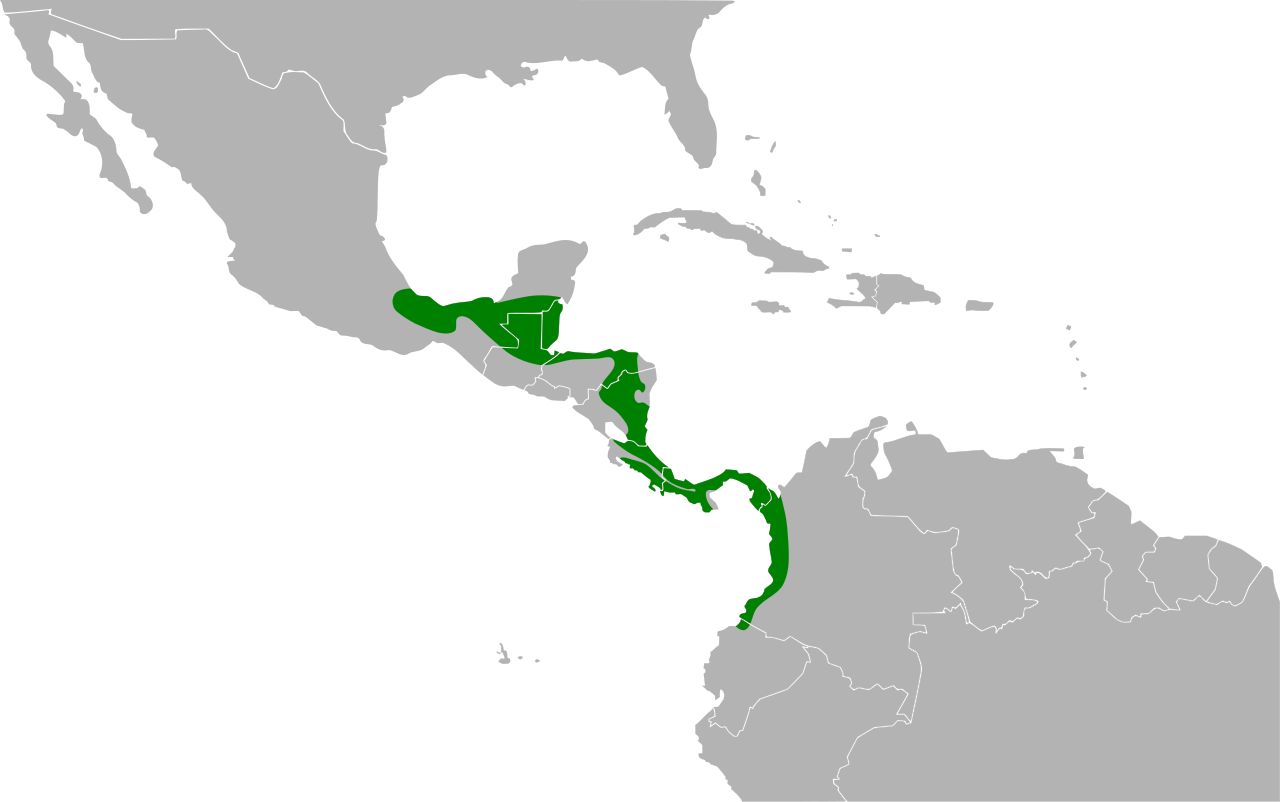
The slaty-tailed trogon is a near passerine bird in the family Trogonidae, the quetzals and trogons. It is found in Mexico, throughout Central America, and in Colombia and Ecuador.
Region
Mesoamerica and northwestern South America
Typical Environment
Occurs from southeastern Mexico through Belize, Guatemala, Honduras, Nicaragua, Costa Rica, and Panama, extending into western Colombia and western Ecuador. Favors humid lowland and foothill evergreen forests, riverine and swamp forests, and tall mature secondary growth. Most often found in the mid- to upper canopy along forest edges, gaps, and shaded plantations. Typically avoids heavily degraded open areas but tolerates older cacao or coffee agroforests near intact forest.
Altitude Range
0–1200 m
Climate Zone
Tropical
Ease of Keeping
Beginner friendly: 1/5
This large trogon sits motionless for long periods, often revealing itself only by a series of low, hollow hoots. Its name refers to the slate-colored tail, and both sexes show a conspicuously thick orange bill and orbital ring. It frequently nests by excavating soft wood or arboreal termitaria, with both parents sharing incubation and care.



Temperament
quiet and unobtrusive
Flight Pattern
short rapid wingbeats with brief glides
Social Behavior
Usually solitary or in pairs, especially during the breeding season. Nests are excavated in rotten wood, soft stumps, or arboreal termitaria; both sexes participate in incubation and feeding the young. Often joins mixed-species flocks peripherally while remaining still on mid-canopy perches.
Migratory Pattern
Resident
Song Description
A series of low, hollow hoots, often spaced evenly and carrying far through humid forest. Calls can be rendered as a rhythmic cow… cow… cow, sometimes accelerating or slightly descending.
Plumage
Male with metallic green head and upperparts, slate-colored tail, and bright red belly; female is brownish-gray above with a paler gray breast and red belly. Both sexes show fine black-and-white barring on the undertail and a thick, short bill. Feathers appear smooth and sleek, with a subtle iridescence on the male’s upperparts.
Diet
Takes a mix of fruits and large arthropods, including beetles, katydids, and caterpillars; occasionally small lizards are taken. Fruits from figs and other canopy trees are important, especially outside peak insect periods. Prey is usually taken by short sallies from a perch or by hovering to pluck fruit.
Preferred Environment
Feeds in the mid- to upper canopy of mature humid forest, along edges, and in old shaded plantations adjacent to forest. Often forages along stream courses and forest gaps where perches offer clear strike paths.


