

The sickle-billed vanga is a species of bird in the vanga family Vangidae. It is monotypic within the genus Falculea. It is endemic to Madagascar. Its natural habitats are tropical dry forests and tropical dry shrubland.
Region
Western and southern Madagascar
Typical Environment
This species occupies dry deciduous forests, spiny thickets, and scrubby woodland, including secondary growth and degraded edges. It is particularly associated with baobab-rich landscapes and semi-open forest mosaics. Birds forage from the understory to the mid-canopy, often along trunks and large branches. It tolerates some habitat disturbance and can persist near villages where mature trees remain.
Altitude Range
Sea level to 800 m
Climate Zone
Tropical
Ease of Keeping
Beginner friendly: 1/5
The sickle-billed vanga is the only member of the genus Falculea and is endemic to Madagascar’s dry forests. Its dramatically long, downcurved bill is specialized for probing into bark, dead wood, and leaf clusters to extract hidden prey. It often travels in noisy family groups and frequently joins mixed-species foraging flocks. The species shows cooperative breeding in some populations, with helpers assisting a breeding pair.

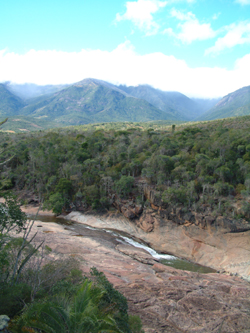
Andohahela National Park is one of many national parks that holds the sickle-billed vanga
Temperament
social and active
Flight Pattern
short rapid wingbeats with bounding glides between trees
Social Behavior
Often moves in small, cohesive groups or family parties, frequently joining mixed-species flocks in dry forests. Nests are placed in trees; both sexes participate in nest building and care. Cooperative breeding can occur, with helpers assisting the primary pair.
Migratory Pattern
Resident
Song Description
Vocalizations are loud, nasal, and chattering, used to keep contact while foraging. Calls include repeated squeaky and grating notes, with excited scolding bursts when groups move or encounter intruders.
Plumage
Striking contrast of largely white head and underparts with dark mantle, wings, and tail; clean, smooth plumage with little streaking. Feathers appear sleek and close-fitting, accentuating the long, decurved bill.
Diet
Primarily takes insects and other arthropods, including beetles, caterpillars, and spiders. The long, curved bill is used to probe under bark, in crevices, and within dead wood for hidden larvae. It will also glean from leaves and branches and occasionally snatch small vertebrates such as lizards. Opportunistic foraging may include taking other invertebrates as available.
Preferred Environment
Feeds along trunks, large branches, and dense leaf clusters in dry deciduous forest and scrub. Often forages at mid-levels but will move from understory to canopy depending on prey. Frequently accompanies mixed flocks to exploit disturbed insects.


