
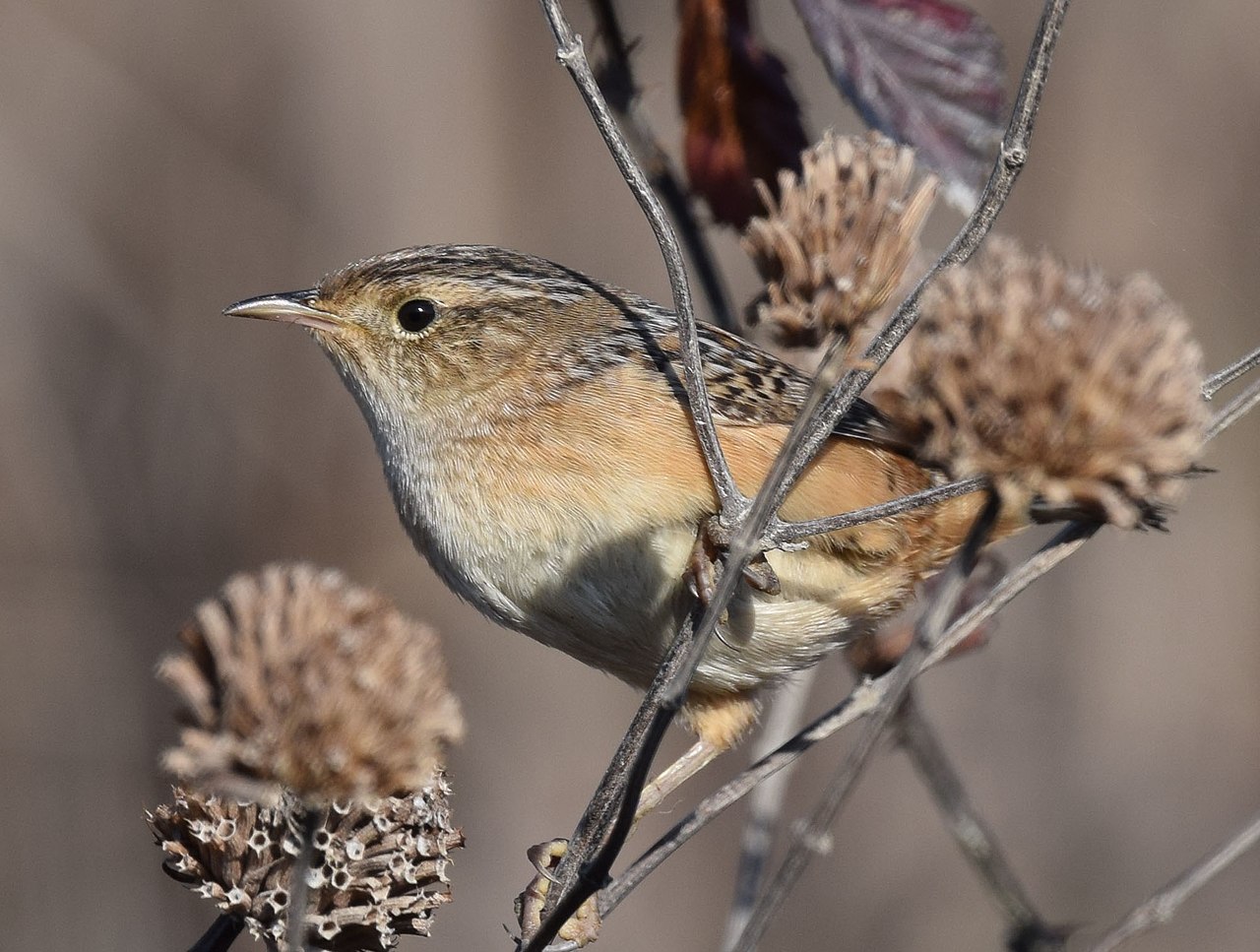
The sedge wren is a small and secretive passerine bird in the family Troglodytidae. It is widely distributed in North America. It is often found in wet grasslands and meadows where it nests in the tall grasses and sedges and feeds on insects. The sedge wren was formerly considered as conspecific with the non-migratory grass wren of central and South America.
Region
North America
Typical Environment
Breeds primarily in the north-central United States and southern Canada in damp prairies, wet meadows, and sedge-dominated marsh edges. During winter it moves to the southeastern U.S. and Gulf Coast, using coastal prairies, fallow fields, and wet pastures. It favors dense, tussocky sedges and grasses with scattered standing water, often avoiding deep, cattail-dominated marshes. Site occupancy is notably irregular and can shift year to year with water levels and mowing regimes.
Altitude Range
Sea level to 1500 m
Climate Zone
Temperate
Ease of Keeping
Beginner friendly: 1/5
The sedge wren is a highly secretive marsh wren that often occupies wet grasslands only briefly, shifting sites with rainfall and vegetation changes. Males build multiple dummy nests within their territory, and females select and line the one they use. Populations can show two breeding peaks in some areas, with late-summer breeding farther north. It was formerly lumped with the non-migratory Grass Wren of Central and South America.


Sedge wren in tall vegetation


A sedge wren signs on a blooming vervain (genus Verbena) in the Kankakee National Wildlife Refuge and Conservation Area in Illinois.
Temperament
secretive and skulking
Flight Pattern
short rapid wingbeats in low, bouncing flights
Social Behavior
Generally solitary or in loose proximity during breeding, with males defending small territories. Males build multiple nests; females select one to line and use. Nests are globular and placed low in dense sedges or grasses above damp ground or shallow water.
Migratory Pattern
Seasonal migrant
Song Description
Song is a dry, insect-like series of trills and chatters, delivered from concealed perches. Calls include sharp tiks and rattles, giving a mechanical quality that blends with the sound of grassland insects.
Plumage
Finely streaked brown upperparts with pale whitish streaks on the crown and back, buffy to whitish underparts with faint barring on the flanks. Short, often-cocked tail and barred wings give a compact, spiky look. Overall appearance is crisp, streaky, and well-camouflaged among sedges.
Diet
Feeds mainly on small insects and other arthropods such as beetles, grasshoppers, caterpillars, spiders, and true bugs. Gleans prey from stems and leaf bases and probes into sedge tussocks. Occasionally takes small seeds, especially outside the breeding season.
Preferred Environment
Forages low in dense sedges, grasses, and rushes at the edges of shallow wetlands and damp meadows. Often stays within cover, moving mouse-like through vegetation and making short sorties to exposed stems.


