
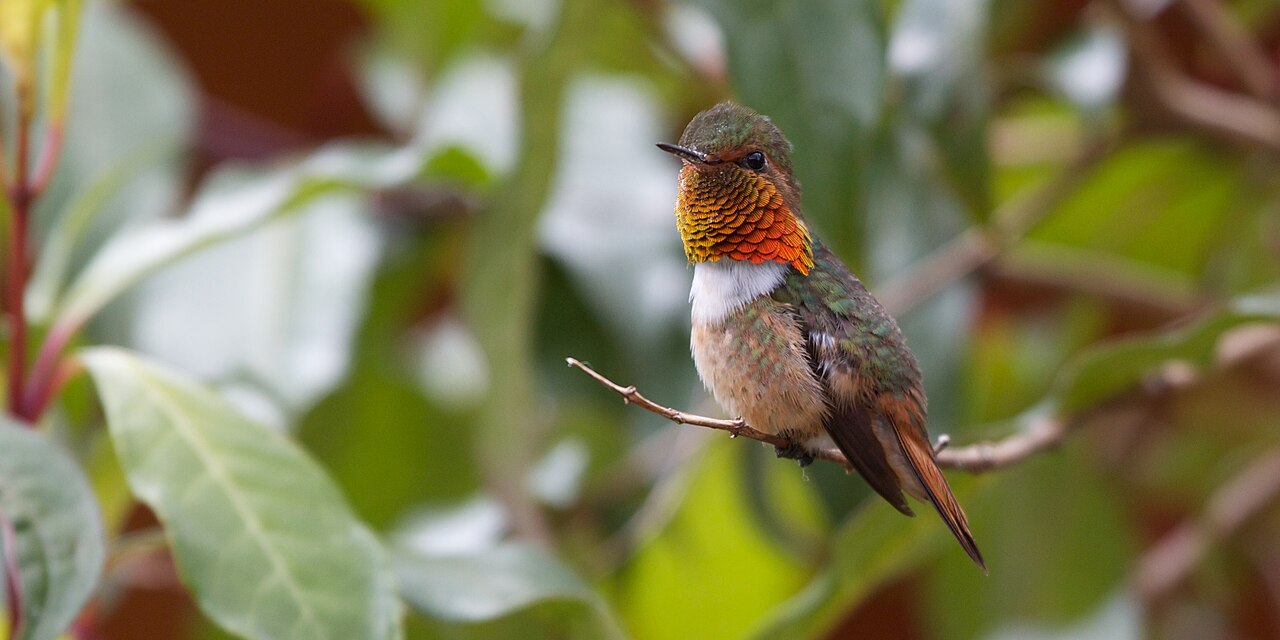
The scintillant hummingbird is a hummingbird endemic to Costa Rica and Panama. This species is replaced at higher elevations by its relative, the volcano hummingbird, S. flammula.
Region
Central America
Typical Environment
Occurs on the slopes and foothills of the Costa Rican and western Panamanian highlands. Favors shrubby edges of montane forests, second growth, semi-open clearings, and flower-rich gardens and shade coffee farms. Often forages along hedgerows and patches of flowering shrubs rather than deep forest interiors. At higher elevations it is replaced by the volcano hummingbird.
Altitude Range
800–2000 m
Climate Zone
Highland
Ease of Keeping
Beginner friendly: 1/5
One of the smallest hummingbirds, the scintillant hummingbird is restricted to middle elevations of Costa Rica and western Panama. Males flash a brilliant coppery-orange gorget that can look dull until it catches the light. It is replaced at higher elevations by the volcano hummingbird (Selasphorus flammula). Highly territorial, it aggressively defends rich flower patches despite its tiny size.


Temperament
territorial and bold
Flight Pattern
rapid hovering and darting with short, whirring wingbeats
Social Behavior
Mostly solitary outside breeding, concentrating around dense flower patches which individuals defend vigorously. Males display to females with aerial chases and flashing gorgets. Nests are tiny cup structures of plant down bound with spider silk, typically placed low to mid-height on sheltered branches. Clutches usually contain two small white eggs.
Migratory Pattern
Resident
Song Description
Vocalizations are thin, high-pitched tseep notes and short, buzzy chips. Males also produce mechanical trills with wings or tail during display flights, adding a faint whirr to the soundscape.
Plumage
Male with iridescent coppery-orange gorget, green upperparts, whitish underparts with rich rufous sides and tail; female lacks the blazing gorget, showing a pale throat with fine spotting, green back, and rufous in the tail. Both sexes are tiny with a compact build and short tail compared to some relatives.
Diet
Primarily nectar from tubular and small flowers, including shrubs, vines, and ornamentals such as salvias. Supplements diet with tiny insects and spiders captured by hawking or gleaning for essential protein. Frequently revisits established feeding circuits and defends rich nectar sources vigorously.
Preferred Environment
Edge habitats and semi-open areas with abundant flowering plants, including gardens, hedgerows, and coffee plantations. Also works along forest margins and sunny clearings where blooms are concentrated.


