

The sarus crane is a large nonmigratory crane found in parts of the Indian subcontinent, Southeast Asia, and northern Australia. The tallest of the flying birds, standing at a height of up to 1.8 m, they are a conspicuous species of open wetlands in South Asia, seasonally flooded Dipterocarpus forests in Southeast Asia, and Eucalyptus-dominated woodlands and grasslands in Australia.
Region
Indian Subcontinent, Mainland Southeast Asia, and Northern Australia
Typical Environment
Prefers open, shallow freshwater wetlands, marshes, and floodplains with emergent vegetation. Frequently uses agricultural landscapes such as rice paddies and fallow fields, especially where water persists through the dry season. In Southeast Asia it occupies seasonally flooded Dipterocarpus forests and adjacent wetlands. In northern Australia it occurs in Eucalyptus woodlands, grasslands, and ephemeral wetlands, shifting locally as water recedes or accumulates.
Altitude Range
Sea level to 1500 m
Climate Zone
Subtropical
Ease of Keeping
Beginner friendly: 2/5
The Sarus Crane is the tallest flying bird, with pairs renowned for elaborate dancing and loud duets that strengthen their lifelong bonds. It nests on raised platforms in shallow wetlands and often benefits from traditional rice agriculture when fields retain water. Though largely nonmigratory, some populations make local seasonal movements in response to water levels. Habitat loss and disturbance remain its main threats.


In flight, the black primaries contrast with the otherwise grey wings (Bharatpur, India)

All cranes have a raised and much reduced hind toe.

Saras Pair

Foraging in marshland (Bharatpur)


feeding juvenile, Lumbini, Nepal

The long, coiled trachea that produces the trumpeting calls

A trumpeting pair

Egg

A pair with young in Velavadar

Age and plumage changes
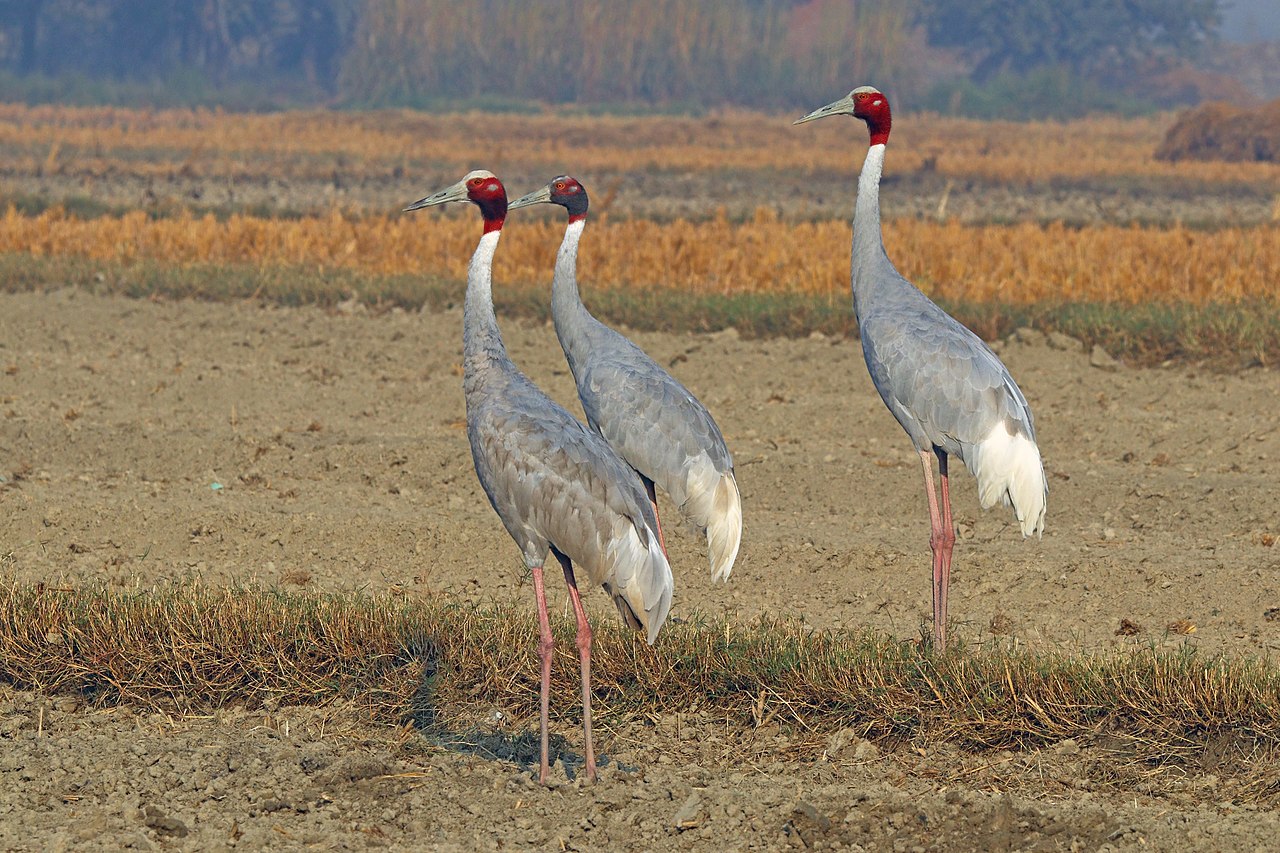
Two adults with a subadult in the middle

The Floating Feather, a painting by Melchior d'Hondecoeter (circa 1680) of the birds in the menagerie of William III of England at the Het Loo Palace showing a sarus crane in the background

A plate by Johann Michael Seligmann published between 1749 and 1776 based on a work by George Edwards
Temperament
solitary and territorial in pairs, social in small flocks outside breeding
Flight Pattern
strong flier with slow, deep wingbeats; soars on thermals
Social Behavior
Pairs are strongly monogamous and perform synchronized dances, leaps, and duets. Nests are built on mounds in shallow water, often in secluded wetlands or flooded fields. After breeding, birds may gather in loose flocks at rich feeding sites, especially where water remains.
Migratory Pattern
Partial migrant
Song Description
Loud, resonant bugling calls that carry over long distances. Pairs often engage in antiphonal duets, with coordinated, trumpet-like notes rising and falling.
Plumage
Smooth, uniform grey body with contrasting bare skin on head and upper neck.
Diet
Eats a mix of plant material and animal prey, including tubers and rhizomes of aquatic plants, grains (such as rice), seeds, and shoots. Also takes insects, snails, crustaceans, frogs, small reptiles, and occasionally fish. Forages by probing soft mud and shallow water, and by gleaning in fields.
Preferred Environment
Feeds in shallow wetlands, marsh edges, wet meadows, and inundated agricultural fields. Will also forage in harvested or fallow rice paddies where residual water and invertebrates are abundant.


