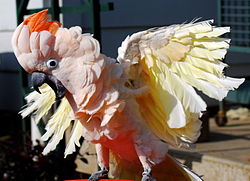
The salmon-crested cockatoo, also known as the Moluccan cockatoo, is a cockatoo endemic to the Seram archipelago in eastern Indonesia. At a height of up to 46–52 cm (1.51–1.71 ft) and weight of up to 850 g (1.87 lb), it is among the largest of the white cockatoos. The female is slightly smaller than the male on average. It has white-pink feathers with a definite peachy glow, a slight yellow on the underwing and underside of the tail feathers and a large retractable recumbent crest, which it raises when threatened, revealing hitherto concealed bright red-orange plumes to frighten potential attackers. It may also be raised in excitement or in other "emotional" displays. Some describe the crest as "flamingo-colored". It also has one of the louder calls in the parrot world and in captivity is a capable mimic.
Region
Maluku Islands, Eastern Indonesia
Typical Environment
Occurs naturally on Seram and adjacent islets within the Seram archipelago. Prefers primary and mature secondary lowland rainforest but also uses selectively logged forest, forest edge, and mixed agroforestry where large trees remain. Roosts and nests in tall emergent trees with deep cavities. Often forages in the mid to upper canopy and sometimes visits cultivated areas to feed.
Altitude Range
Sea level to 1000 m
Climate Zone
Tropical
Ease of Keeping
Beginner friendly: 1/5
Also called the Moluccan cockatoo, it is among the largest white cockatoos and famed for its spectacular salmon-orange crest. It has an exceptionally loud voice and is an adept mimic in captivity. Heavy historical trapping for the pet trade and habitat loss have pressured wild populations. It nests in large tree cavities and depends on intact rainforest structure.


At Kuala Lumpur Bird Park


Temperament
social and intelligent, but can be loud and excitable
Flight Pattern
strong flier with deep wingbeats
Social Behavior
Typically seen in pairs or small family groups, occasionally forming larger flocks at feeding sites or roosts. Monogamous pairs nest in tree cavities lined with wood chips. Breeding coincides with periods of food abundance, and parents share incubation and chick rearing. Communal roosting in tall trees is common outside the breeding season.
Migratory Pattern
Resident
Song Description
Very loud, piercing screeches and wails that carry over long distances, used to maintain contact and advertise territory. Also produces growls and harsh grating calls; in captivity it can mimic human speech and sounds.
Plumage
Powdery white-pink plumage with a peachy salmon flush; slight yellow wash on the underwings and underside of tail. Large retractile crest reveals bright red-orange plumes when raised.
Diet
Feeds on seeds, nuts, fruits, and berries, cracking hard kernels with its powerful bill. Takes buds and nectar when available and may consume insect larvae opportunistically. Will visit cultivated areas to feed on coconuts or other crops. Often manipulates food with the feet while feeding.
Preferred Environment
Forages mainly in the mid to upper canopy of lowland rainforest and along forest edges. Also uses secondary growth and mixed plantations with large remnant trees. Occasionally descends to the ground for fallen fruits or grit.