

Reeves's pheasant is a large pheasant within the genus Syrmaticus. It is endemic to China. It is named after the British naturalist John Reeves, who first introduced live specimens to Europe in 1831.
Region
East Asia
Typical Environment
Endemic to north-central and central China, primarily in mixed and deciduous forests of provinces such as Shaanxi, Gansu, Henan, Hubei, and Anhui. It favors forest edges, scrubby hillsides, and mosaics of secondary woodland and farmland. Birds often use dense understory for cover, moving into open glades and edges to forage. Roosting commonly occurs in trees near steep slopes or thickets. Introduced populations have occurred locally in parts of Europe, but most are now sparse or localized.
Altitude Range
300–2600 m
Climate Zone
Temperate
Ease of Keeping
Beginner friendly: 2/5
Males have the longest natural tail feathers of any wild bird, often exceeding 1.5 m and sometimes approaching 2 m. The species is named after British naturalist John Reeves, who introduced it to Europe in the 19th century. Reeves's pheasants can be notably aggressive, especially males during the breeding season, and require ample space in captivity.


Male

Male
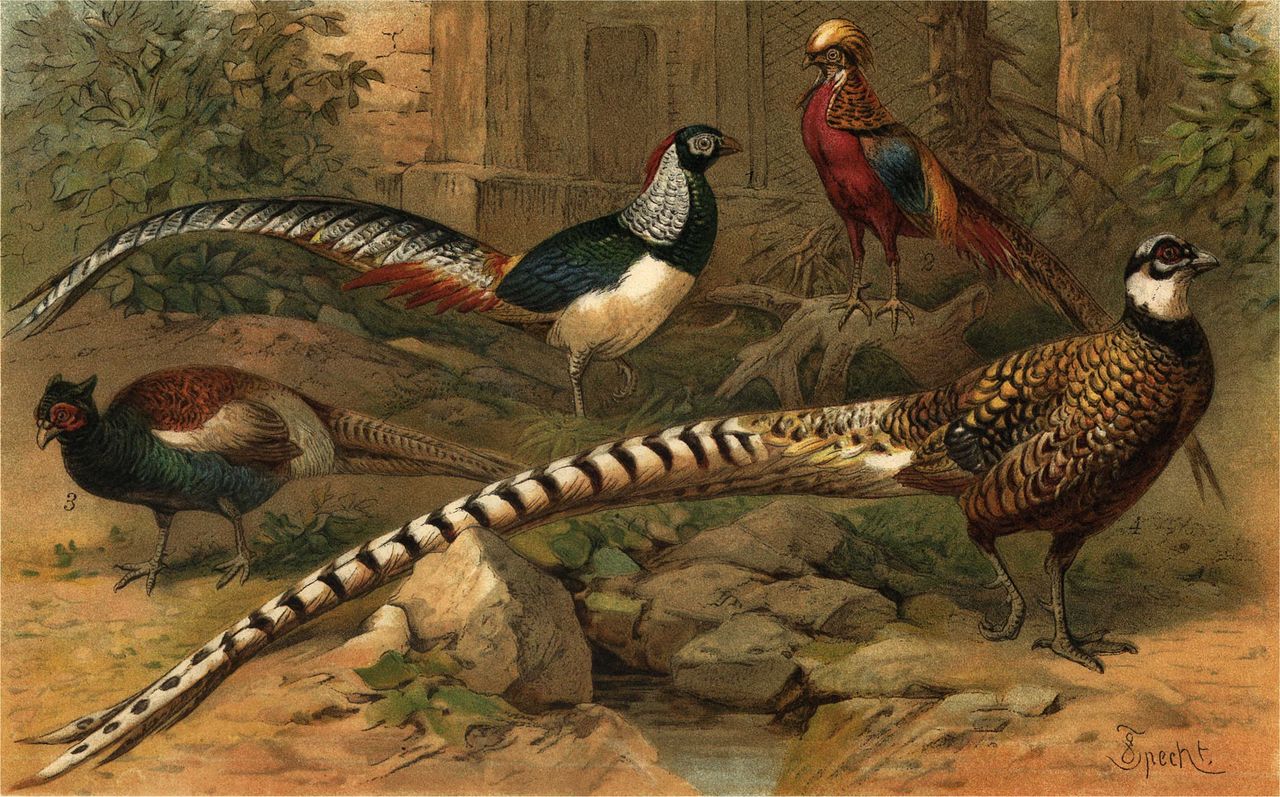
Male Reeves's pheasant, green pheasant, Lady Amherst's pheasant and golden pheasant (front to back).
Temperament
solitary and territorial
Flight Pattern
short rapid wingbeats with explosive takeoff; strong but brief flights to cover or roost
Social Behavior
Outside the breeding season, birds are mostly solitary or in small loose groups. During breeding, males defend territories and may court multiple females. Nests are shallow ground scrapes hidden under dense vegetation, where the female incubates and raises the brood.
Migratory Pattern
Resident
Song Description
Vocalizations include sharp whistles and harsh, cackling calls, especially from males during the breeding season. Alarm calls are abrupt and carrying, often given before an explosive flush into cover.
Plumage
Males show bold golden and white scaly body plumage edged in black, a striking white head with a black facial mask and throat, and an extremely long, barred tail. Females are mottled brown with fine barring and a much shorter tail, providing excellent camouflage.
Diet
Feeds on a mix of seeds, grains, acorns, buds, leaves, and berries, supplemented with insects and other invertebrates. It scratches through leaf litter and soil to uncover bulbs, tubers, and fallen mast. Seasonal availability influences the balance of plant versus animal matter, with more insects taken in spring and summer.
Preferred Environment
Forages mainly on the forest floor along edges, clearings, and lightly disturbed secondary growth. It also uses adjacent farmland margins and scrubby slopes where cover is close at hand.


