

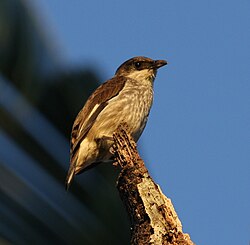
The Polynesian starling is a species of starling of the family Sturnidae. It is found in the Samoan Islands, Fiji, Niue, Tonga, the Santa Cruz Islands and Wallis and Futuna. Its natural habitats are subtropical or tropical dry forests and tropical moist forests. Various subspecies exist throughout this wide range, some darker in coloration and some lighter. Its call is a raspy buzz or rattle. Diet is fruit and insects.
Region
South Pacific
Typical Environment
Occurs across the Samoan Islands, Fiji, Tonga, Niue, the Santa Cruz Islands, and Wallis and Futuna. It uses tropical moist and dry forests, secondary growth, edges, and agroforestry landscapes such as coconut and fruit plantations. The species is often found from coastal lowlands into foothills, frequenting fruiting trees and forest edges. It tolerates moderate habitat disturbance but can decline where extensive deforestation reduces large trees and nesting cavities.
Altitude Range
Sea level to 1200 m
Climate Zone
Tropical
Ease of Keeping
Beginner friendly: 2/5
The Polynesian starling inhabits many South Pacific islands, where it adapts well to both native forests and human-modified habitats like plantations and village gardens. Multiple subspecies vary noticeably in plumage darkness and the amount of underpart streaking. It plays an important ecological role as a seed disperser while also helping control insects. Its voice is a harsh, buzzy rattle interspersed with chatters and squeaks.


Temperament
social and active
Flight Pattern
strong flier with rapid, direct wingbeats
Social Behavior
Usually found in pairs or small groups, especially around fruiting trees. Breeds in tree cavities, including holes in palms and large native trees, and may accept nest sites in modified habitats. Pairs defend nest areas but may forage loosely in small flocks outside the breeding territory.
Migratory Pattern
Resident
Song Description
Vocalizations are a harsh, raspy buzz and rattling chatter, often delivered from a prominent perch. Calls can include metallic squeaks and scolding notes. Song bouts are brief but frequent when birds are active around fruiting trees.
Plumage
Generally dark brown to blackish with a subtle gloss; many forms show paler, faintly streaked underparts. The tail is medium-length and the wings are pointed. Plumage tone and streaking vary among island subspecies.
Diet
Consumes a mix of fruits and invertebrates. Regularly takes figs and other native fruits, as well as cultivated fruits like guava and papaya. Gleans beetles, caterpillars, and other insects from foliage and occasionally hawks for flying insects. Its fruit-eating helps disperse seeds across forest edges and secondary growth.
Preferred Environment
Forages in forest canopies, edges, and clearings, and is common in plantations and village gardens with fruiting trees. Often concentrates where trees are fruiting, moving between patches and along ridges and stream edges.


