

The palila is a critically endangered finch-billed species of Hawaiian honeycreeper. It has a golden-yellow head and breast, with a light belly, gray back, and greenish wings and tail. The bird has a close ecological relationship with the māmane tree, and became endangered due to destruction of the trees and accompanying dry forests. The first specimen of the palila was collected in 1876 at the Greenwell Ranch on the Big Island by Pierre Étienne Théodore Ballieu (1828–1885), who was French consul in Hawaiʻi from 1869 to 1878. The type specimen is housed at the Muséum national d'histoire naturelle in Paris.
Region
Hawaiian Islands
Typical Environment
Today the palila is largely restricted to subalpine dry māmane–naio forests on the upper slopes of Mauna Kea. Historically it also occurred on Mauna Loa and Hualālai, but habitat loss, introduced predators, and disease pushed it into a much smaller range. It favors dense stands of mature māmane where seed pods are abundant and nesting sites are sheltered. The species avoids lower elevations where mosquitoes and avian diseases are more prevalent.
Altitude Range
1800–2900 m
Climate Zone
Highland
Ease of Keeping
Beginner friendly: 1/5
The palila is a finch-billed Hawaiian honeycreeper specialized on the māmane tree, whose toxic seeds it can safely eat thanks to remarkable physiological tolerance to alkaloids. It now survives on the upper slopes of Mauna Kea and has become a flagship for Hawaiian dry-forest restoration. Landmark legal cases (Palila v. DLNR) helped establish habitat protection under the U.S. Endangered Species Act.


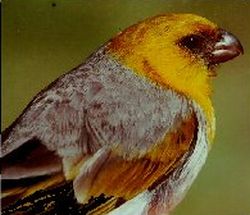
Closeup (probably of an adult female)

Palila
Temperament
social and active
Flight Pattern
short rapid wingbeats
Social Behavior
Outside the breeding season, palila often forage in small groups and loose flocks. Pairs nest in māmane trees, typically building a cup nest and laying a small clutch that both parents tend. They show strong site fidelity to productive māmane patches.
Migratory Pattern
Resident
Song Description
The song is a series of clear, sweet whistles and chirps, often delivered from high perches in māmane. Calls include sharp metallic chips used to maintain contact in the canopy.
Plumage
Golden-yellow head and breast with a pale whitish belly, gray back, and greenish wings and tail; dense, smooth plumage with a clean, contrasting look.
Diet
Palila feed primarily on the seeds of the māmane tree, prying open pods with their stout bills and extracting the kernels. They also consume māmane flower buds and young leaves, and occasionally take naio fruits. Insect larvae found in pods and other small invertebrates supplement their largely plant-based diet.
Preferred Environment
They forage high in the canopy of mature māmane, moving methodically among branches and pods. Birds sometimes descend to mid-canopy or edges where pods are most abundant.


