

The Palawan fairy-bluebird is a species of bird in the family Irenidae. It is native to Balabac Island, Palawan and the Calamian Islands in the Philippines. Its natural habitats are tropical moist lowland forest and it is declining due to habitat destruction and deforestation.
Region
Western Philippines (Palawan, Balabac, and the Calamian Islands)
Typical Environment
Occurs in primary and mature secondary tropical moist lowland forests, favoring the canopy and subcanopy. It frequents forest edges and clearings when fruiting trees are abundant, but is most regular in interior forest. The species is closely tied to fruit resources, especially figs, and moves locally to track crops. Habitat fragmentation and logging reduce suitable continuous canopy it prefers.
Altitude Range
Sea level to 800 m
Climate Zone
Tropical
Ease of Keeping
Beginner friendly: 1/5
The Palawan fairy-bluebird is a canopy-dwelling frugivore that plays an important role as a seed disperser in lowland forests. Males are strikingly black-and-electric blue with crimson eyes, while females are duller blue-green. It is confined to Palawan and nearby islands, where forest loss is the main threat. It often joins mixed-species flocks around fruiting trees.


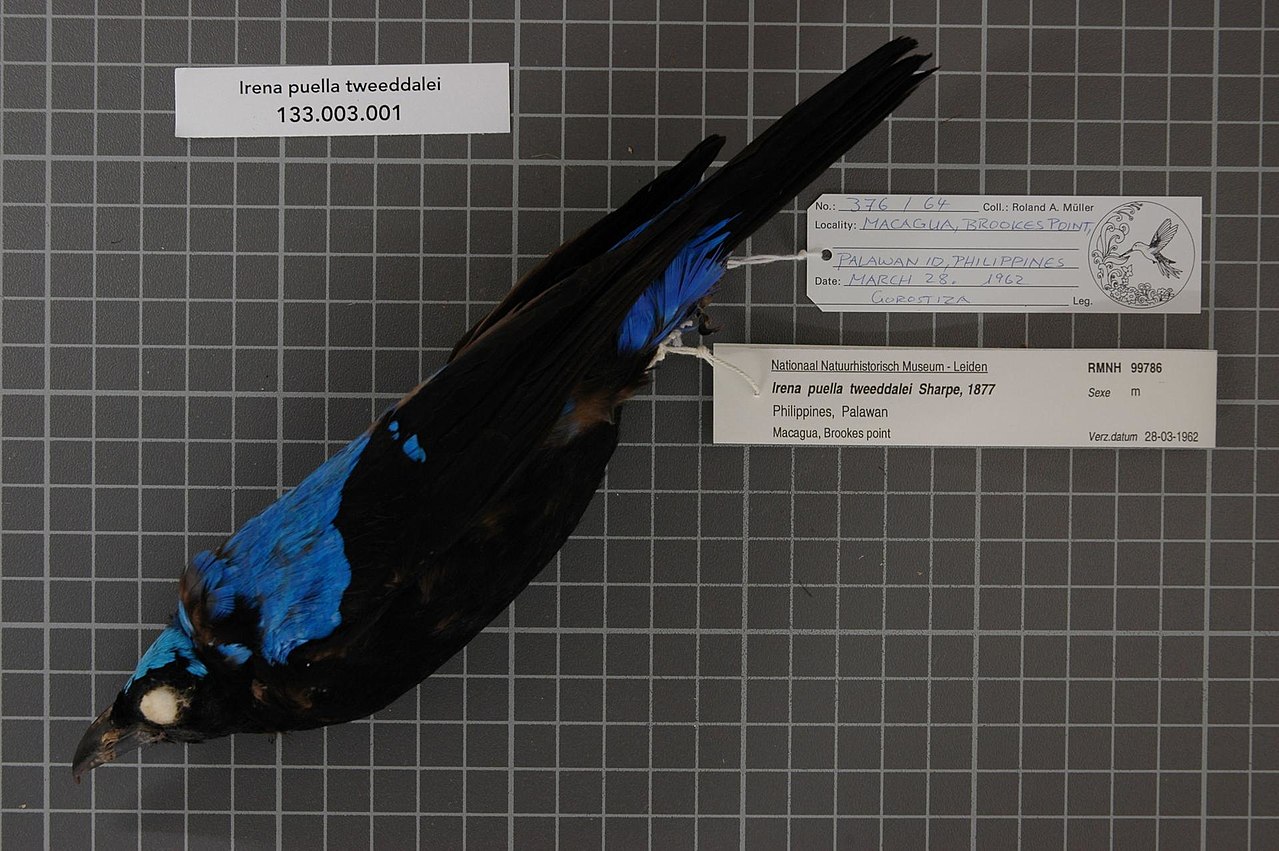
Preserved male specimen at Naturalis Biodiversity Center
Temperament
wary and canopy-oriented, but can be confiding at fruiting trees
Flight Pattern
strong, direct flight between treetops with short glides
Social Behavior
Usually seen in pairs or small family groups and often joins mixed-species flocks around fruiting trees. Presumed monogamous, building a neat cup nest placed high in trees. Both parents likely participate in feeding the young.
Migratory Pattern
Resident
Song Description
Vocalizations are mellow, fluty whistles interspersed with soft, liquid notes. Calls include clearer contact whistles and occasional harsher chacks when alarmed.
Plumage
Male glossy black on head, breast, and belly with vivid electric-blue mantle, scapulars, and rump; wings show blue panels. Female is duller blue-green above with greyer underparts and less contrast overall. Both sexes have smooth, sleek plumage suited to canopy life.
Diet
Primarily feeds on fruits and berries, especially figs (Ficus), swallowing small fruits whole and dispersing seeds. Supplements its diet with nectar and occasional insects gleaned from foliage. It forages methodically through the canopy, often pausing to sally to nearby fruit clusters.
Preferred Environment
Mostly forages in the canopy and subcanopy of intact lowland forest, particularly at fruiting trees. It also visits forest edges and semi-open areas when fruit is abundant. Mixed-species flocks and fruiting fig trees are typical feeding venues.


