

The painted spurfowl is a bird of the pheasant family found in rocky hill and scrub forests mainly in peninsular India. Males are more brightly coloured and spotted boldly in white. Males have two to four spurs while females can have one or two of the spurs on their tarsus. The species is found mainly in rocky and scrub forest habitats unlike the red spurfowl. It is found in the undergrowth in pairs or small groups, escaping by running and rarely taking to the wing when flushed.
Region
Peninsular India
Typical Environment
Occurs patchily across rocky hill tracts, boulder-strewn slopes, and dry deciduous and thorn scrub forests. It favors broken terrain with dense undergrowth, thickets along hill streams, and scrubby edges of cultivation. Birds keep close to cover and use rocky outcrops for loafing and vantage. In many areas it overlaps with dry forest mosaics and degraded scrub, provided there is sufficient ground cover and water nearby.
Altitude Range
100–1500 m
Climate Zone
Tropical
Ease of Keeping
Beginner friendly: 2/5
A ground-dwelling member of the pheasant family, the painted spurfowl prefers to run through rocky scrub rather than take to the wing, flushing only when pressed. Males carry two to four sharp tarsal spurs used in dominance disputes, while females usually have one or two. Pairs or small family groups keep to dense cover and are most active at dawn and dusk.


Painted Spurfowl (Galloperdix lunulata). Daroji Sloth bear sanctuary, India
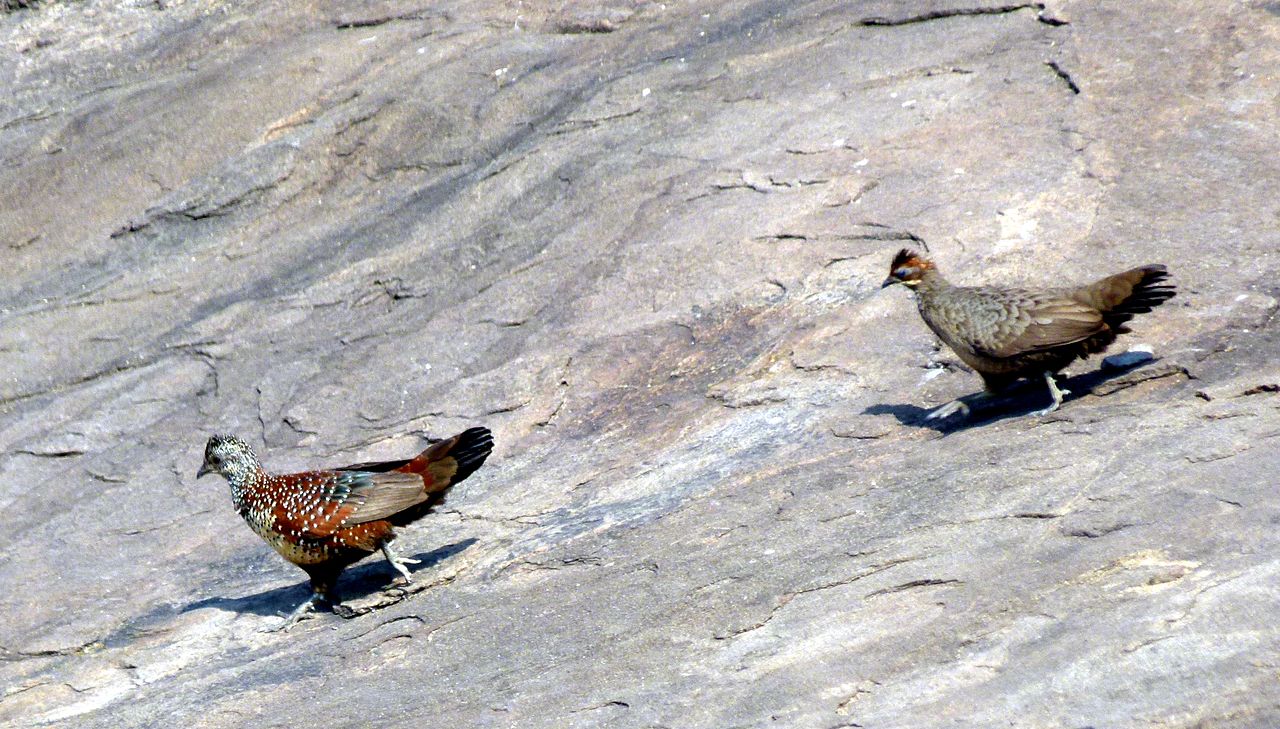
Male and female
Temperament
shy and wary
Flight Pattern
short rapid wingbeats
Social Behavior
Usually found in pairs or small coveys that keep tight contact while moving through cover. Nests are simple ground scrapes placed under bushes or rocks. Breeding coincides with the pre-monsoon to monsoon period in much of its range, and family groups remain together while chicks are precocial and follow adults.
Migratory Pattern
Resident
Song Description
The call is a loud, rapid series of cackles and chuckles, often delivered from a rock or low perch at dawn and dusk. Contact calls are softer clucks used to keep the group together in thick cover.
Plumage
Male shows richly rufous-chestnut body densely patterned with bold white, black-edged spots giving a 'painted' look; female is browner with finer spotting and barring. Both sexes have short, rounded wings and a short barred tail.
Diet
Scratches in leaf litter and soil for a mix of fallen seeds, grains, berries, tender shoots, and tubers. It supplements plant matter with insects such as ants, termites, beetles, and other small invertebrates, especially during the breeding season. Foraging often involves systematic probing around rocks and at the base of shrubs.
Preferred Environment
Feeds along scrubby hillsides, rocky gullies, and the edges of dry deciduous forest where cover is close at hand. It also uses field margins and lightly grazed scrub near villages when disturbance is low.


