

The osprey, historically known as sea hawk, river hawk, and fish hawk, is a diurnal, fish-eating bird of prey with a cosmopolitan range. It is a large raptor, reaching more than 60 cm (24 in) in length and a wingspan of 180 cm (71 in). It is brown on the upperparts and predominantly greyish on the head and underparts.
Region
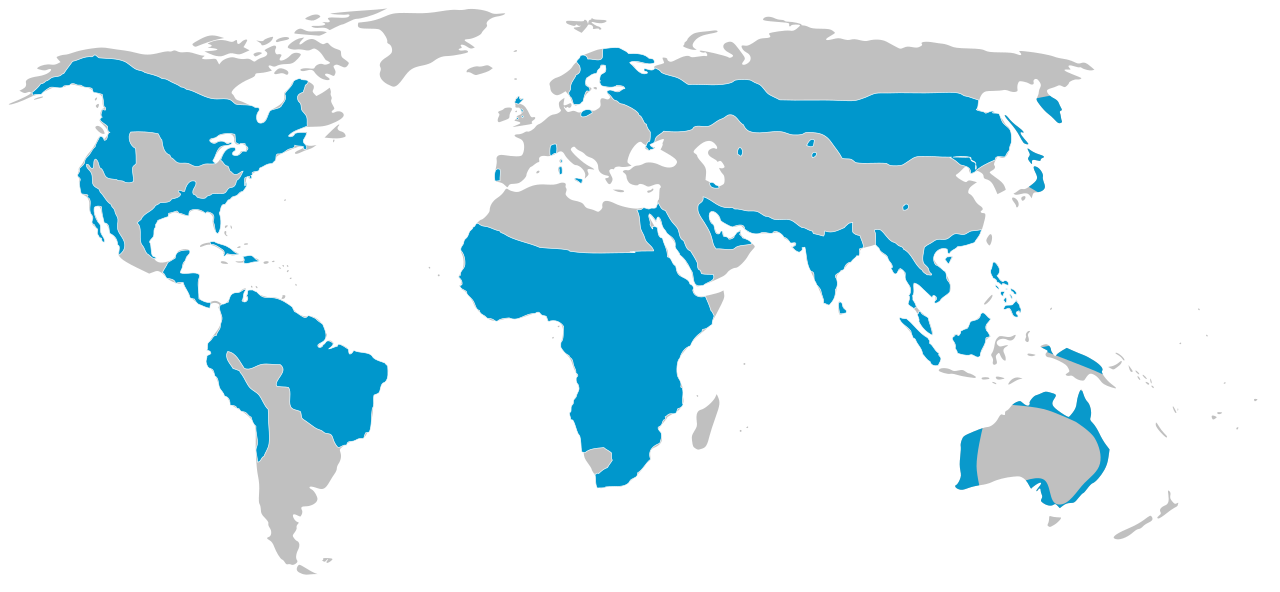
Global (cosmopolitan)
Typical Environment
Found on all continents except Antarctica, the osprey occurs anywhere with adequate fish populations and open water. It frequents coastlines, estuaries, large rivers, lakes, reservoirs, and wetlands. Nests are placed on tall structures such as dead trees, cliffs, utility poles, and purpose‑built platforms. It avoids dense forest interiors and arid areas far from water, but will use human‑modified landscapes if foraging is good.
Altitude Range
Sea level to 2000 m
Climate Zone
Other
Ease of Keeping
Beginner friendly: 1/5
The osprey is the only species in the family Pandionidae and is specialized almost entirely on catching fish. It has a reversible outer toe and spiny pads on its feet that help grip slippery prey, and it often carries fish head‑first to reduce drag. Ospreys readily use artificial nesting platforms, a conservation tool that has aided their recovery in many regions.



Eurasian osprey in flight, Northern Territory, Australia


American osprey pursued by a bald eagle attempting to steal a fish it caught; in Colorado


American ospreys preparing to mate on the nest

Eurasian osprey standing next to its nest showing their relative sizes

American osprey standing on its nest


Adult American ospreys on a man-made nest in New Jersey, US


Temperament
solitary and territorial
Flight Pattern
strong flier with hovering before plunge-dives
Social Behavior
Ospreys are generally solitary breeders but may nest in loose colonies where nesting sites and food are abundant. Pairs often re‑use and add to large stick nests year after year. Both sexes defend the nest area, and the male provides much of the fish during incubation and early chick rearing.
Migratory Pattern
Partial migrant
Song Description
Calls are high‑pitched, whistled cheeps and chirps, often given in rapid series near the nest. Alarm calls become sharper and more insistent when intruders approach. Vocal activity increases during courtship and when begging for food.
Plumage
Dark brown upperparts with contrasting white underparts and a variable dusky breast band; head largely white with a bold dark eye stripe. Long, narrow wings show a kink at the wrist, giving an M‑shaped silhouette in flight; tail and flight feathers are barred.
Diet
Almost exclusively fish, which it captures by hovering and then diving feet‑first into the water. The reversible outer toe and sharp spicules on the soles aid in seizing and holding prey. It often shakes off water after takeoff and aligns fish head‑first for aerodynamic flight. Occasional non‑fish prey is rare and opportunistic.
Preferred Environment
Hunts over shallow, clear waters of lakes, rivers, estuaries, and coastal lagoons. Frequently forages from perches with good visibility or by circling and hovering over open water.


