

The New Zealand rock wren is a small New Zealand wren endemic to the South Island of New Zealand. Its Māori names include pīwauwau, mātuitui, and tuke. Outside New Zealand it is sometimes known as the rockwren to distinguish it from the unrelated rock wren of North America.
Region
Southern Alps (South Island, New Zealand)
Typical Environment
Occurs in alpine and subalpine zones above the treeline, favoring boulder fields, rock outcrops, scree slopes, and cushion-plant herbfields. It uses rock crevices and dense alpine vegetation for cover and nesting. During winter it may shift slightly downslope to wind-sheltered faces and gullies but remains in rugged terrain. The species is patchily distributed where predator pressure is low and suitable rock habitat is continuous.
Altitude Range
900–2500 m
Climate Zone
Highland
Ease of Keeping
Beginner friendly: 1/5
The New Zealand rock wren is one of only two surviving members of the ancient New Zealand wren family (Acanthisittidae). It is a tiny alpine specialist that mostly hops and flutters short distances, rarely flying far. Nests are domed structures tucked into rock crevices, well insulated against cold mountain weather. Predation by introduced mammals is a key threat, and conservation programs target predator control in alpine zones.


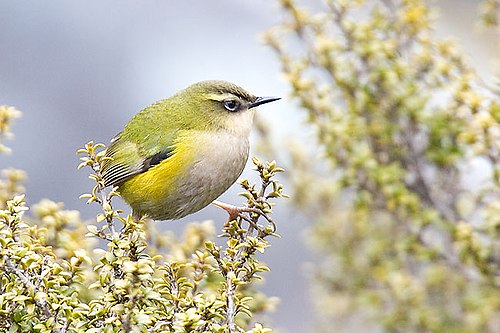
Xenicus gilviventris, showing distinctive green, yellow, and grey colouring.

Rock wren nest

Rock wren in its preferred habitat
Temperament
secretive but active
Flight Pattern
short rapid wingbeats with weak, fluttering flights between rocks
Social Behavior
Typically seen singly or in pairs, maintaining territories year-round. Pairs build domed nests of moss and grass in rock cavities; the female incubates while the male assists with provisioning. Broods are small, and both parents feed nestlings. They spend much of the day hopping and gleaning among boulders, rarely perching high.
Migratory Pattern
Resident
Song Description
High, thin, tinkling notes delivered in short phrases, often a delicate series of see-see or titters. Calls are sharp, high-pitched chips used for contact between mates and alarm.
Plumage
Olive-green to brownish upperparts with a greyer head and pale buff to yellowish underparts; soft, plain plumage with minimal streaking. Very short tail often held cocked and long legs adapted for hopping among rocks.
Diet
Primarily feeds on alpine invertebrates including insects, spiders, and other small arthropods. Gleans prey from rock crevices, moss mats, and low alpine shrubs. Will probe among cushion plants and under stones, occasionally making short sallies to snatch moving prey. Diet varies seasonally with invertebrate availability.
Preferred Environment
Forages on the ground and within rock piles, among scree edges, and in low, dense alpine vegetation. Seeks sun-warmed rock faces and sheltered pockets during cold or windy conditions.


