
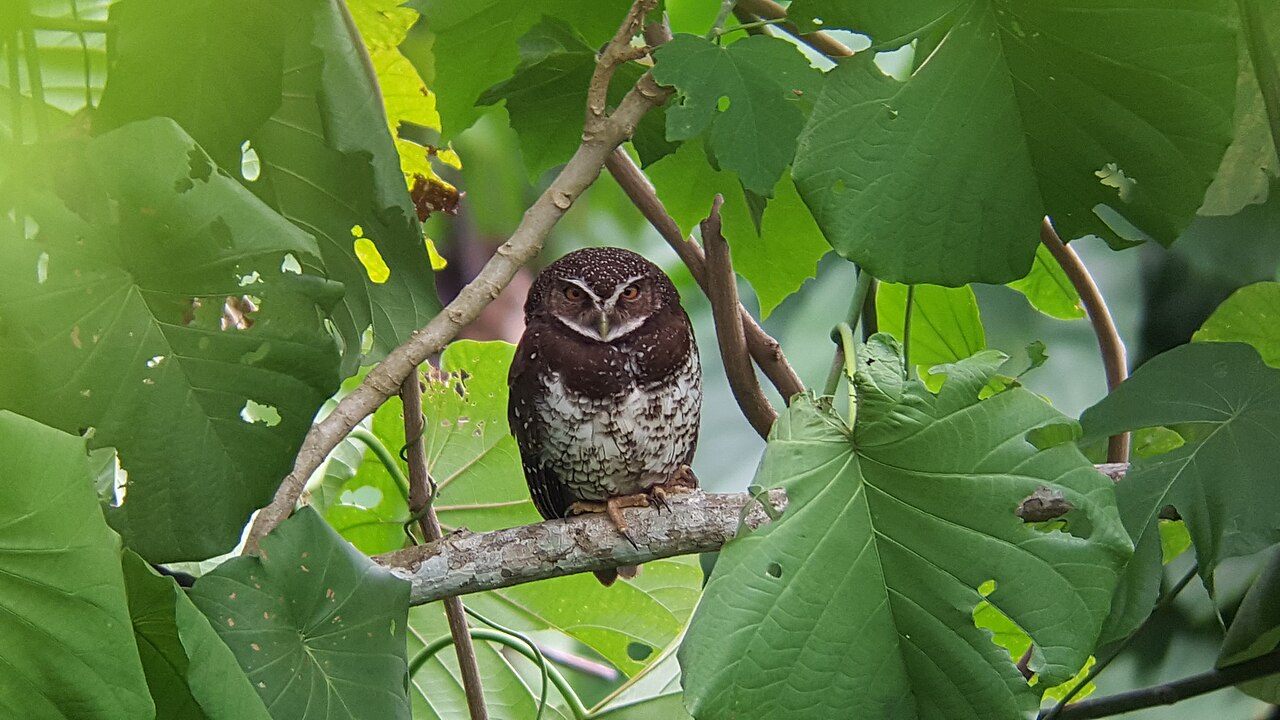
The New Britain boobook, also known as the spangled boobook, russet boobook, New Britain hawk-owl or russet hawk-owl, is a small owl that is endemic to New Britain, the largest island in the Bismarck Archipelago in Papua New Guinea.
Region
Bismarck Archipelago
Typical Environment
Occurs across New Britain in lowland and foothill forests, including primary rainforest and well-developed secondary growth. Frequently hunts along forest edges, riverine corridors, gardens, and cocoa or oil palm mosaics where trees remain. It roosts by day in dense foliage or vine tangles and becomes active at dusk. The species tolerates some habitat modification but depends on wooded areas for nesting cavities and cover.
Altitude Range
Sea level to 1200 m
Climate Zone
Tropical
Ease of Keeping
Beginner friendly: 1/5
Also called the spangled or russet boobook, this small hawk-owl is confined to New Britain in Papua New Guinea. It is a nocturnal forest hunter that often adapts to edges and secondary growth. Pairs are territorial and nest in natural tree cavities. Its repeated boo-book style notes carry through lowland forests at night.

Temperament
solitary and territorial
Flight Pattern
short rapid wingbeats with agile, low flights through forest gaps
Social Behavior
Typically encountered singly or in pairs, especially during the breeding season when pairs defend territories. Nests in natural tree cavities or old holes, laying a small clutch and relying on dense cover nearby. The male often provisions the incubating female and later the young with prey deliveries at night.
Migratory Pattern
Resident
Song Description
A repeated two-note boo-book or hoo-hoo call, often delivered in steady series at dusk and during the night. Also gives trills and sharper whistles when agitated or during pair communication.
Plumage
Rich russet-brown to chocolate-brown with fine pale spotting and speckling that gives a ‘spangled’ appearance; underparts paler with buffy streaking and bars. Facial disk is subtle, with a slightly paler brow and lores. Scapulars often show small white spots that form broken lines on the back.
Diet
Primarily hunts large insects such as beetles, moths, and orthopterans. Also takes small vertebrates including frogs, lizards, and occasionally small rodents or birds. Prey is usually detected from a perch and seized in short sallies or drops to the ground or low branches. It swallows smaller prey whole and dismembers larger items.
Preferred Environment
Forages along forest edges, clearings, and lightly disturbed secondary growth where perches and open sightlines are available. Frequently hunts near streams, tracks, and around village gardens adjacent to forest.


