
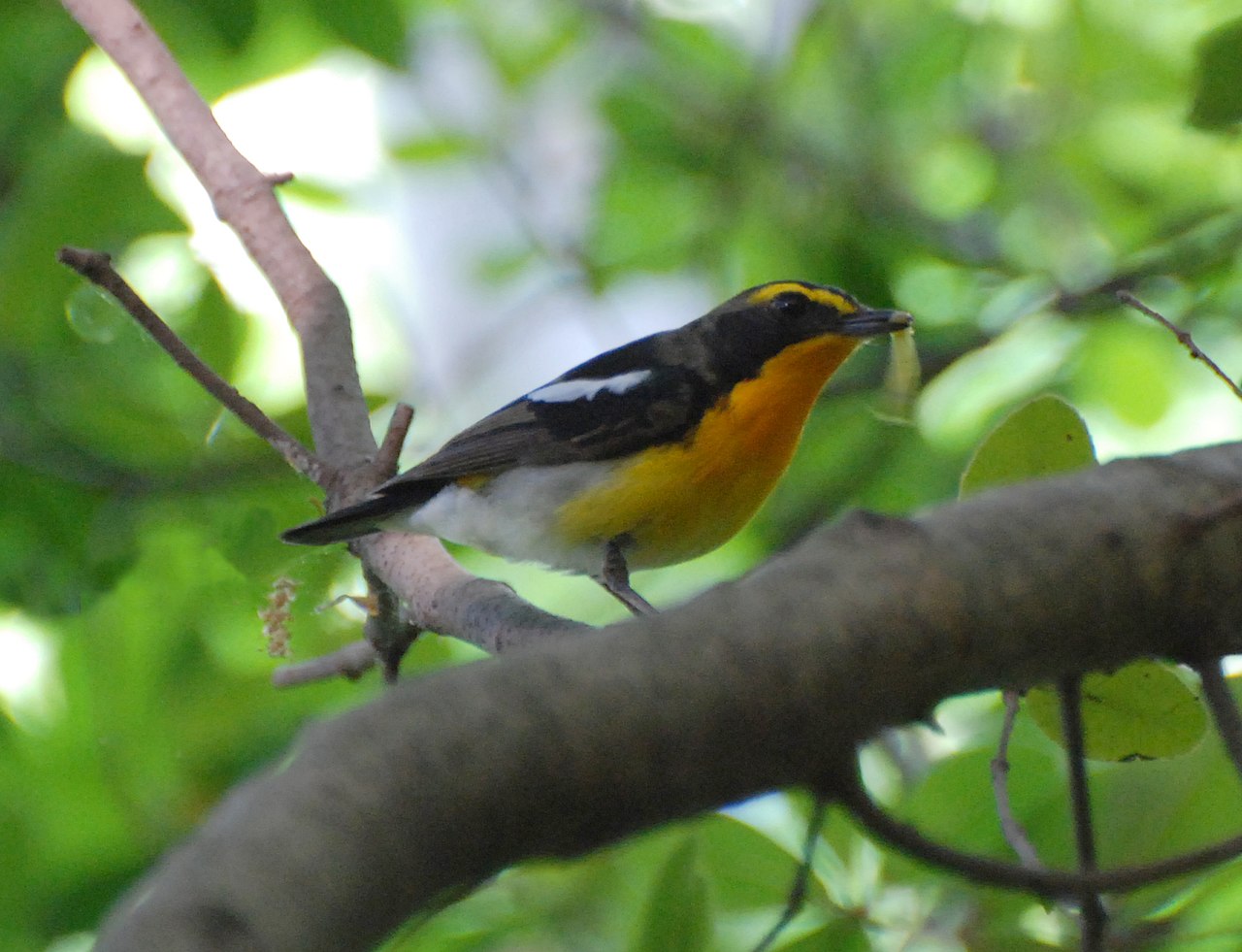
The narcissus flycatcher is a passerine bird in the Old World flycatcher family. It is native to the East Palearctic, from Sakhalin to the north, through Japan across through Korea, mainland China, and Taiwan, wintering in southeast Asia, including the Philippines, Vietnam and Borneo. It is highly migratory, and has been found as a vagrant from Australia in the south to Alaska in the north Archived 2006-01-10 at the Wayback Machine.
Region
East Asia and Southeast Asia
Typical Environment
Breeds in mature deciduous and mixed forests across Japan and parts of Korea, northeast China, and the Russian Far East. Outside the breeding season it winters in lowland to foothill forests of Southeast Asia, including the Philippines, Borneo, and Indochina. Prefers forest interiors, shaded ravines, and edges with dense understory, but also uses secondary growth and wooded parks on migration. During passage it can appear in coastal thickets and urban green spaces. It forages mostly in the mid to upper canopy.
Altitude Range
0–1800 m
Climate Zone
Other
Ease of Keeping
Beginner friendly: 1/5
Males are striking with velvety black upperparts, a vivid yellow throat and supercilium, and a white wing patch, while females are olive-brown and much subtler. It breeds mainly in temperate East Asian forests and winters in tropical Southeast Asia, and is an occasional vagrant as far as Alaska and northern Australia. It readily uses natural cavities and nest boxes where available.


Temperament
shy and active
Flight Pattern
short rapid wingbeats
Social Behavior
Generally solitary or in pairs during breeding, with males holding well-defined territories and singing from elevated perches. Nests in natural tree cavities or nest boxes, lining them with soft plant material; typical clutches are 4–6 eggs. Outside breeding, may join mixed-species foraging flocks in forest canopies.
Migratory Pattern
Seasonal migrant
Song Description
Male song is a rich, clear series of whistled phrases with sweet, descending notes that carry through the forest. Calls include sharp tik or tack notes and soft chips during foraging.
Plumage
Male with black upperparts, bright yellow supercilium and throat to breast, white wing patch, and yellowish rump; female olive-brown above with pale buff underparts and faint whitish wing bars. First-winter males show intermediate patterns. Clean, crisp contrasts on males are distinctive.
Diet
Primarily hunts flying and arboreal insects such as flies, beetles, moths, and caterpillars, sallying from exposed perches and gleaning from foliage. Will take spiders and other small arthropods. During migration and on wintering grounds it occasionally supplements with small berries and other soft fruits.
Preferred Environment
Feeds mainly in the mid to upper canopy of mature forests, along forest edges, and over shaded streams. On passage it also forages in secondary growth, wooded parks, and gardens with tall trees.


