

The mute swan is a species of swan and a member of the waterfowl family Anatidae. It is native to much of Eurasia and the far north of Africa. It is an introduced species in North America, home to the largest populations outside of its native range, with additional smaller introductions in Australasia and Southern Africa. The name "mute" derives from it being less vocal than other swan species. Measuring 125 to 160 cm in length, this large swan is wholly white in plumage, with an orange beak bordered with black. It is recognisable by its pronounced knob atop the beak, which is larger in males.
Region
Europe and temperate Asia; introduced in North America and Australasia
Typical Environment
Mute swans inhabit shallow freshwater lakes, ponds, slow-flowing rivers, and marshes with abundant submerged and emergent vegetation. They also use brackish coastal lagoons and estuaries, especially outside the breeding season. They favor eutrophic waters with rich macrophyte growth and open shorelines for grazing. In winter, they gather on large, ice-free water bodies and sheltered coasts. In many urban and suburban areas they thrive in parks and ornamental lakes.
Altitude Range
Sea level to 2000 m
Climate Zone
Temperate
Ease of Keeping
Beginner friendly: 2/5
Despite the name, mute swans are not silent; they hiss, grunt, and produce a distinctive whooshing from their wings in flight. Adults are snowy white with an orange bill and a prominent black basal knob, which is larger in males. Pairs are strongly territorial in the breeding season and often mate for life. Juveniles (cygnets) are grey-brown and gradually molt to white in their first year.


Mute swan pair with their five cygnets gliding across a lake in Romania

Two mute swan cygnets a few weeks old; the cygnet on the right is of the "Polish swan" colour morph, expressing the recessive gene responsible for leucism.

Nest in Drilon National Park, Pogradec, Albania; the cob (male) is patrolling the area close to the nest to protect his mate.

Courtship, in Switzerland

Mating, in Henan, China

Nesting in spring, Cologne, Germany

A female mute swan carrying three cygnets between its wings


An older mute swan cygnet in Haut-Rhin, France, showing developing adult plumage and developed flight feathers on wings
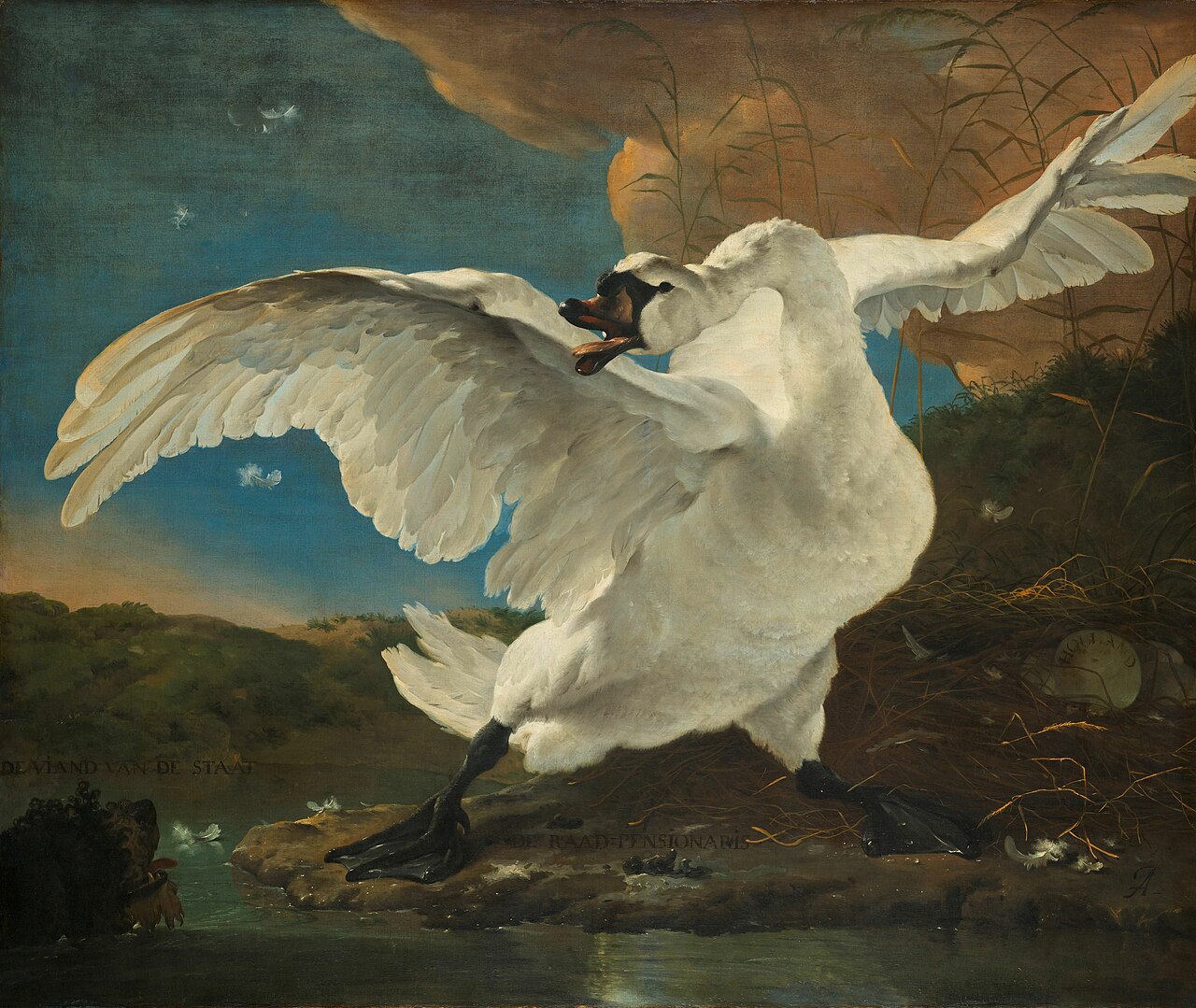
The Threatened Swan (c. 1650) by Jan Asselijn
Temperament
territorial and defensive
Flight Pattern
powerful flier with strong wingbeats and audible wing whoosh; heavy takeoff, neck outstretched
Social Behavior
Pairs are largely monogamous and defend breeding territories vigorously. Nests are large mounds of vegetation near water, often on islands or in reedbeds. Outside the breeding season, they form family groups and larger flocks on suitable water bodies.
Migratory Pattern
Partial migrant
Song Description
Generally quiet, they communicate with hisses, grunts, and snorts, especially when threatened. Wingbeats produce a loud rhythmic whooshing in flight that carries over long distances.
Plumage
Wholly white, dense plumage with a long S-curved neck; juveniles are grey-brown and paler below.
Diet
Primarily consumes aquatic vegetation, including submerged macrophytes, algae, and pondweeds, which it reaches by upending and sweeping its long neck underwater. It also grazes on shoreline grasses and agricultural fields near water. Small invertebrates and mollusks may be ingested incidentally, especially by cygnets.
Preferred Environment
Feeds in shallow, vegetated freshwater bodies, backwaters, and quiet river margins. Also forages in brackish lagoons and on adjacent lawns or pasture. Often exploits human-made ponds and park lakes where plants are abundant.


