

The marsh wren is a small North American songbird of the wren family. It was formerly called the long-billed marsh wren to distinguish it from the sedge wren, then known as the short-billed marsh wren.
Region
North America
Typical Environment
Found widely in freshwater and brackish marshes across Canada, the United States, and into northern Mexico. Prefers dense stands of cattail, bulrush, and reed where stems emerge from standing water. Occurs in coastal saltmarshes, inland prairie potholes, and riverine wetlands. During winter, it frequents tidal marshes and sheltered reedbeds in milder regions. Requires thick emergent vegetation for nesting and cover and generally avoids open water or sparsely vegetated shorelines.
Altitude Range
Sea level to 2500 m
Climate Zone
Temperate
Ease of Keeping
Beginner friendly: 1/5
Marsh wrens weave enclosed, globular nests with side entrances, anchoring them to cattails and reeds. Males often build multiple dummy nests and may be polygynous. They are fiercely territorial and have been observed puncturing the eggs of rivals. Their bubbly, mechanical song carries surprisingly far across dense marsh vegetation.


Singing in a marsh at Hammonasset Beach, Connecticut

Cap Tourmente National Wildlife Area, Quebec, Canada
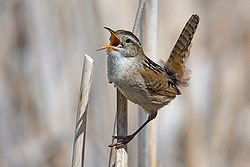
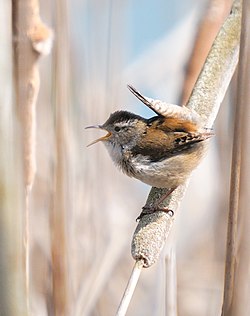


Temperament
secretive and highly territorial
Flight Pattern
short rapid wingbeats; low, darting flights over reeds
Social Behavior
Males defend small territories within dense marsh vegetation and often maintain several nests, some used for mating displays or roosting. Polygyny is common, and pairs place nests a short distance above water, woven to vertical stems. They can be aggressive toward neighboring wrens and sometimes destroy rivals’ eggs.
Migratory Pattern
Partial migrant
Song Description
A loud, bubbly series of rattles, gurgles, and trills delivered in rapid bursts. Males sing persistently from exposed perches, especially at dawn and dusk, and may continue at night during peak breeding activity.
Plumage
Reddish-brown upperparts with a blackish back panel streaked with narrow white lines; underparts whitish with warm buffy flanks. Tail is short and often cocked, showing fine dark barring. Feathers are compact and sleek, aiding movement through dense reeds.
Diet
Primarily consumes insects and spiders, including beetles, flies, caterpillars, and various larvae. It gleans prey from stems and leaf bases and probes into crevices among cattails and reeds. Occasionally takes small snails or seeds, especially in winter when insects are scarce.
Preferred Environment
Feeds within dense emergent vegetation, often low to the waterline on cattail, bulrush, and reed stems. Forages along muddy edges, among floating vegetation mats, and inside thick reedbeds where cover is close at hand.


