

The Madagascar pochard or Madagascan pochard is an extremely rare diving duck of the genus Aythya. Thought to be extinct in the late 1990s, specimens of the species were rediscovered at Lake Matsaborimena near Bemanevika in Madagascar in 2006. By 2017, a captive breeding program had produced a population of around 90 individuals. The birds were reintroduced to the wild in December 2018.
Region
Northern and central highlands of Madagascar
Typical Environment
Now restricted to a few highland crater and freshwater lakes, notably around Bemanevika and reintroduction sites such as Lake Sofia. Historically it occurred on larger lakes including Lake Alaotra, but habitat degradation and introduced fish led to collapse. It favors clear, deep, low-disturbance waters with extensive emergent vegetation for nesting and cover. Birds dive in open water and forage along vegetated margins. Human disturbance, siltation, and invasive species strongly limit suitable habitat.
Altitude Range
700–1700 m
Climate Zone
Highland
Ease of Keeping
Beginner friendly: 1/5
The Madagascar pochard is a diving duck once thought extinct until a small population was rediscovered in 2006 at Lake Matsaborimena near Bemanevika. Intensive conservation, including captive breeding and head-starting ducklings, has grown numbers from a handful of birds to a managed population. Reintroductions to Lake Sofia began in 2018 using floating aviaries and habitat restoration. It remains one of the world’s rarest ducks and a flagship for wetland recovery in Madagascar.


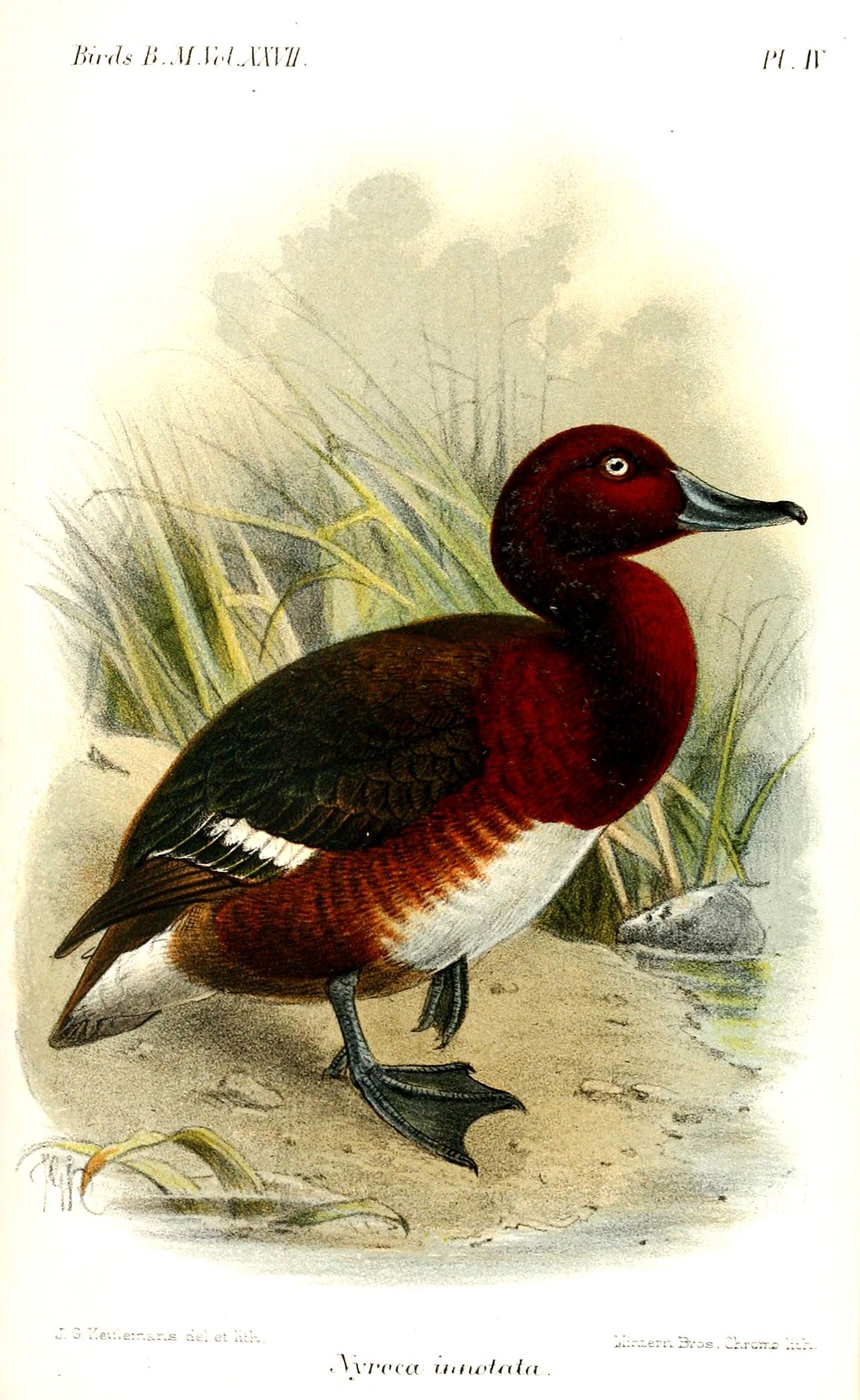
The Madagascar pochard in the Catalogue of the Birds in the British Museum. Volume 27, 1895.

The 1960 specimen now held by the Naturalis Biodiversity Center

A. innotata in a captive breeding program in Madagascar.
Temperament
wary and shy
Flight Pattern
swift, direct flight with rapid wingbeats
Social Behavior
Usually found singly, in pairs, or small groups; forms larger aggregations only rarely where safe habitat exists. Nests are built low over water or in dense emergent vegetation, with the female incubating. Pairs are seasonal and show strong site fidelity when undisturbed. Ducklings are precocial and remain close to vegetated cover.
Migratory Pattern
Resident
Song Description
Generally quiet; males give soft whistles during display, while females produce harsher quacks and grunts. Alarm calls are abrupt and subdued, often given from cover.
Plumage
Overall dark chocolate-brown with slightly darker head and back; paler brown flanks and a whitish undertail/vent. Underwings are pale, contrasting in flight. Feathers are smooth and compact, suited to frequent diving.
Diet
Feeds mainly by diving for aquatic invertebrates such as insect larvae (e.g., chironomids), small mollusks, and crustaceans. Also takes seeds and tender parts of submerged and emergent plants. Ducklings rely heavily on small invertebrates to fuel rapid growth. Foraging bouts are interspersed with resting under dense vegetation to avoid disturbance.
Preferred Environment
Clear, relatively deep freshwater lakes with extensive rushes and sedges, and patches of open water for diving. It forages near vegetated margins and over benthic zones with abundant invertebrates, avoiding turbid, heavily fished, or disturbed waters.


