

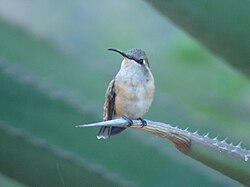
The lucifer sheartail or lucifer hummingbird is a medium-sized, 10 cm long, green hummingbird with a slightly curved bill and distinctive outward flare of its gorget feathers. Its habitat is in high-altitude areas of northern Mexico and southwestern United States. It winters in central Mexico.
Region
Southwestern United States and Northern/Central Mexico
Typical Environment
Found in arid and semi-arid slopes, canyons, and desert scrub from southern Arizona, New Mexico, and west Texas south through northern and central Mexico. It favors areas with abundant flowering agaves, ocotillo, and desert shrubs, and also uses edges of oak-pine woodlands in uplands. During the breeding season it occupies rugged canyons and foothills; in winter it shifts southward and sometimes downslope to regions with reliable nectar sources. It occasionally frequents gardens and hummingbird feeders near its natural habitats.
Altitude Range
800–2500 m
Climate Zone
Arid
Ease of Keeping
Beginner friendly: 1/5
The lucifer sheartail is a small hummingbird known for the male’s striking, outward-flared purple gorget and long, narrow tail. It is closely tied to flowering desert plants such as agave and ocotillo, and will also visit feeders. Breeding occurs in arid canyons of northern Mexico and the southwestern United States, with most birds wintering farther south in central Mexico. Nests are tiny cups bound with spider silk and lined with plant down.




Temperament
solitary and territorial
Flight Pattern
short rapid wingbeats with agile hovering
Social Behavior
Typically solitary outside of breeding, defending rich flower patches vigorously against other hummingbirds. Males perform display flights and shuttle movements near favored perches. Nests are small cups attached to stems or branches, often in shrubs or cacti, with two tiny white eggs per clutch.
Migratory Pattern
Seasonal migrant
Song Description
Vocalizations are high, thin chips and buzzy notes, often given during foraging or display. Wing trills and mechanical sounds may accompany display flights.
Plumage
Male with iridescent purple gorget that flares outward, green upperparts, and dark, long, narrow, slightly forked tail; underparts pale with buff wash. Female shows green upperparts, buffy to cinnamon-washed underparts, and a more rounded tail with white tips. Both sexes have a slightly decurved, slender bill.
Diet
Primarily consumes nectar from tubular flowers such as agave, ocotillo, penstemon, and thistles. Supplements diet with small insects and spiders for protein, gleaned from foliage or caught on the wing. Will occasionally visit hummingbird feeders where available.
Preferred Environment
Feeds at flowering desert shrubs and agave stalks on rocky slopes and in canyons. Also uses edges of upland woodland and arroyos where nectar sources are concentrated.


