

The Lord Howe woodhen also known as the Lord Howe Island woodhen, Lord Howe wood rail, Lord Howe rail or Lord Howe Island rail, is a flightless bird of the rail family, Rallidae. It is endemic to Lord Howe Island off the Australian coast. It is currently classified as endangered by the IUCN. The species was formerly placed in the genus Hypotaenidia.
Region
Southwest Pacific (Lord Howe Island group)
Typical Environment
This species occurs only on Lord Howe Island, using subtropical evergreen forest, palm groves, fern thickets, and wet gullies. After recovery efforts it expanded from high-elevation refuges on Mt Gower and Mt Lidgbird back into lower valleys and some pasture edges. It forages on the forest floor, probing leaf litter and soft soils. Nesting sites are concealed among dense vegetation, fallen logs, or rock crevices to avoid predators.
Altitude Range
Sea level to 875 m
Climate Zone
Subtropical
Ease of Keeping
Beginner friendly: 2/5
The Lord Howe woodhen is a flightless rail that survived a dramatic population crash in the 20th century and became a flagship for island conservation. Intensive predator control and a captive-breeding program in the 1980s helped lift numbers from a few dozen to a few hundred. It remains restricted to Lord Howe Island and is highly vulnerable to introduced predators and habitat changes. Taxonomically it has been shuffled between Gallirallus and Hypotaenidia.

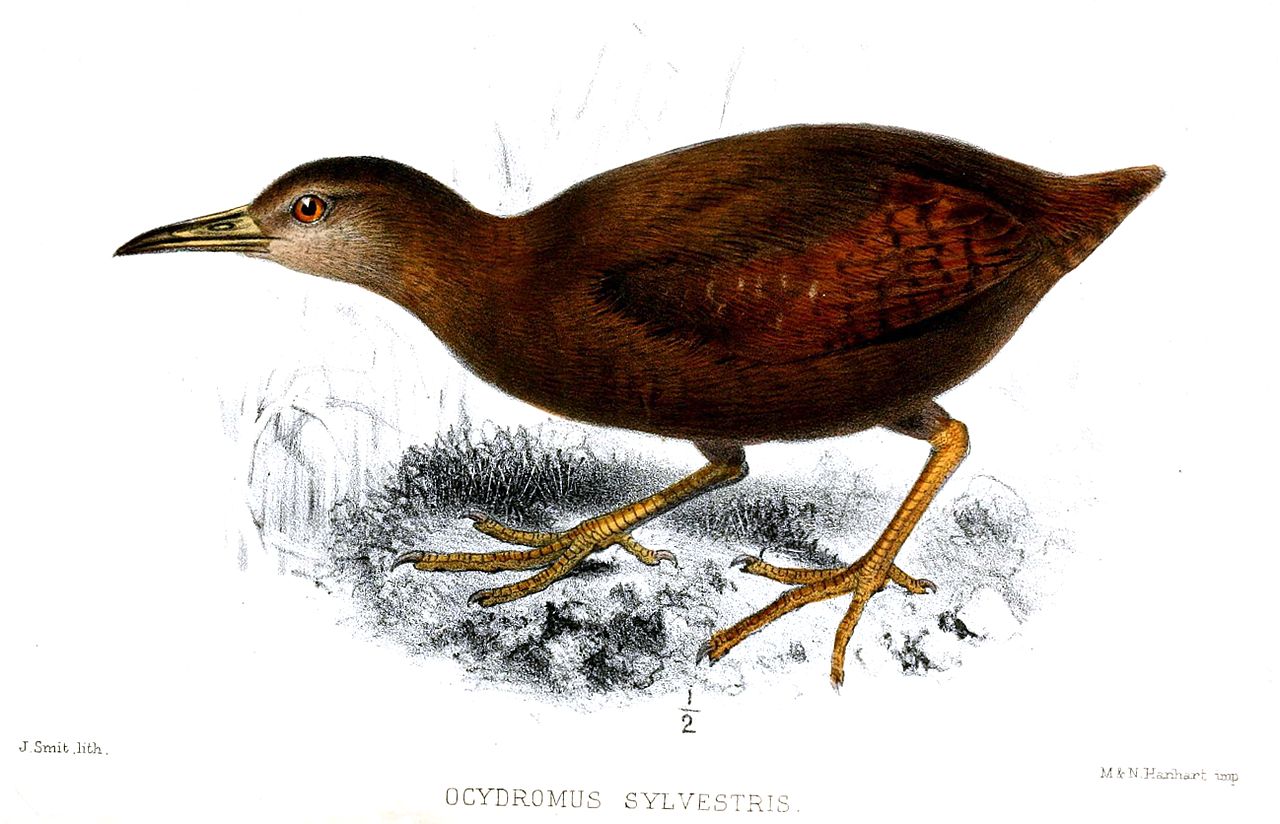
Illustration by Joseph Smit (1869)

A pair of woodhens with a chick
Temperament
curious but territorial
Flight Pattern
flightless; runs swiftly through undergrowth
Social Behavior
Typically found in monogamous pairs defending small territories year-round. Nests are placed on the ground in dense cover, with both parents incubating and caring for chicks. Family groups may remain together for some time after fledging, especially in high-quality territories.
Migratory Pattern
Resident
Song Description
Vocalizations include sharp clucks and squeals, with loud, carrying duet calls between pair members at dawn and dusk. Alarm calls are harsher, while contact notes are softer and repeated when foraging.
Plumage
Dense, plain to slightly streaked olive-brown plumage with softer, fluffier texture on the underparts; short rounded wings and a stubby tail often held cocked.
Diet
It feeds mainly on invertebrates such as earthworms, beetles, snails, and insect larvae, probing soil and leaf litter. It also takes small crustaceans or mollusks where available and occasionally consumes fallen fruits, seeds, and tender plant material. Opportunistic and adaptable, it will investigate carrion or human-altered areas for additional food.
Preferred Environment
Most feeding occurs on the shaded forest floor, in wet gullies, palm groves, and along track edges. It also forages in pasture margins and around logs and rocks where invertebrates are abundant.


