

The laced woodpecker is a species of bird in the family Picidae.
Region
Southeast Asia
Typical Environment
Occurs from the Malay Peninsula through Singapore and southern Thailand to Sumatra, Borneo, and Java. It inhabits lowland rainforests, riverine woodland, mangroves, and secondary growth, and is often found along forest edges and in lightly wooded plantations. The species tolerates some habitat disturbance but remains most common in mature or semi-mature forest with large trees. It forages from the understory to the mid-canopy, frequently on trunks and larger branches.
Altitude Range
Sea level to 1500 m
Climate Zone
Tropical
Ease of Keeping
Beginner friendly: 1/5
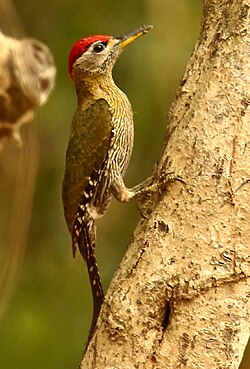
The laced woodpecker is a medium-sized woodpecker of lowland forests in Southeast Asia, named for the delicate pale edging on its green feathers that creates a 'laced' effect. It excavates nest cavities in soft or dead wood and plays an important role in forest ecosystems by controlling termite and ant populations. Males and females differ subtly in head markings, with males showing more red on the head and malar area.

Temperament
shy and wary
Flight Pattern
undulating with short rapid wingbeats
Social Behavior
Usually seen singly or in pairs, occasionally joining mixed-species flocks in forest edge habitats. Pairs excavate nest cavities in dead trunks or large branches, both sexes participating in excavation and incubation. Territorial drumming and calls are used to advertise and maintain territories.
Migratory Pattern
Resident
Song Description
Gives a sharp, repeated series of piping notes, often rendered as klee-klee-klee that accelerates slightly. Also produces rapid mechanical drumming on resonant wood for territorial display.
Plumage
Olive-green upperparts with fine pale edging that creates a scalloped or laced appearance; underparts are paler with faint barring or streaking. The crown and nape show red in males, while females have reduced or no red and darker malar markings. The back is smooth with a satiny sheen, and the flight feathers are darker with paler barring.
Diet
Feeds primarily on ants, termites, beetle larvae, and other wood-boring insects. It pecks and probes into decayed wood, bark crevices, and epiphyte mats, and will flake bark to expose prey. Occasionally takes small fruits or berries, especially when insect prey is less abundant.
Preferred Environment
Forages on trunks, stumps, and large branches in lowland forest, mangroves, and secondary growth. Often uses edges, clearings, and lightly wooded plantations where deadwood is available.


