

The Karoo lark should not be confused with the similarly named Karoo long-billed lark.
Region
Southwestern South Africa
Typical Environment
Occurs across the Nama and Succulent Karoo, favoring semi-desert dwarf shrublands, gravel plains, and sandy flats with scattered low bushes. It uses areas with open ground between shrubs and often frequents dry washes and road verges. The species avoids dense grass and tall shrub thickets, preferring low, sparse cover that allows ground foraging. It may persist in lightly grazed rangeland and occasionally in fallow fields adjacent to natural Karoo habitat.
Altitude Range
Sea level to 1600 m
Climate Zone
Arid
Ease of Keeping
Beginner friendly: 1/5
A characteristic bird of South Africa’s arid Karoo, the Karoo lark is adapted to open, sparsely vegetated shrublands. It forages almost entirely on the ground and often performs brief song-flights from low perches. The Karoo lark should not be confused with the similarly named Karoo long-billed lark, which has a noticeably longer bill and different proportions. After rains, it often breeds and increases insect intake when prey becomes more abundant.


Temperament
solitary and territorial
Flight Pattern
short rapid wingbeats with low, undulating flights; occasional brief song-flights
Social Behavior
Typically seen singly or in pairs, maintaining territories in suitable shrubland. Nests on the ground, often tucked under a small shrub or grass tuft, with a well-camouflaged cup. Pairs are monogamous during the breeding season, and breeding activity often follows rainfall. Clutches are small, and adults remain close to cover when disturbed.
Migratory Pattern
Resident
Song Description
A soft, melodious series of trills and tinkling phrases, delivered from a low perch or during a short song-flight. Calls include thin tzit notes and soft chatters, often given while foraging or when flushed.
Plumage
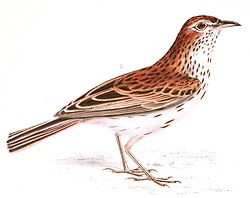
Sandy-brown upperparts with fine dark streaking and paler fringes, contrasting with whitish to buff underparts that show light breast streaking. Feathers appear soft and well-camouflaged for arid shrubland. Tail often shows darker central feathers with paler outer edges.
Diet
Eats small seeds of grasses and forbs along with a wide range of invertebrates, including beetles, ants, termites, and caterpillars. Insects form a larger portion of the diet during breeding and after rains when prey is abundant. It picks items from the ground surface, probes among leaf litter, and occasionally scratches lightly in loose soil.
Preferred Environment
Forages on open ground among low shrubs and bare patches in Karoo shrubland. Often uses track edges, dry riverbeds, and lightly grazed plains where visibility and movement are easier. Keeps close to cover to avoid predators while feeding.


