

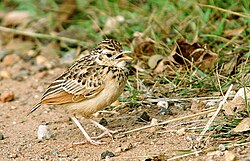
Jerdon's bush lark or Jerdon's lark is a species of lark in the family Alaudidae found in south Asia. This was formerly placed in the genus Mirafra and considered as a subspecies of Mirafra assamica and termed as the Madras bushlark. Two other species in the complex includde Mirafra marionae and Mirafra microptera. Jerdon's bush lark is typically very pale on the underside
Region
South Asia
Typical Environment
Occurs widely in peninsular India and parts of Sri Lanka, favoring dry scrub, fallow fields, open grasslands, and agricultural margins. It prefers areas with scattered low bushes, bare patches of soil, and short grasses where it can forage and nest. It avoids dense forest and very wet habitats, but may use edges of wetlands or irrigation bunds. Outside the breeding season, it can be found along roadsides and in recently burned or disturbed open areas.
Altitude Range
Sea level to 1500 m
Climate Zone
Tropical
Ease of Keeping
Beginner friendly: 1/5
Jerdon's bush lark is a small, ground-dwelling lark of dry open country in peninsular India and Sri Lanka. It was once lumped with the Bengal bushlark but is now treated as a separate species, best told by its very pale underparts and distinctive song-flight. Males often rise on fluttering wings to deliver a rich, varied warble before parachuting back down. It frequently perches on low bushes, fence posts, and wires despite spending much time foraging on the ground.



Temperament
wary and cryptic
Flight Pattern
short rapid wingbeats with fluttering song-flights
Social Behavior
Typically solitary or in pairs while breeding, nesting on the ground in a small, well-hidden scrape lined with grass. Outside the breeding season it may form loose, small groups while foraging. Males perform aerial displays, rising and descending while singing to advertise territory.
Migratory Pattern
Resident
Song Description
A varied, sweet warble of trills, chirrs, and tinkling notes delivered from a perch or during a fluttering song-flight. Calls include short chips and soft twitters when flushed.
Plumage
Sandy-brown upperparts heavily streaked with darker brown and a paler, buffy to whitish underside that is only lightly marked on the breast. Shows warm rufous tones in the wings forming a subtle panel, with white-edged outer tail feathers visible in flight.
Diet
Consumes small seeds of grasses and herbs along with a wide range of invertebrates such as ants, termites, beetles, and grasshoppers. During the breeding season it takes more animal prey to feed nestlings. Forages by walking and gleaning items from bare ground and low vegetation.
Preferred Environment
Feeds in open, sparsely vegetated ground, field edges, and scrubby patches with exposed soil. Often uses recently ploughed fields, stubble, and burned grasslands where food is accessible.


