

James's flamingo, also known as the puna flamingo, is a species of flamingo that lives at high altitudes in the Andean plateaus of Peru, Chile, Bolivia, and northwest Argentina.
Region
Central Andes (Peru, Bolivia, Chile, northwest Argentina)
Typical Environment
This species is confined to high-altitude saline and alkaline lakes of the Andean Altiplano. It favors shallow, diatom-rich waters with extensive mudflats and salt crusts, often in remote basins with sparse vegetation. Breeding occurs on isolated islands or peninsulas where mud and salt can be shaped into nest cones. Outside the breeding season, birds may disperse among lakes as water levels and food abundance change. It sometimes moves to lower or less saline wetlands during harsh conditions.
Altitude Range
3,500–4,800 m
Climate Zone
Highland
Ease of Keeping
Beginner friendly: 1/5
James's flamingo, also called the puna flamingo, is a high-Andean specialist that breeds on remote, hypersaline lakes. It filter-feeds primarily on diatoms using a finely lamellated, downcurved bill, and its carotenoid-rich diet contributes to its pink tones. The species nests in dense colonies on mud-cone mounds, laying a single egg. Named for the British naturalist Harry Berkeley James, it was once feared extinct but later rediscovered and has since shown signs of recovery in protected areas.


Illustration by J. G. Keulemans (1886)

Comparison of bills of Andean flamingo (top) and James's flamingo (bottom)

Feeding at Laguna Hedionda, Bolivia.
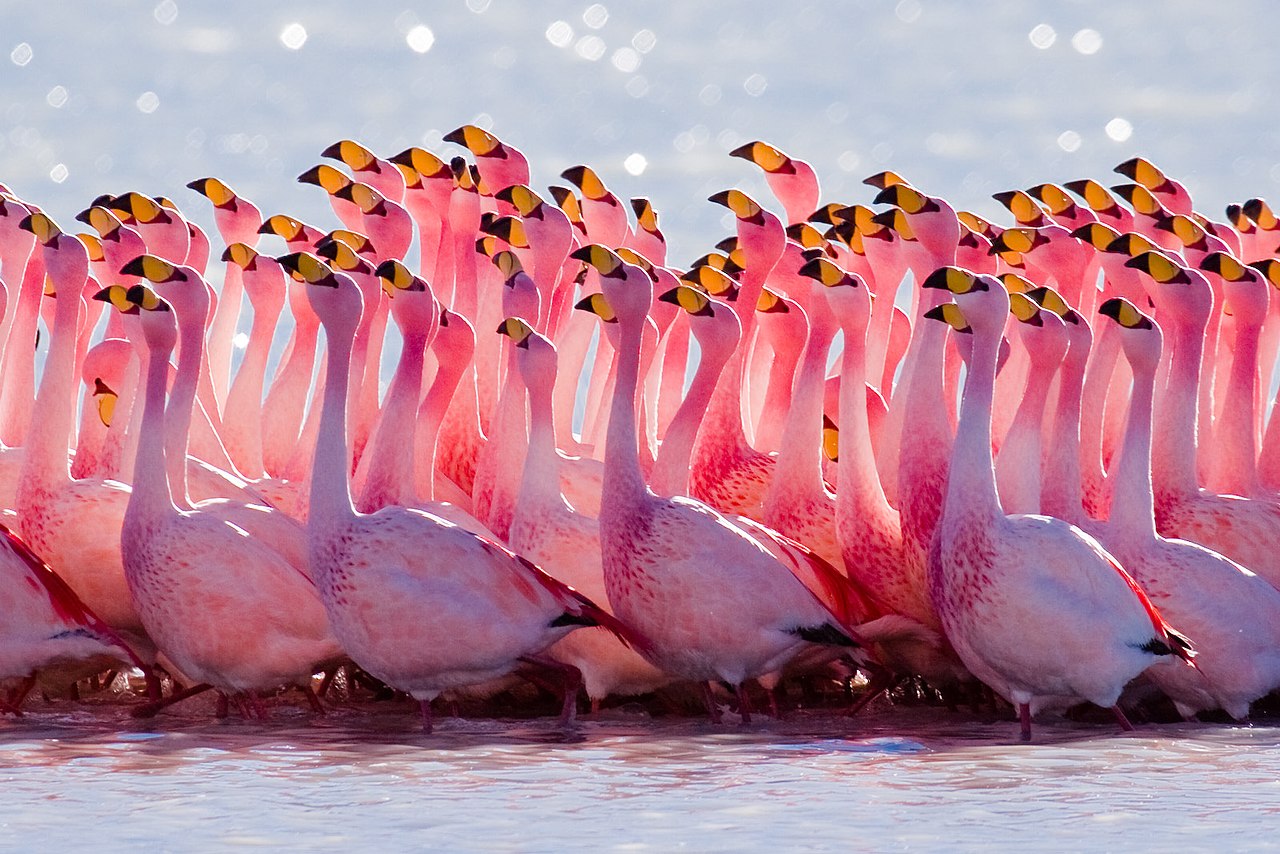
Mating ritual
Temperament
social and colonial
Flight Pattern
strong direct flier with steady wingbeats
Social Behavior
Breeds in large, dense colonies, forming monogamous pairs for the season. Each pair builds a conical mud nest and typically lays a single egg, with both parents incubating and tending the chick. Chicks often gather in crèches guarded by adults while parents forage. Colonies may shift locations between years depending on water levels and food availability.
Migratory Pattern
Partial migrant
Song Description
Vocalizations are nasal, goose-like honks and gabbling chatter used to maintain group cohesion. Calls can become louder and more frequent during takeoff, in flight, and at breeding colonies.
Plumage
Very pale pink to whitish body with a delicate pink wash, deep carmine streaks on the wing coverts, and black primaries visible in flight.
Diet
Primarily consumes microscopic algae and especially diatoms filtered from the water column and surface films. It also ingests small aquatic invertebrates such as rotifers and copepods when available. The bill’s fine lamellae and a rapid pumping tongue allow efficient extraction of tiny prey. Carotenoid pigments from the diet contribute to the bird’s pink coloration.
Preferred Environment
Feeds in shallow edges of hypersaline and alkaline lakes, often where wind concentrates diatom blooms. It wades through knee-deep water, sweeping the bill side-to-side upside down. Birds often forage in loose to tight groups, sometimes mixing with Andean Flamingos.


