
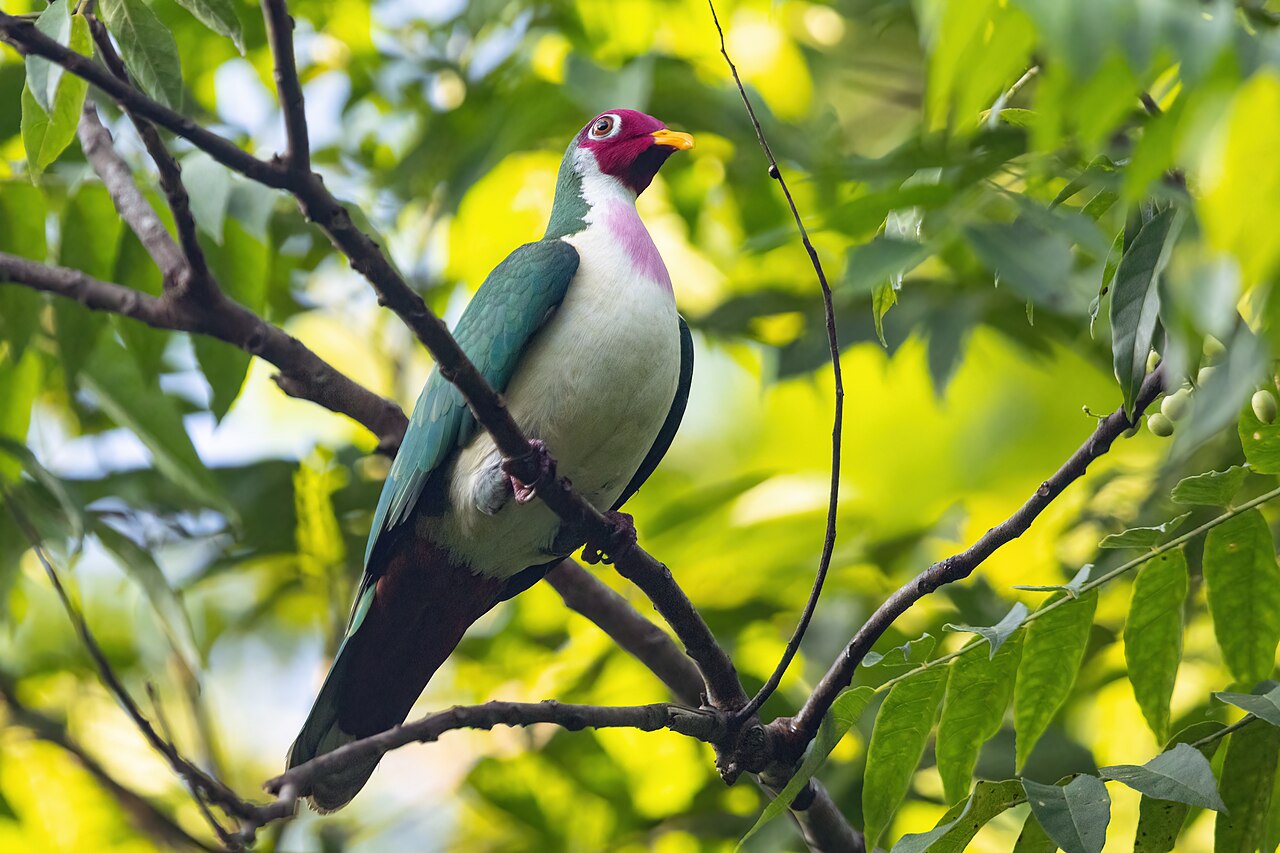
The jambu fruit dove is a smallish colourful fruit dove. It is a resident breeding species in southern Thailand, Malaysia, Brunei and the Indonesian islands of Kalimantan, Sumatra and Java. This species was formerly placed in the genus Ptilinopus.
Region
Southeast Asia
Typical Environment
Found from southern Thailand through Peninsular Malaysia and Singapore to Brunei and the Indonesian islands of Sumatra, Borneo (Kalimantan and Brunei), and Java. It favors lowland evergreen and peat-swamp forests, riverine forest, mangroves, and well-wooded secondary growth. Birds often track fruiting trees, especially figs, and can appear in orchards or gardens near forest edges. Local occurrence is patchy where lowland forest has been cleared. Typically forages from mid-story to canopy but may descend to lower levels when feeding.
Altitude Range
Sea level to 1200 m
Climate Zone
Tropical
Ease of Keeping
Beginner friendly: 1/5
The jambu fruit dove is a shy forest pigeon that often remains hidden in dense foliage, betraying its presence only when feeding at fruiting trees. Males are striking with a crimson facial mask and pink breast, while females are largely green and well camouflaged. It plays an important role in seed dispersal for many rainforest plants. Habitat loss in lowland forests has led to regional declines.

Temperament
shy and unobtrusive
Flight Pattern
short rapid wingbeats
Social Behavior
Usually seen singly or in pairs, occasionally in small groups at fruiting trees. Builds a small, flimsy platform nest of twigs placed on a horizontal branch. Typically lays a single egg, with both parents sharing incubation and chick rearing. Courtship includes bowing, soft coos, and short display flights.
Migratory Pattern
Resident
Song Description
Voice consists of soft, low-pitched coos delivered in spaced intervals, often hard to locate in dense foliage. Males give simple advertising calls from shaded perches during early morning and late afternoon.
Plumage
Male with glossy green upperparts, a vivid crimson facial mask, pink breast patch, clean white belly, and maroon undertail coverts; female largely green with a paler face and whitish belly. Both sexes show smooth, neat plumage typical of fruit-doves with a slight sheen on the wings.
Diet
Primarily eats soft fruits such as figs (Ficus), berries, and small drupes, swallowing them whole and later regurgitating seeds. Also takes palm fruits and occasionally other fleshy forest fruits. By dispersing seeds over distances, it contributes to forest regeneration. It rarely, if ever, takes animal matter.
Preferred Environment
Feeds in the mid-story and canopy of lowland rainforest and swamp forest, visiting fruiting trees and lianas. Will also forage at forest edges, along rivers, and in wooded parks and orchards adjacent to forest.


