

The Humboldt penguin is a medium-sized penguin. It resides in South America, along the Pacific coast of Peru, former Bolivia and Chile. Its nearest relatives are the African penguin, the Magellanic penguin and the Galápagos penguin. The Humboldt penguin and the cold water current it swims in are both named after the explorer Alexander von Humboldt. The species is listed as vulnerable by the IUCN with no population recovery plan in place. The current wild population is composed of roughly 23,800 mature individuals and is declining. It is a migrant species.
Region
Pacific coast of western South America
Typical Environment
Occurs along the Humboldt Current from coastal Peru into northern and central Chile, favoring rocky shorelines, offshore islets, and guano islands. Colonies occupy cliffs, boulder fields, and dunes with burrowable substrates. Birds forage mainly in nearshore waters over continental shelves and around upwelling fronts rich in anchovies and sardines. They may disperse more widely at sea outside the breeding period, especially during warm-water events.
Altitude Range
Sea level to 100 m
Climate Zone
Subtropical
Ease of Keeping
Beginner friendly: 1/5
Named after naturalist Alexander von Humboldt, this penguin rides the cold, nutrient-rich Humboldt Current along the coasts of Peru and Chile. It nests in burrows and crevices on rocky islands and coasts, often in old guano deposits. Major threats include bycatch in fisheries, guano extraction, disturbance, and food shortages during El Niño events. It is closely related to the African, Magellanic, and Galápagos penguins.


Nazca Penguin effigy vessel, 350 CE–500 CE, said to represent a Humboldt Penguin by the Art Institute of Chicago
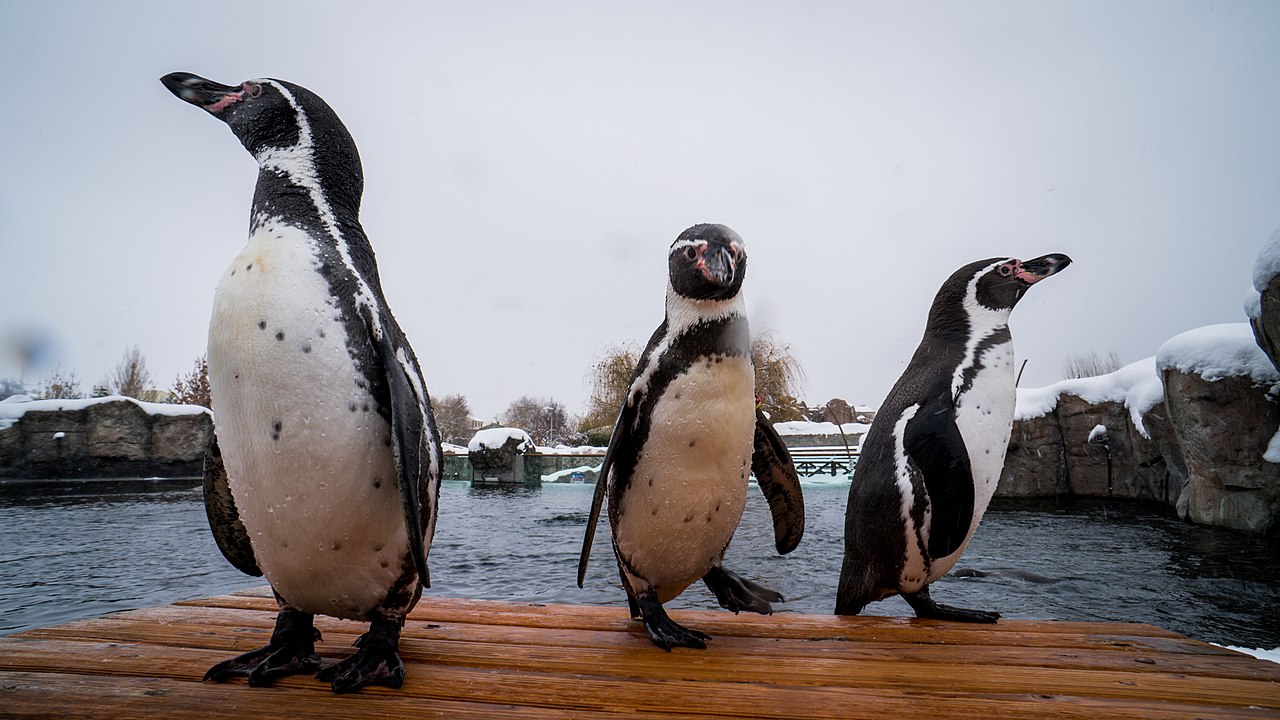
Humboldt penguin in Eskişehir Zoo


Temperament
social and colonial
Flight Pattern
flightless; powerful underwater flier
Social Behavior
Breeds in colonies, nesting in burrows, crevices, or under vegetation. Pairs are often monogamous across seasons, sharing incubation and chick-rearing duties. Clutch size is typically two eggs, and breeding timing varies with local food availability. Adults show strong site fidelity but may skip breeding in poor years.
Migratory Pattern
Partial migrant
Song Description
Vocalizations include loud, braying calls reminiscent of a donkey, used for mate and territory recognition. Softer honks and growls occur at close range within colonies.
Plumage
Classic black-and-white penguin pattern with a broad black breast band and fine black spotting on the white underparts. The head is black with a white eyebrow stripe that curves around the ear and joins at the throat. Bare pink skin around the eyes and base of the bill aids thermoregulation.
Diet
Feeds primarily on small schooling fishes such as Peruvian anchoveta and sardines, supplemented by silversides and small cephalopods. Foraging dives commonly reach 20–60 m, with deeper dives when prey is scarce. Diet composition shifts with oceanographic conditions, particularly during El Niño when prey availability declines.
Preferred Environment
Nearshore waters over continental shelves, especially along upwelling fronts of the Humboldt Current. Often forages around rocky reefs, island fringes, and kelp beds where prey schools aggregate.


