

The helmet vanga is a distinctive-looking bird of the vanga family, Vangidae, and is classified in its own genus, Euryceros. It is mainly blue-black, with rufous wings and a huge arched blue bill. It is restricted to lowland and lower montane rainforests of northeastern Madagascar. Its diet is composed of invertebrates, predominantly insects. The species is threatened by habitat loss.
Region
Northeastern Madagascar
Typical Environment
Occurs in primary and well-structured secondary rainforest, especially along humid ravines and stream corridors. It favors dense understory and midstory tangles where it can glean and probe for prey. The species is most regularly encountered in protected tracts such as Masoala and nearby forest blocks like Makira and Marojejy. It avoids heavily degraded habitats and plantations, persisting best where continuous canopy and liana-rich forest remain.
Altitude Range
Sea level to 1200 m
Climate Zone
Tropical
Ease of Keeping
Beginner friendly: 1/5
The helmet vanga is the sole member of its genus, Euryceros, and is instantly recognized by its massive, bright blue, casque-like bill. It inhabits dense lowland and lower montane rainforests in northeastern Madagascar, where it forages methodically in the midstory. The species is a flagship bird for protected areas like Masoala National Park but is threatened by ongoing forest loss and fragmentation.


Global distribution


Temperament
skulking and wary within dense forest
Flight Pattern
short rapid wingbeats with brief, direct flights between perches
Social Behavior
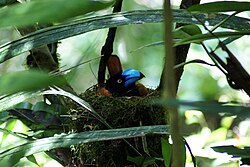
Usually found singly, in pairs, or small family groups, often maintaining territories within quality forest. Pairs communicate frequently and may engage in mutual preening. Nests are placed in low to mid-level vegetation, and both parents are believed to share incubation and chick-rearing duties.
Migratory Pattern
Resident
Song Description
A series of mellow, fluty whistles interspersed with richer, nasal notes. Calls carry softly through the understory and are used for contact between pair members, sometimes resembling quiet duets.
Plumage
Glossy blue-black head, back, and underparts with contrasting rich rufous wings; tail dark and moderately long. Feathers appear sleek, with minimal streaking and a clean contrast between dark body and chestnut-toned wings.
Diet
Feeds primarily on large invertebrates, including beetles, caterpillars, orthopterans, and spiders. Uses its powerful bill to pry at bark, probe clusters of dead leaves, and snap prey on branches and lianas. Will occasionally take small vertebrates when encountered.
Preferred Environment
Forages in the lower to mid canopy and dense understory of mature rainforest, especially along stream edges, vine tangles, and fallen log complexes. Less frequently ventures into edge habitats unless adjacent to intact forest.


