

Harris's hawk, formerly also known as the bay-winged hawk or dusky hawk, and known in Latin America as the peuco, is a medium-large bird of prey that breeds from the southwestern United States south to Chile, central Argentina, and Brazil.
Region
Southwestern North America to South America
Typical Environment
Found from the southwestern United States through Mexico and Central America to Chile, central Argentina, and Brazil. It favors arid and semi-arid landscapes such as deserts, thornscrub, mesquite bosques, savannas, and open woodland edges. Common around saguaro and other large cacti, it also uses riparian corridors and agricultural mosaics. It adapts to human-modified areas, frequently perching on utility poles and fence posts for hunting.
Altitude Range
Sea level to 2500 m
Climate Zone
Arid
Ease of Keeping
Beginner friendly: 4/5
Harris's hawk is unusual among raptors for its cooperative hunting, where groups work together to flush and corner prey. It often nests and perches in tall cacti in desert habitats and may even 'stack' by perching on each other's backs. The species is popular in falconry due to its trainability and social nature, making it a common beginner’s hawk. Despite human-altered landscapes, it adapts well to utility poles and agricultural edges.


Juvenile, at La Plata, Argentina

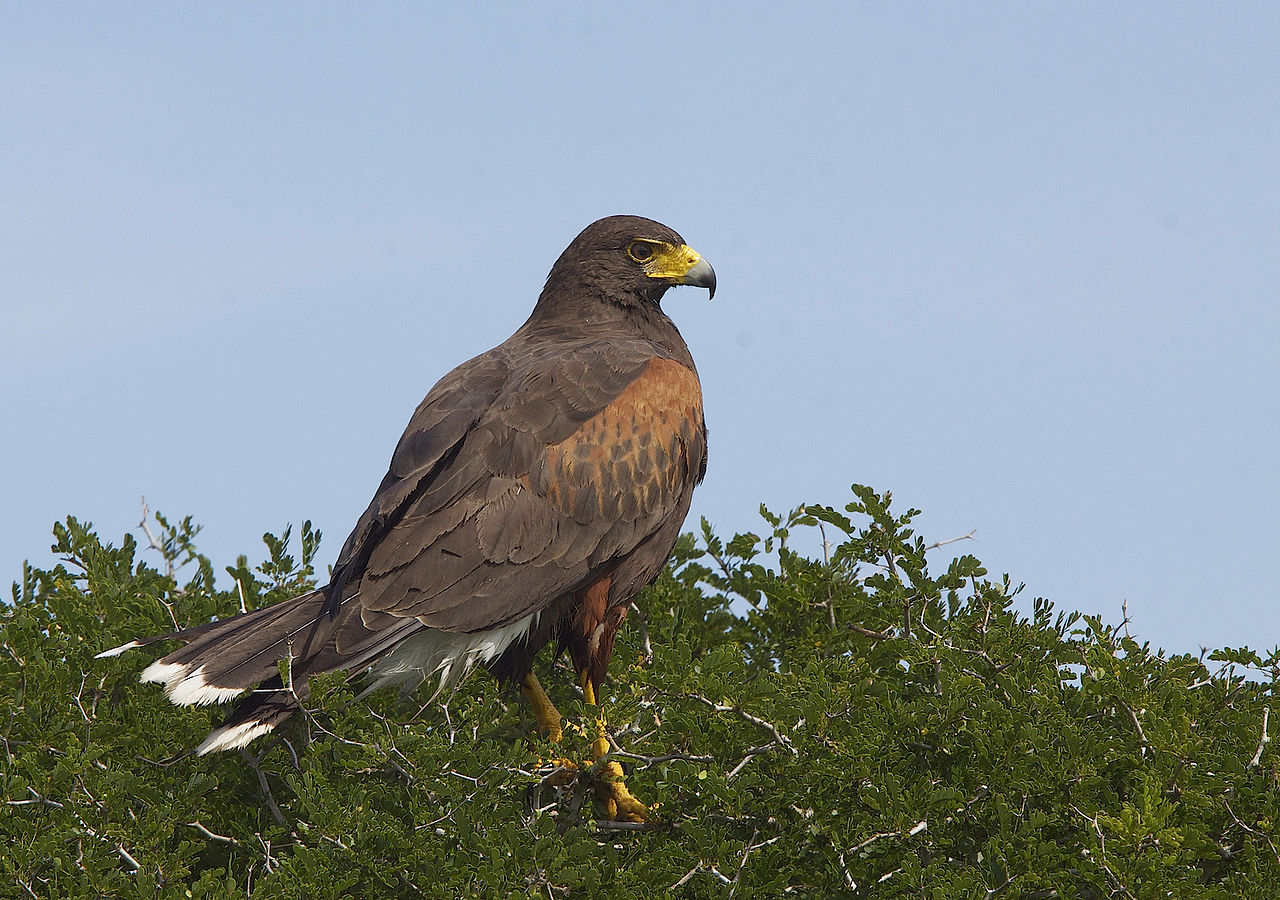
Adult of P. u. unicinctus in Argentina.


Temperament
social and active
Flight Pattern
soaring glider with bursts of rapid wingbeats
Social Behavior
Often forms stable hunting parties of 2–6 birds that coordinate to flush prey from cover. Pairs are typically monogamous and may be assisted by helpers at the nest (cooperative breeding). Nests are built in tall cacti, trees, or on man-made structures and are reused or refurbished across seasons.
Migratory Pattern
Resident
Song Description
Vocalizations include a loud, harsh keeer or kaa notes, often given in series during territorial or alarm contexts. Calls can be scratchy and scolding, with a descending quality, and become more frequent around the nest.
Plumage
Mostly dark chocolate-brown with rich rufous shoulders and thighs, and contrasting white uppertail coverts and tail tip. Flight feathers are darker, creating a subtle two-toned wing. The tail shows a broad blackish band with a clean white terminal band.
Diet
Takes small to medium prey including rabbits and hares, ground squirrels, other rodents, quail and small birds, and reptiles such as lizards and snakes. Cooperative groups may surround and flush prey, or take turns pursuing it. It sometimes scavenges and will exploit abundant prey around agricultural fields.
Preferred Environment
Hunts from elevated perches like cacti, trees, and utility poles, as well as by low coursing flights over open ground. Prefers open or broken habitats with scattered cover that allows ambush and coordinated maneuvers.


