
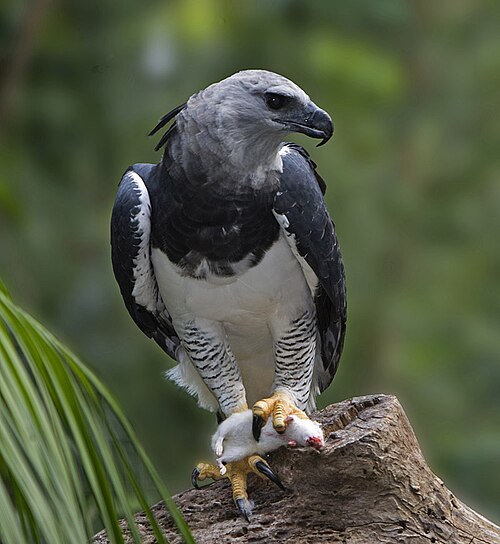
The harpy eagle is a large neotropical species of eagle. It is also called the American harpy eagle to distinguish it from the Papuan eagle, which is sometimes known as the New Guinea harpy eagle or Papuan harpy eagle. It is the largest bird of prey throughout its range, and among the largest extant species of eagles in the world. It usually inhabits tropical lowland rainforests in the upper (emergent) canopy layer. Destruction of its natural habitat has caused it to vanish from many parts of its former range, and it is nearly extirpated from much of Central America. It is the only member of the genus Harpia, which, together with Harpyopsis, Macheiramphus and Morphnus, forms the subfamily Harpiinae.
Region
Neotropics (Central and South America)
Typical Environment
Occurs from southern Mexico through Central America and into much of tropical South America, including the Amazon Basin and Atlantic Forest remnants. It prefers extensive, undisturbed lowland rainforest, especially near river systems and in areas with towering emergent trees. It sometimes persists in selectively logged forests and along forest edges if large trees remain. Local extirpations have occurred where continuous canopy has been heavily fragmented.
Altitude Range
0–900 m (occasionally to 1500 m)
Climate Zone
Tropical
Ease of Keeping
Beginner friendly: 1/5
The harpy eagle is among the largest and most powerful eagles, capable of lifting prey nearly equal to its own mass. It specializes in hunting arboreal mammals like sloths and monkeys, using short, broad wings and immense talons to maneuver through dense canopy. Pairs build massive nests high in emergent trees and raise a single chick every 2–3 years, making populations slow to recover. Habitat loss and fragmentation are the primary threats across its range.


Feeding on small prey

A stuffed specimen of a harpy eagle preying on a macaw at the Museum für Naturkunde, Berlin
![Along with sloths, monkeys, such as the tufted capuchin (Cebus appella), are one of the main prey of the harpy eagle[40]](https://upload.wikimedia.org/wikipedia/commons/thumb/f/fb/Harpia_chega_ao_ninho_com_um_macaco-prego.jpg/1280px-Harpia_chega_ao_ninho_com_um_macaco-prego.jpg)
Along with sloths, monkeys, such as the tufted capuchin (Cebus appella), are one of the main prey of the harpy eagle[40]

Subadult in Belize Zoo

Adult at São Paulo Zoo, Brazil
![Depiction of harpy eagles in Maya codices according to the 1910 book, Animal figures in the Maya codices by Alfred Tozzer and Glover Morrill Allen[86]](https://upload.wikimedia.org/wikipedia/commons/thumb/0/05/Animal_figures_in_the_Maya_codices_%28Plate_20%29_BHL41003954.jpg/1280px-Animal_figures_in_the_Maya_codices_%28Plate_20%29_BHL41003954.jpg)
Depiction of harpy eagles in Maya codices according to the 1910 book, Animal figures in the Maya codices by Alfred Tozzer and Glover Morrill Allen[86]
Temperament
solitary and territorial
Flight Pattern
short powerful wingbeats with agile canopy maneuvering; occasional soaring
Social Behavior
Typically seen alone or in bonded pairs defending large territories. Monogamous pairs build huge stick nests in emergent trees like kapok or Brazil nut and reuse them for years. Reproductive rate is low, usually one chick every 2–3 years, with prolonged parental care.
Migratory Pattern
Resident
Song Description
Vocalizations are mostly high-pitched, whistled calls, often given near the nest or during pair interactions. Calls can be plaintive, ringing weee or whee-eee notes that carry through the canopy.
Plumage
Slate-black upperparts with contrasting white underparts and a bold black breast band; the head is pale gray with a prominent double crest.
Diet
Primarily preys on arboreal mammals such as sloths and monkeys, captured by sudden ambush from a perch. It also takes opossums, large birds like curassows and macaws, and occasionally reptiles such as iguanas. Powerful feet and massive talons allow it to subdue large, struggling prey, which may be cached at the nest.
Preferred Environment
Hunts within and just above the rainforest canopy, using tall emergent trees as vantage points. Often follows natural gaps, river corridors, and edges within extensive forest to surprise prey.


