

The guira cuckoo, known in Spanish as the pirincho is a species of gregarious bird found widely in open and semi-open habitats of northeastern, eastern and southern Brazil, Uruguay, Paraguay, Bolivia, and northeastern Argentina. It is the only species placed in the genus Guira.
Region
Eastern and southern South America
Typical Environment
Occurs widely in open and semi-open habitats from northeastern, eastern, and southern Brazil through Paraguay, Uruguay, Bolivia (lowlands), and northeastern Argentina. Prefers savannas, pasturelands, scrub, forest edges, and agricultural mosaics, and adapts well to human-modified landscapes. Often found near livestock where insects are abundant. Avoids dense, continuous forest and very arid expanses. Frequently uses hedgerows, riparian thickets, and town outskirts.
Altitude Range
Sea level to 1800 m
Climate Zone
Subtropical
Ease of Keeping
Beginner friendly: 1/5
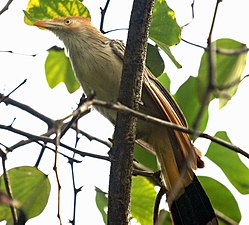
The Guira Cuckoo is a highly social, gregarious bird that often moves and forages in noisy groups. It practices communal nesting, with several females laying eggs in a single stick nest and multiple adults helping to rear the young. Its shaggy crest, long tail with white tips, and orange-yellow bill make it easy to recognize. It is largely a ground and low-perch forager and has relatively weak, gliding flight.


Guira cuckoo with a captured frog. Tacuaras, Ñeembucú Department, Paraguay.

Eggs, Collection Museum Wiesbaden


Temperament
social and active
Flight Pattern
short rapid wingbeats followed by glides
Social Behavior
Usually in groups of 6–20 birds that forage and move together while maintaining contact calls. Breeds cooperatively, building a large stick nest where several females lay eggs; multiple adults participate in incubation and chick care. Roosts communally and engages in frequent allopreening within the group.
Migratory Pattern
Resident
Song Description
Vocalizations are harsh, chattering clucks, squeals, and wheezy whistles. Calls are often delivered in chorus by the group and can carry across open country.
Plumage
Shaggy, scruffy appearance with streaked brown upperparts and pale buff underparts; long graduated tail with bold white tips.
Diet
Takes large insects such as grasshoppers, crickets, and beetles, along with spiders and other arthropods. Also consumes small vertebrates including lizards, frogs, and occasionally nestlings or eggs. Will opportunistically take fruit and some carrion, especially when insect prey is scarce.
Preferred Environment
Forages on the ground and in low shrubs, fence lines, and hedgerows. Common in pastures and agricultural fields, often near cattle where disturbed insects are plentiful.


