

The grey parrot, also known as the Congo grey parrot, is an African parrot in the family Psittacidae. It was previously also known as the African grey parrot until the Timneh parrot, previously treated as a subspecies, was elevated to a full species.
Region
West and Central Africa
Typical Environment
Found from southeastern Côte d’Ivoire and Ghana east through southern Nigeria and Cameroon into Equatorial Guinea, Gabon, the Republic of the Congo, the Democratic Republic of the Congo, and northern Angola, with scattered occurrences further east. It occupies primary and secondary lowland rainforest, gallery forests, and forest–savanna mosaics. Birds frequently visit forest edges, clearings, and cultivated areas to feed. They roost communally in tall trees near water and travel between feeding and roost sites daily.
Altitude Range
Sea level to 2200 m
Climate Zone
Tropical
Ease of Keeping
Beginner friendly: 2/5
Grey parrots are renowned for exceptional vocal mimicry and problem-solving, often ranking among the most cognitively advanced birds. They form strong pair bonds and family groups and depend on large, old trees for nesting cavities. Heavy trapping for the pet trade and habitat loss have caused major declines, and international trade is now tightly regulated.


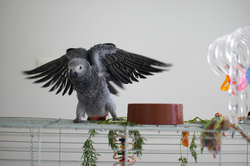
Head of a grey parrot

Skeleton



A pet grey parrot eating a cucumber slice
Temperament
social and cautious
Flight Pattern
strong flier with rapid, direct wingbeats
Social Behavior
Often seen in pairs or family parties that gather into larger flocks at fruiting trees and roosts. Monogamous pairs nest in cavities high in large trees, where they lay a small clutch and both parents tend the young. Communal roosting is common, and birds commute daily between roosts and feeding sites.
Migratory Pattern
Resident
Song Description
Vocalizations include loud whistles, screeches, and chattering, along with remarkable mimicry of other species and environmental sounds. Calls carry over long distances and vary with context, from contact calls in flight to more complex, mixed sequences at roosts.
Plumage
Mostly medium to dark grey with fine pale edging that gives a scalloped effect on the body; paler face with bare whitish skin; bright contrasting red tail.
Diet
Feeds primarily on fruits, nuts, and seeds, including figs and oil palm nuts. Also takes flowers, leaf buds, and bark, and may ingest mineral-rich clay to neutralize plant toxins. Birds sometimes raid crops such as maize and cacao near forest edges. Food is manipulated deftly with the feet and a powerful bill.
Preferred Environment
Most foraging occurs in the forest canopy and at forest edges, especially at fruiting trees and plantations with oil palms. They also feed in secondary growth and clearings adjacent to intact forest.


