

The Gila woodpecker is a medium-sized woodpecker of the desert regions of the southwestern United States and western Mexico. In the U.S., they range through southeastern California, southern Nevada, Arizona, and New Mexico.
Region
Southwestern United States and Northwestern Mexico
Typical Environment
Found across the Sonoran Desert and adjacent arid regions, including southeastern California, southern Nevada, Arizona, and southwestern New Mexico, extending south into northwestern Mexico. It thrives in saguaro-studded deserts, desert washes, and mesquite or palo verde woodlands. Riparian corridors with cottonwood and willow also support populations, as do urban parks and desert neighborhoods. The species is generally non-migratory and maintains year-round territories where cactus and desert trees are available.
Altitude Range
Sea level to 1500 m
Climate Zone
Arid
Ease of Keeping
Beginner friendly: 1/5
This desert woodpecker is famous for excavating nest cavities in saguaro cacti, which later become crucial homes for species like elf owls and cactus wrens. It readily adapts to towns and suburbs in the desert, often visiting nectar and hummingbird feeders. Its old cavities improve desert biodiversity by providing scarce nesting sites.


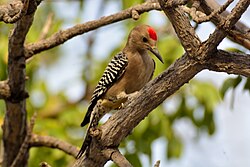
On saguaro cactus next to nesting hole



Temperament
social and active
Flight Pattern
undulating flight with short rapid wingbeats
Social Behavior
Usually seen in pairs or small family groups and can be assertive at feeders or nest sites. Pairs excavate cavities in saguaro cacti or soft desert trees and defend territories year-round. They may reuse or enlarge prior cavities, and their nesting activity benefits many secondary cavity-nesters.
Migratory Pattern
Resident
Song Description
Vocalizations include a loud, rolling chatter and sharp peek notes. Drumming is brief and forceful, used for communication and territorial display.
Plumage
Back and wings are boldly barred black and white, with a gray-buff head and underparts. Males show a small red patch on the crown. Tail is barred; feathers are sleek and closely fitted, giving a clean, laddered look on the back.
Diet
Eats insects such as ants, beetles, and larvae gleaned from bark, cactus tissue, and the ground. Also consumes fruits and seeds, notably saguaro and other cactus fruits, and will sip nectar. Frequently visits hummingbird and nectar feeders in residential areas.
Preferred Environment
Forages on saguaro and other cacti, mesquite, palo verde, and riparian trees. Will also search for food on utility poles, fence posts, and in desert yards and parks.


