

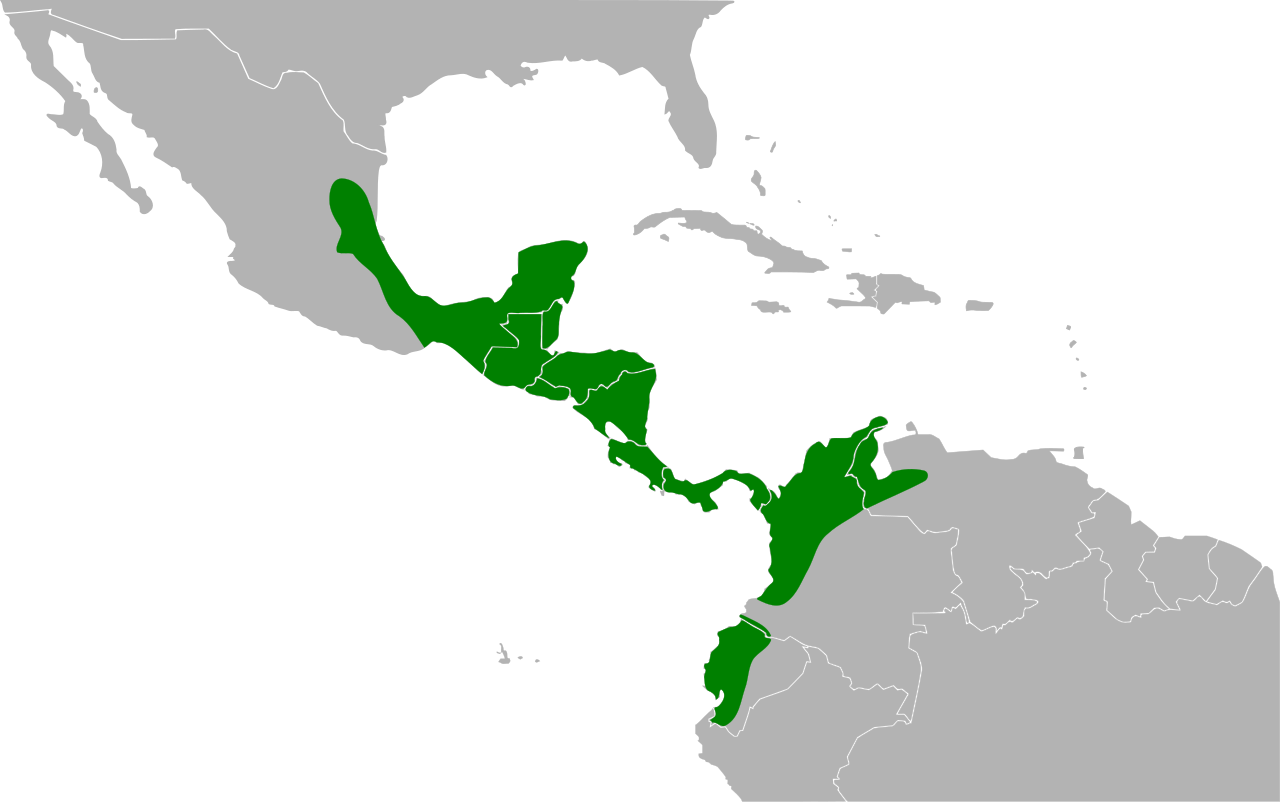
The gartered trogon, also known as the northern violaceous trogon, is a bird in the family Trogonidae, the quetzals and trogons. It is found in Mexico, all of Central America, and Colombia, Ecuador, Peru, and Venezuela.
Region
Central America and northern South America
Typical Environment
Occurs from southeastern Mexico through Belize, Guatemala, Honduras, Nicaragua, Costa Rica, and Panama, and into Colombia, Venezuela, Ecuador, and northern Peru. It favors lowland and foothill humid forests, forest edges, and riverine gallery forests. The species readily uses secondary growth, clearings with scattered trees, and shaded coffee and cacao plantations. Most encounters are in the midstory and canopy where it perches quietly and forages.
Altitude Range
Sea level to 1500 m
Climate Zone
Tropical
Ease of Keeping
Beginner friendly: 1/5
The gartered trogon, sometimes called the northern violaceous trogon, is a colorful forest bird of the family Trogonidae. It is typically quiet and motionless for long periods, then darts out to snatch insects or pluck small fruits. It often nests in cavities excavated in rotten wood or in active or inactive arboreal termite nests. Its stable populations benefit from tolerance of secondary growth and shaded agroforestry habitats.


Chan Chich Lodge area - Belize

Temperament
quiet and unobtrusive
Flight Pattern
short rapid wingbeats with brief sallies
Social Behavior
Usually seen singly or in pairs, sometimes loosely associating with mixed-species flocks. Nests in cavities in decayed wood or in arboreal termite nests, which both sexes may excavate. Clutches are small, and both parents share incubation and chick-rearing duties.
Migratory Pattern
Resident
Song Description
Song is a clear, rapid series of mellow cow or coo notes delivered at an even pace, often accelerating slightly. Calls include soft churring or clucking notes given while perched. Vocalizations carry well through forest understory and edge habitats.
Plumage
Male has metallic green head and upperparts with a bluish-violet chest, a narrow white breast band, and bright yellow belly; undertail shows bold black-and-white barring. Female is gray-brown above with a gray breast, narrow white band, and yellow belly; undertail pattern is similar but duller. Both sexes show a contrasting dark upper tail with white outer tail tips when viewed from below.
Diet
Eats a mix of small fruits and arthropods, including berries and figs as well as katydids, cicadas, and beetles. It often sallies from a perch to snatch flying insects and gleans prey from foliage. Fruits are swallowed whole and later regurgitated, aiding seed dispersal. Occasional small vertebrates may be taken opportunistically.
Preferred Environment
Forages in the midstory and canopy along forest edges, clearings, and riparian corridors. Frequently uses shaded agroforestry systems such as coffee and cacao plantations. Perches motionless for long periods before short foraging flights.


