

The freckled nightjar or freckled rock nightjar is a species of nightjar in the family Caprimulgidae. It has a wide yet patchy distribution throughout the Afrotropics.
Region
Sub-Saharan Africa
Typical Environment
Occurs widely but patchily across the Afrotropics, favoring rocky landscapes within savanna and woodland mosaics. Most frequently found on granite outcrops, cliffs, and boulder-strewn hills where its plumage matches the substrate. It is scarce or absent from dense forest and extensive wetlands. Local presence can be highly site-specific, tied to suitable rock formations. Often persists near human settlements if rugged rocky habitat remains.
Altitude Range
0–2500 m
Climate Zone
Subtropical
Ease of Keeping
Beginner friendly: 1/5
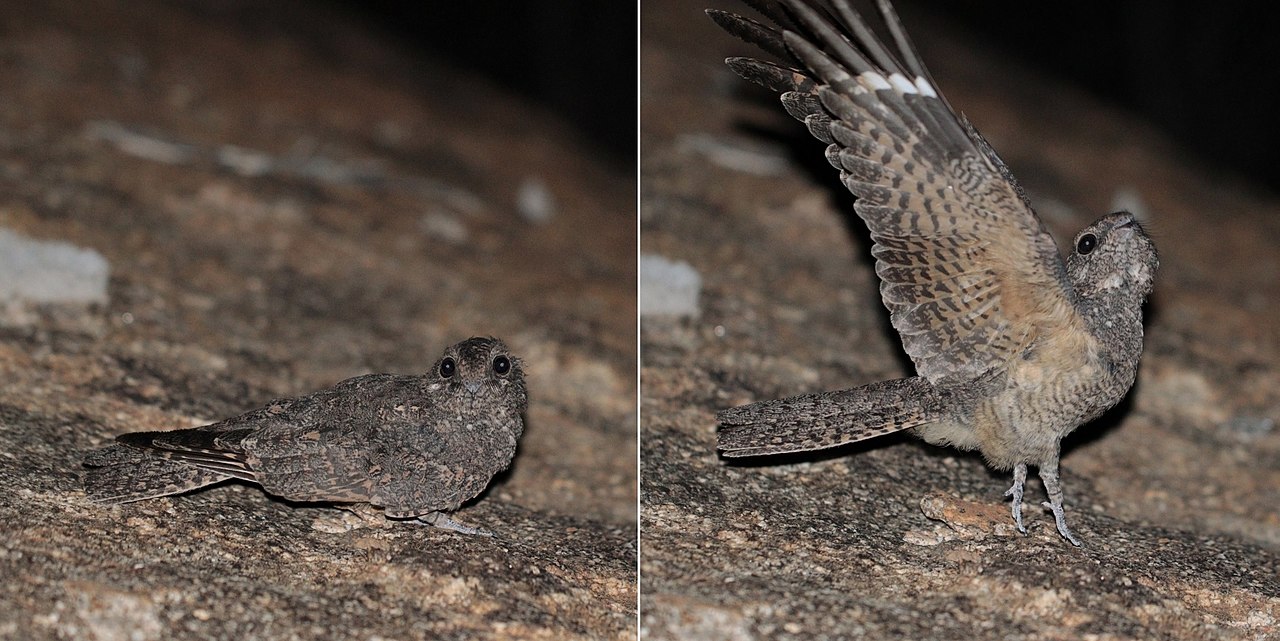
This nocturnal nightjar roosts and nests directly on bare rock, relying on superb freckled camouflage to avoid detection. Its repetitive, mechanical churring call carries far on warm nights from rocky hillsides. It often hunts around cliffs, boulder fields, and occasionally near lights where insects congregate.

Temperament
solitary and territorial
Flight Pattern
short rapid wingbeats with buoyant, erratic sallies
Social Behavior
Usually seen singly or in pairs, especially during the breeding season. Nests are simple scrapes on bare rock with no added material. Pairs rely on camouflage and immobility at the nest site; chicks are semi-precocial and well-camouflaged.
Migratory Pattern
Resident
Song Description
A persistent, mechanical churring or trilling call delivered from exposed rocks at night. Also gives soft clucks and chitters during close interactions.
Plumage
Densely mottled and freckled grey, brown, and rufous with fine vermiculation, giving a rock-like appearance; soft, fluffy texture typical of nightjars.
Diet
Feeds on flying insects such as moths, beetles, termites, and other nocturnal arthropods. Captures prey on the wing using a broad gape and silent flight. May forage near cliffs, over rocky slopes, and occasionally around artificial lights that attract insects.
Preferred Environment
Open airspace over rocky hills, inselbergs, and adjacent savanna or open woodland. Often hunts along ridgelines and above boulder fields where updrafts concentrate insects.


