

The flaming sunbird is a species of bird in the family Nectariniidae. It is endemic to the northern Philippines found on the islands of Luzon and Catanduanes. Its natural habitat is tropical moist lowland forests. It was formerly conspecific with the Maroon-naped sunbird.
Region
Northern Philippines
Typical Environment
Occurs in tropical moist lowland and foothill forests, including forest edges, secondary growth, and occasionally gardens with abundant flowering plants. Prefers areas with a steady supply of nectar-producing trees and shrubs. Common along ridgelines, riverine corridors, and clearings where flowers are concentrated. It forages from understory to mid- and upper canopy and often follows seasonal flowering.
Altitude Range
Sea level to 1200 m
Climate Zone
Tropical
Ease of Keeping
Beginner friendly: 1/5
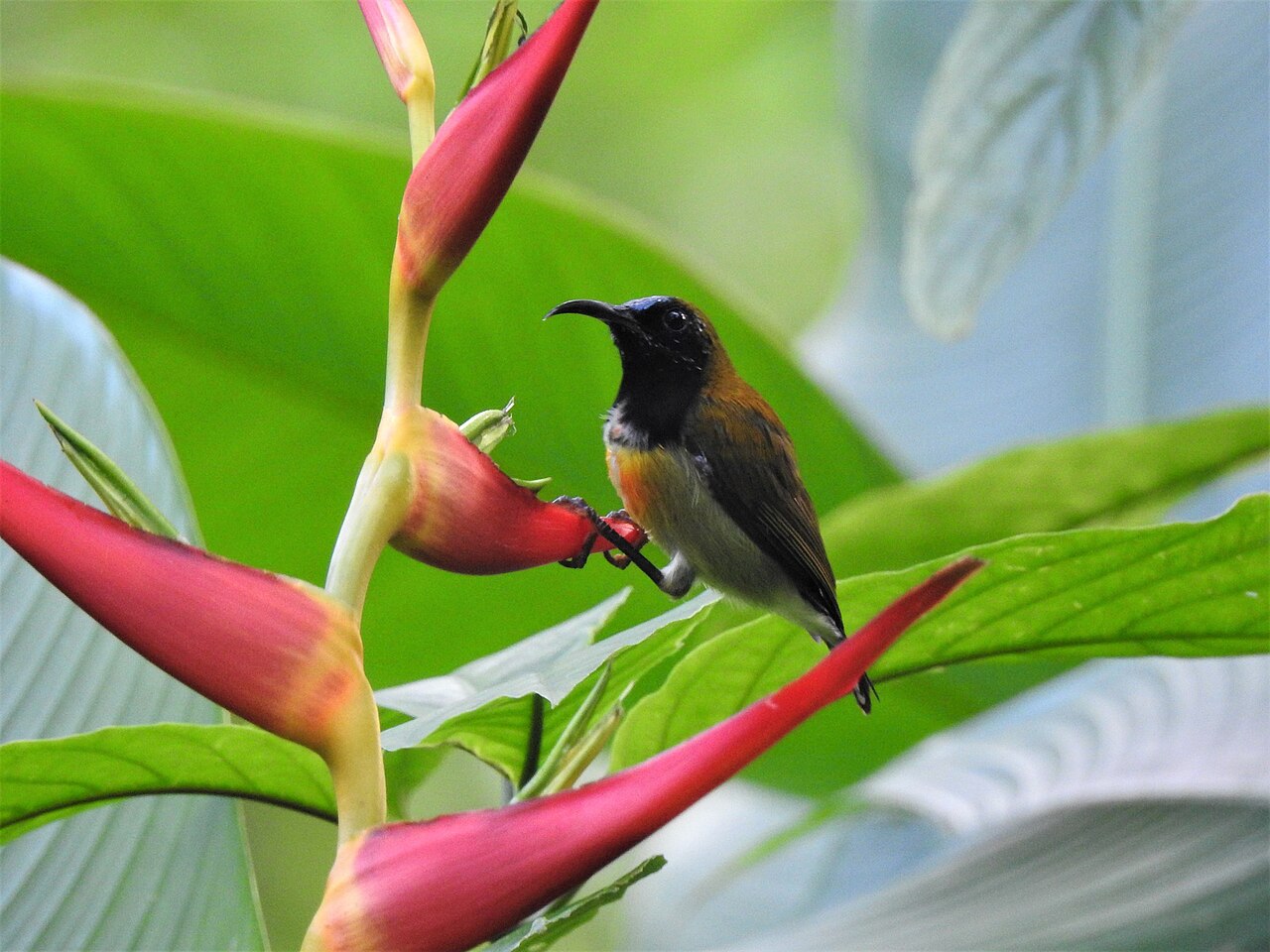
A brilliant nectar-feeding sunbird, the male shows fiery reds and yellows that inspired its common name, while the female is much duller and olive-yellow. It is an important pollinator, visiting many native and cultivated flowers and also taking small insects for protein. Often seen at forest edges and in secondary growth, it adapts to disturbed habitats better than some forest specialists.


Temperament
active and territorial
Flight Pattern
short rapid wingbeats with brief hovering at flowers
Social Behavior
Usually found singly or in pairs; males defend rich flower patches against rivals. Frequently joins mixed-species feeding groups in forest edges. Nest is a small pendant purse of plant fibers and spider silk, suspended from a twig or leaf; both parents tend the young.
Migratory Pattern
Resident
Song Description
High, thin tseet and tsee-tsee notes interspersed with rapid twitters. Calls are sharp and metallic, often given while foraging among flowers.
Plumage
Male is vividly colored with fiery red to orange upper breast and mantle, contrasting yellow underparts, metallic green gloss on the crown, and dark wings and tail; central tail feathers may be slightly elongated. Female is olive-brown above with yellowish underparts and faint streaking, lacking the male’s iridescence. Both sexes have a slender, downcurved bill suited for nectar feeding.
Diet
Primarily nectar from a variety of flowering trees and shrubs, probing with its brush-tipped tongue. Supplements its diet with small insects and spiders, especially during breeding to feed nestlings. Takes arthropods by gleaning foliage and occasional aerial sallies. Acts as a pollinator for many native plants.
Preferred Environment
Feeds along forest edges, secondary growth, and flowering trees in clearings and gardens. Forages from lower understory shrubs up to the canopy, concentrating where blooms are abundant.


