

The eastern wood pewee is a small tyrant flycatcher from North, Central and South America. This bird and the western wood pewee were formerly considered a single species. The two species are virtually identical in appearance, and can be distinguished most easily by their calls.
Region
Eastern North America and northern South America
Typical Environment
Breeds in deciduous and mixed forests from southern Canada through the eastern United States. It favors semi-open woodlands, forest edges, and clearings with scattered trees, often perching in the mid to upper canopy. During migration and winter it occupies second growth, forest borders, shade coffee and other agroforestry systems, and riverine woodlands across northern South America. It is commonly found along ridgelines and gaps where flying insects concentrate. The species generally avoids the darkest, closed-canopy interior for foraging.
Altitude Range
Sea level to 2000 m
Climate Zone
Other
Ease of Keeping
Beginner friendly: 1/5
The eastern wood pewee is a small tyrant flycatcher that breeds in eastern North America and winters in northern South America. It was once lumped with the western wood pewee, and the two are best told apart by voice. Its plaintive pee-a-wee song is a hallmark of summer woodlands, often delivered at dawn and dusk. A sit-and-wait aerial insectivore, it frequently returns to the same perch after short sallies for flying insects.


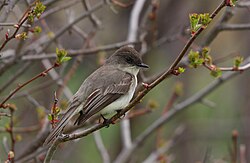
South Padre Island, Texas



Temperament
solitary and territorial
Flight Pattern
short rapid wingbeats with agile aerial sallies; often returns to the same perch
Social Behavior
Breeding pairs defend territories, with males singing from exposed mid-canopy perches. The nest is a neat, lichen-camouflaged cup saddled on a horizontal branch; the female incubates while both parents feed the young. Outside the breeding season they may join loose mixed-species foraging flocks during migration.
Migratory Pattern
Seasonal migrant
Song Description
A distinctive, plaintive, slurred pee-a-wee or pee-wee, often descending in pitch and repeated at regular intervals, especially at dawn and dusk. Also gives a burry pee-wee and sharp chip notes. The cadence and quality differ from the western wood pewee, aiding identification by ear.
Plumage
Plain gray-olive upperparts with a slightly peaked crown; pale underparts with a light gray wash on the breast. Two narrow whitish wingbars and long primary projection. Throat often cleaner and paler than the breast.
Diet
Primarily captures flying insects such as flies, wasps, bees, beetles, moths, and winged ants by sallying from exposed perches. It occasionally gleans caterpillars and other arthropods from foliage. In late summer and on wintering grounds it supplements its diet with small fruits and berries. The bird employs a sit-and-wait strategy, making quick sorties and frequently returning to the same perch.
Preferred Environment
Forages along forest edges, gaps, and over streams where aerial insects are abundant. Uses mid to upper canopy perches in mature woods, parks, and semi-open habitats. On wintering grounds it frequents edge habitats and agroforestry systems such as shade coffee.


