

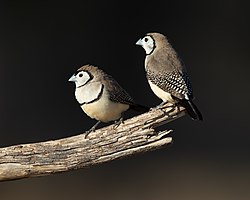
The double-barred finch is an estrildid finch found in dry savannah, tropical (lowland) dry grassland and shrubland habitats in northern and eastern Australia. It is sometimes referred to as Bicheno's finch or as the owl finch, the latter of which owing to the dark ring of feathers around the face. It is the only species placed in the genus Stizoptera .
Region
Northern and Eastern Australia
Typical Environment
Occurs across dry savanna, open woodland, and tropical lowland grasslands from northern Australia through eastern Queensland into northern New South Wales. It favors areas with seeding grasses, scattered shrubs, and access to water. Frequently found along creeklines, edges of mangroves, acacia scrubs, and lightly grazed pastoral lands. It readily uses parks, roadside verges, and other open, lightly disturbed sites.
Altitude Range
Sea level to 800 m
Climate Zone
Tropical
Ease of Keeping
Beginner friendly: 4/5
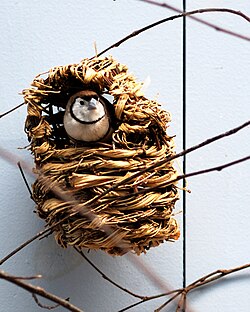
Also called Bicheno's finch or owl finch, it is named for the dark, owl-like ring around the face and the two black bars across the chest. Two main forms occur: a white-rumped eastern form and a black-rumped northern form. It builds neat, domed grass nests with a side entrance and adapts well to lightly modified habitats. Popular in aviculture, but not truly domesticated.


Temperament
social and active
Flight Pattern
short rapid wingbeats
Social Behavior
Typically seen in pairs or small flocks, sometimes joining mixed seed-eating groups at waterholes. Pairs are monogamous and cooperative, constructing domed nests of fine grasses in shrubs or low trees. They often breed opportunistically following rainfall when grasses seed.
Migratory Pattern
Resident
Song Description
A soft, high-pitched series of tinkling trills and twittering notes. Males give a gentle, rhythmic song during courtship, often accompanied by a hopping display.
Plumage
Neat, smooth plumage with warm brown upperparts, white underparts, and fine black-and-white barring on the flanks. A bold black ring encircles the pale face and a second black band crosses the upper breast. Rump color varies by form (white in the east, black in the north). Tail is black with white edging.
Diet
Primarily granivorous, taking small grass seeds from native and introduced grasses such as spinifex and sorghum. Supplements diet with small insects and larvae, especially during the breeding season for added protein. Will also take green seedheads and occasionally small fruits or vegetable matter. Drinks frequently and visits water sources daily.
Preferred Environment
Forages mostly on the ground and low in grasses at the edges of open woodlands, savannas, and lightly grazed areas. Common around watercourses, stock dams, and in weedy clearings and parklands.


