

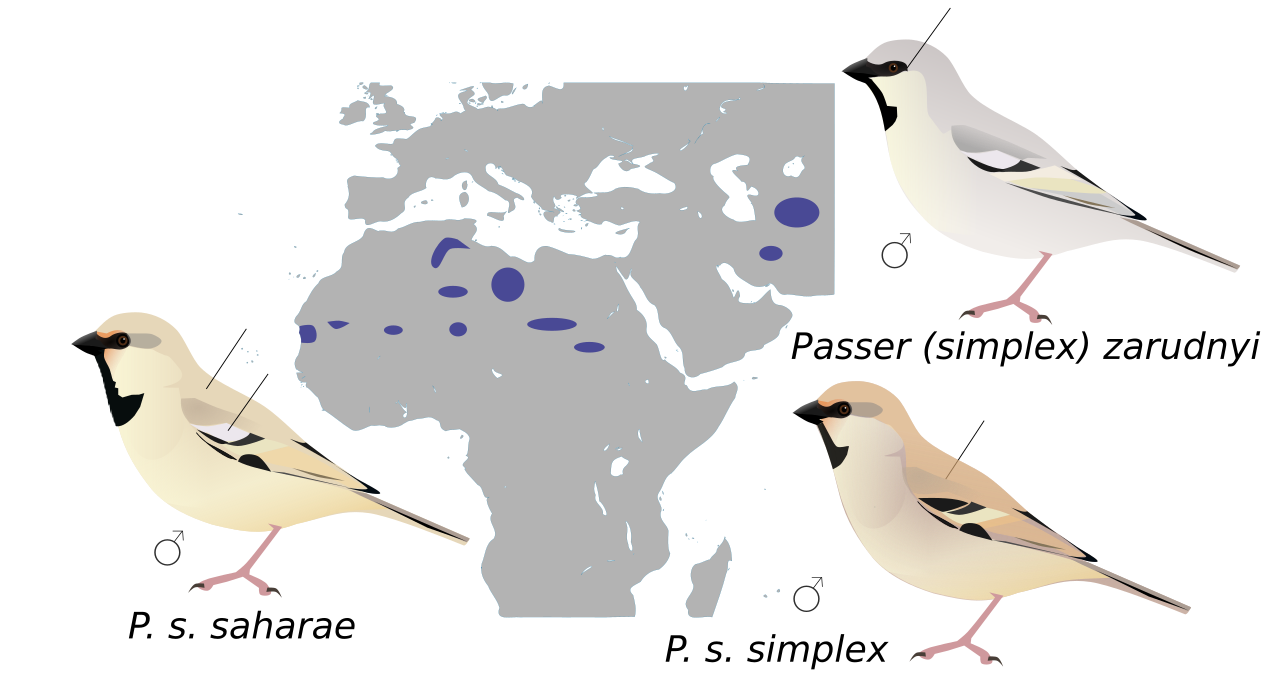
The desert sparrow is a species of bird in the sparrow family Passeridae, found in the Sahara Desert of northern Africa. A similar bird, Zarudny's sparrow, is found in Central Asia and was historically recognised as a subspecies of the desert sparrow, but varies in a number of ways and is now recognised as a separate species by BirdLife International, the IOC World Bird List, and the Handbook of the Birds of the World Alive.
Region
Sahara Desert, North Africa
Typical Environment
Occurs across the Sahara from Western Sahara and Morocco through Mauritania, Mali, Algeria, Niger, Libya, Chad, and into Egypt and Sudan. It favors extremely arid landscapes with sparse shrubs, dunes, rocky wadis, and especially oases and palm groves. Often found around nomadic camps and small villages where water and seed are available. Nests in date palms, buildings, cliffs, or shrubs near limited water. Local abundance can be high near reliable water but very sparse in open desert.
Altitude Range
0–1500 m
Climate Zone
Arid
Ease of Keeping
Beginner friendly: 1/5
This pale, sand-colored sparrow is superbly adapted to the harsh Sahara, often keeping close to oases, wadis, and small settlements. Males show a distinctive black face mask and throat, while females are plainer and sandy. It was once lumped with Zarudny's sparrow of Central Asia, but that form is now treated as a separate species. Despite arid conditions, it thrives by exploiting scattered water sources and human habitation.



Temperament
social and active
Flight Pattern
short rapid wingbeats with low, direct flights between cover
Social Behavior
Usually in pairs or small groups, forming looser flocks near water and human habitation. Nests in cavities, palm crowns, or building crevices; often semi-colonial where sites are available. Both parents feed the young, increasing insect intake during the breeding season.
Migratory Pattern
Resident
Song Description
A simple series of chirps and twitters, dry and buzzy in quality. Calls are clipped and carry well in open desert, used frequently for contact within small groups.
Plumage
Clean, pale sandy-buff overall with minimal streaking; smooth, unmarked appearance suited to desert substrates.
Diet
Primarily seeds of desert grasses and shrubs, supplemented with grain around settlements. Takes insects and other small invertebrates, especially during breeding to provide protein for chicks. Opportunistic around oases, feeding on fallen dates and spilled food. Will glean from the ground and low vegetation.
Preferred Environment
Feeds on open sandy ground, around shrubs, and in palm groves at oases. Common near wells, camps, and villages where water and food are concentrated.


